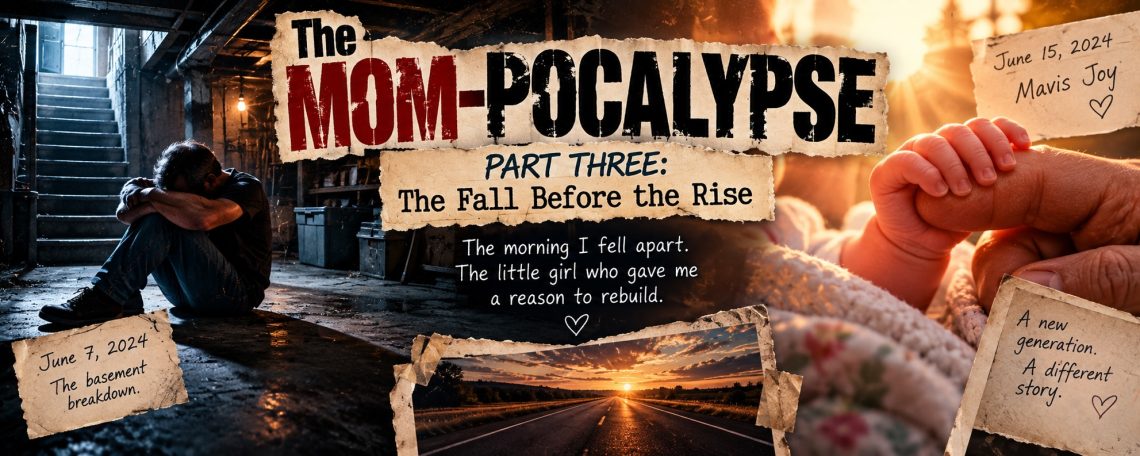
The morning I fell apart. The little girl who gave me a reason to rebuild.
Welcome back to The Mom-pocalypse.
Previously, on what is rapidly becoming the world’s least relaxing family documentary…
A seemingly innocent DNA test had revealed that the man I’d believed was my biological father for forty-six years wasn’t.
My newly discovered biological father, novelist James Pumpelly, turned out to be an extraordinary man—and, in one of life’s more spectacular ironies, everything I’d spent decades wishing a father could be.
My mother, when confronted with the results, offered the remarkably convenient explanation:
“I didn’t know.”
Which became considerably harder to reconcile with the details she reportedly remembered when speaking to my biological father.
Meanwhile, my son and I had undertaken a monumental cleanup of a Missouri lake house, only to discover that removing decades of accumulated clutter revealed a whole new collection of unpleasant surprises.
Structural damage.
Mold.
Decay.
A pretty impressive physical representation of the family history I was simultaneously beginning to uncover.
And then came Mother’s Day 2024.
The actual Mom-pocalypse.
The day I learned that the man who’d raised me hadn’t known the truth about my biological father, either.
He’d had suspicions.
But he’d never known for certain.
My biological father hadn’t known.
The man who raised me hadn’t known for certain.
And I hadn’t known.
Three lives profoundly affected by a secret that had remained buried for more than four decades.
And suddenly, the explanations I’d spent years constructing to make sense of my childhood no longer held together.
My mother’s mask, as I’d come to understand it, hadn’t merely slipped.
It had shattered.
Now, you might imagine that a revelation of that magnitude would lead to some triumphant moment of clarity.
A dramatic confrontation.
A powerful declaration of independence.
Perhaps some inspirational music and a slow-motion walk toward the sunset.
Well…
That’s not quite how it went.
Instead, twenty-six days later, I found myself sobbing uncontrollably on the concrete floor of a basement.
And strangely enough?
That may have been one of the most important moments of my life.
Chapter Eight: The Family Evacuation Plan
Following the Mother’s Day revelation on May 12, 2024, life didn’t exactly offer me the luxury of a quiet emotional processing period.
There was still a household to manage.
A baby on the way.
A lake house that was proving increasingly unsuitable for human habitation.
And a mother whose impending relocation had become something resembling an interstate logistical nightmare.
You know.
Normal family stuff.
By this point, we’d spent months trying to make that Missouri house work.
My son and I had cleared out decades of accumulated junk.
My daughter and her fiancé had arrived.
And we’d genuinely hoped to build something stable together.
But the more we uncovered about the house, the clearer it became that staying there wasn’t a viable long-term option.
Especially not with a newborn entering the picture.
The place had structural issues.
Mold.
Hidden damage.
And enough unpleasant surprises to make the average home inspector consider a career change.
Meanwhile, my entire understanding of my childhood was undergoing its own structural inspection.
And believe me, that building wasn’t passing, either.
Time for a Different Plan
So I sat down with my kids.
We talked about what came next.
My daughter and her fiancé would return to Texas, where she would soon give birth.
I would follow shortly afterward.
No way was I missing the arrival of my first grandchild!
My son, meanwhile, wanted to help his grandmother.
She was preparing to move back to Missouri after roughly three years of living with my sister in Washington.
And despite all the warning signs we’d encountered, he chose to go help her get moved and settled.
He knew there were red flags.
Hell, by that point, our family had accumulated enough red flags to supply a NASCAR caution-light convention.
But he wanted to do something decent.
Help his grandmother.
Figure out his own next steps.
And I respected that.
Now, knowing what I know today, it’s tempting to look back and wish we’d done things differently.
But hindsight is a wonderful thing.
Especially when it arrives after the emotional equivalent of a category-five hurricane.
At the time, we were all trying to make the best decisions we could with the information we had.
And the departures began.
June 4, 2024.
My son flew to Seattle to help my mother move.
June 6.
My daughter and her fiancé headed back to Texas.
And suddenly, after months of activity, the Missouri house was quiet.
Really quiet.
There were no more urgent cleaning projects.
No more mountains of junk waiting to be hauled away.
No more family members coming and going.
No more immediate distractions.
Just me.
An empty house.
And a lifetime of things I’d been trying very hard not to think about.
As it turned out, that combination was about to become a problem.
A rather spectacular one.
Chapter Nine: The Basement Breakdown — When Survival Mode Finally Runs Out of Fuel
June 7, 2024.
Not exactly the sort of event you enthusiastically add to the family photo album.
And definitely not how I’d planned to spend the morning I was supposed to leave Missouri for good.
But before we get to the basement, let’s talk about those preceding twenty-six days.
Twenty-Six Days of Emotional Whiplash
Remember Mother’s Day?
May 12?
The day I discovered that the man who raised me hadn’t actually known I wasn’t his biological son?
The day my mother’s carefully maintained narrative finally collapsed under the weight of its own contradictions?
Yeah.
That was just twenty-six days earlier.
And in those twenty-six days, my nervous system had apparently decided to experience every human emotion ever invented.
Shock.
Grief.
Anger.
Clarity.
Guilt.
Hope.
Fear.
Numbness.
Resolve.
Wash. Rinse. Repeat.
It was like somebody had handed the emotional controls to a toddler with a sugar rush.
Except underneath all that emotional chaos was something profoundly serious.
For the first time in my life, I was beginning to understand just how thoroughly my childhood experiences had shaped my entire existence.
And I was grieving.
Not just the DNA revelation.
Not just the lies.
I was grieving forty-nine years of trying to understand a life that had been explained to me through a distorted lens.
The childhood I couldn’t get back.
The father I’d been denied.
The relationships I’d misunderstood.
The years I’d spent convincing myself that perhaps I was the problem.
And all of that was happening while our carefully constructed plans in Missouri were falling apart.
For a while, I’d been able to keep moving.
There was always another task.
Another room to clean.
Another load to haul.
Another problem to solve.
Another person who needed something.
Classic Gen-X survival strategy.
“Can’t have an emotional breakdown if you’re too busy to schedule one.”
Turns out, that particular strategy has some limitations.
Because on the morning of June 7, there was nothing left to do but leave.
And that’s when everything I’d been holding together finally came apart.
The Moment the Floor Caught Me
I went down into the basement to grab the last of my belongings before hitting the road for Texas.
That was the plan.
Get my things.
Load the truck.
Drive away.
Simple enough.
Except I never made it back to the truck.
Somewhere between the staircase and the concrete floor, my knees buckled.
My chest tightened.
And suddenly, after decades of keeping everything locked down, my body seemed to reach a conclusion my mind had been avoiding.
“I can’t do this anymore.”
And down I went.
Not metaphorically.
Not emotionally in some abstract, poetic sense.
Physically.
Onto that basement floor.
And I sobbed.
Not the quiet, dignified kind of crying you see in movies, where one tasteful tear rolls down somebody’s cheek while inspirational music swells in the background.
No.
This was ugly crying.
Full-body shaking.
Gasping for air.
The kind of sobbing that comes from somewhere so deep you didn’t even realize you’d been carrying it.
The kind that makes decades of emotional suppression look like a spectacularly bad long-term investment.
And for once, there was nobody around who needed me to be strong.
Nobody to reassure.
Nobody to rescue.
Nobody whose feelings I needed to manage.
Nobody to tell me I was overreacting.
Just me.
Alone on a concrete floor.
Finally allowing myself to feel what I’d spent nearly half a century trying not to feel.
And here’s what made that moment so devastating.
I wasn’t simply crying because my mother had lied to me.
I wasn’t simply crying because the man I’d believed was my father wasn’t.
I was crying for the little boy who’d grown up feeling like an outsider.
For the teenager trying to navigate family dysfunction without understanding it.
For the young adult who’d made so many terrible choices while carrying pain he couldn’t even identify.
For the father who’d spent years trying to be better without fully understanding what he was trying to overcome.
And for the forty-nine-year-old man who had finally begun to realize just how much of his own life he’d spent surviving instead of living.
There was no joke for that moment.
No sarcastic observation that could make it smaller.
No clever Gen-X one-liner that could explain it away.
And for once, I didn’t try to find one.
I just wept.
When the Body Finally Sends the Invoice
I’ve learned a few things about trauma since that morning.
One of them is that you can intellectually recognize something long before you’ve emotionally processed what it means.
My mind had spent weeks trying to make sense of the Mom-pocalypse.
But my body had been carrying the effects of a lifetime of chronic stress, emotional confusion, and learned survival patterns.
Hypervigilance.
People-pleasing.
Second-guessing myself.
Minimizing harm.
Trying to keep the peace.
Always anticipating somebody else’s emotional reaction.
You know.
The Deluxe Childhood Dysfunction Starter Pack.
Comes with complimentary anxiety and a lifetime supply of misplaced guilt.
And when you’ve spent decades operating that way, you can become remarkably good at functioning through circumstances that are quietly destroying you.
Until you can’t.
In my case, the practical demands of the preceding months had finally stopped.
My son was gone.
My daughter was gone.
The house was empty.
The immediate work was done.
There was nothing left to distract me from what had happened.
I can’t tell you exactly what was happening neurologically that morning.
But I can tell you what it felt like.
It felt like my entire system had finally run out of emergency power.
Like the person responsible for keeping everything functioning had simply walked away from the control panel.
And all those years of buried grief finally came rushing through.
Not neatly.
Not conveniently.
And definitely not according to schedule.
But perhaps for the first time, I wasn’t trying to push them back down.
Grieving Someone Who Was Still Alive
There’s another part of that breakdown that’s difficult to explain unless you’ve experienced something similar.
I wasn’t grieving a death in the traditional sense.
My mother was still alive.
But something I had carried for most of my life was dying.
The hope that maybe someday we’d have the relationship I’d always wanted.
The belief that if I could just explain things the right way, she’d finally understand.
The possibility that one more conversation, one more opportunity, one more carefully worded attempt at reconciliation might somehow produce the honesty and accountability I needed.
I was beginning to understand that I couldn’t build a healthy relationship by myself.
And that realization hurt. Deeply.
Because walking away from a parent isn’t simply walking away from the person standing in front of you.
Sometimes it means grieving the parent you needed but never truly had.
Grieving the relationship you kept hoping would emerge.
Grieving the fantasy that if you were patient enough, forgiving enough, understanding enough, things would eventually be different.
And on June 7, sitting on that basement floor, I was beginning to let go of that fantasy.
Not because I wanted to.
But because holding onto it had become too painful.
Getting Up
I don’t know how long I sat there.
Long enough for the sobbing to slow.
Long enough for the shaking to ease.
Long enough to catch my breath.
And eventually, something else began to emerge.
Not happiness.
Not some magical sense that everything was suddenly okay.
And certainly not the feeling that I’d completely healed from nearly five decades of trauma in one extraordinarily unpleasant morning.
That would’ve been convenient.
“Congratulations! Your childhood trauma has been successfully uninstalled. Please restart to complete the update.”
Yeah, no.
If only.
What I felt was quieter than that.
Resolve.
The understanding that I couldn’t continue living the way I had been.
That I couldn’t keep sacrificing my own well-being to maintain relationships built around denial, manipulation, and emotional obligation.
That I was allowed to stop.
I was allowed to leave.
I was allowed to choose something different.
Eventually, I stood up.
Wiped my face.
Gathered my things.
Grabbed my keys.
And walked out of that basement.
Not healed.
Not suddenly fearless.
Not transformed into some inspirational superhero with a flowing cape and a motivational speaking contract.
Just a tired, grieving, forty-nine-year-old man who had finally stopped pretending he was okay.
But something had changed.
I’d gone into that basement still trying to hold together the pieces of a life I was beginning to recognize had been built around someone else’s version of reality.
I came out knowing I couldn’t keep living inside it.
And then I did something extraordinarily ordinary.
I got in my truck.
And drove away.
What I Didn’t Know Yet
Here’s the part that still gets me.
When I walked out of that basement on June 7, I had no idea how the rest of that summer would unfold.
I didn’t know that eight days later, my granddaughter would be born. A full month ahead of “schedule.”
I didn’t know that seeing that beautiful little girl, and looking toward her future would give me a powerful new reason to confront the patterns of my past.
I didn’t know that the son who’d gone to Washington to help his grandmother would eventually find himself on the receiving end of the very dynamics we were trying to escape.
I didn’t know that I’d be driving back across the country to get him.
And I certainly didn’t know that August 29, 2024—Judgment Day, of all dates—would become the day No Contact finally became permanent.
All I knew that morning was that something inside me had reached its limit.
And perhaps that’s enough.
Because sometimes the turning points in our lives don’t arrive with certainty, confidence, or a perfectly developed five-year plan.
Sometimes they arrive with shaking hands and swollen eyes.
Sometimes they happen when nobody’s watching.
Sometimes they happen on the cold concrete floor of a basement in a house you spent months trying to save.
A house that, much like the family history you’d inherited, looked far more stable before you started uncovering what was hidden beneath the surface.
And sometimes, the moment you finally fall apart is also the moment you begin making room for something better.
I didn’t know it then.
But that morning wasn’t the end of my story.
It was the beginning of my escape.
Sometimes the basement fall is what finally frees you from the house altogether.
Chapter Ten: June 15 — The Smallest Person Changes Everything
Eight days.
That’s how much time passed between the morning I collapsed on that basement floor and the day my granddaughter entered the world.
Eight days.
June 15, 2024.
Mavis Joy.
Little MJ.
Now, I’d been back in Texas for about a week.
Staying in an extended-stay hotel while I figured things out.
And after everything that had happened in Missouri, I was still trying to figure out how to exist in a world where almost everything I thought I knew about my own life was suddenly subject to revision.
The Mom-pocalypse hadn’t magically resolved itself.
The grief hadn’t disappeared.
My nervous system certainly hadn’t filed a formal notice that normal operations could resume.
If anything, I was still running on the emotional equivalent of a computer that’s been rebooted after a catastrophic system failure.
Some services had started.
Others were still throwing errors.
And the progress bar seemed to be stuck at about 12%.
But then?
A baby.
My granddaughter.
A brand-new human being who had absolutely no idea what kind of emotional circus her grandfather had just escaped.
And suddenly, amid all that wreckage, there was something genuinely beautiful.
A New Generation
There’s something extraordinary about a newborn.
Especially your first grandchild.
Here was this tiny little girl, completely innocent, completely dependent on the adults around her to create a world in which she could feel safe and loved.
She didn’t know anything about DNA tests.
Or family secrets.
Or manipulation.
Or the emotional wreckage that had shaped so much of the generations before her.
She didn’t know what a trauma bond was.
She didn’t know what gaslighting meant.
She didn’t know anything about the years I’d spent feeling like an outsider in my own family.
And she certainly didn’t know that Grandpa had just experienced something resembling a complete emotional operating-system failure.
She was simply here.
Mavis Joy.
A new life.
A new generation.
A new beginning.
And looking at her, something began to change in the way I understood everything I’d been through.
For the preceding weeks, I’d been looking backward.
At the lies.
The betrayals.
The childhood I couldn’t recover.
The decades of confusion.
The relationships I’d misunderstood.
The years I’d spent surviving without fully understanding why everything felt so difficult.
But seeing MJ?
I found myself looking forward.
For the first time in what felt like forever.
And the question began to change.
It wasn’t simply:
“What the hell happened to me?”
It became:
“What can I do to make sure this doesn’t become her story, too?”
The Cycle Ends Here
Now, I want to be clear about something.
I don’t believe that becoming a grandparent magically transforms you into some enlightened spiritual guru who suddenly has all the answers.
If that were the case, I’d expect the hospital to hand out certificates.
CONGRATULATIONS!
You are now a grandfather.
Your generational trauma has been automatically resolved.
Your emotional intelligence has increased by 400%.
Please collect your complimentary cardigan and proceed to the nearest rocking chair.
Unfortunately, it doesn’t work that way.
I was still grieving.
Still angry.
Still trying to understand the implications of what I’d discovered.
Still carrying the habits and survival mechanisms of a childhood I was only beginning to make sense of.
And I knew I wasn’t going to fix decades of dysfunction overnight.
But I could make a decision.
One very important decision.
Whatever had happened to me, whatever damage had already reached my children, I was not going to knowingly pass those same patterns down to my granddaughter.
Not to MJ.
Not if I could help it.
She deserved honesty.
She deserved emotional safety.
She deserved relationships built on trust instead of manipulation.
She deserved love that wasn’t dependent on obedience.
She deserved to grow up knowing that her feelings mattered.
That her boundaries mattered.
That her identity belonged to her.
That she could ask questions without being treated as disloyal.
That telling the truth wasn’t an act of rebellion.
And that being part of a family didn’t mean surrendering herself to keep somebody else comfortable.
Those might sound like relatively ordinary things.
But when you grew up without consistently experiencing them, you understand just how extraordinary they really are.
And I wanted them for her.
More than anything.
The Grandfather I Wanted to Be
Something else happened when I became a grandfather.
I started thinking about what kind of man I wanted MJ to know.
Not simply the man I’d been.
Not the sum total of every mistake I’d made.
Not the version of myself shaped by nearly fifty years of trying to survive family dysfunction.
But the man I was becoming.
A grandfather who could admit when he was wrong.
Who could apologize without attaching a list of excuses.
Who could respect boundaries without treating them as personal attacks.
Who could love without manipulating.
And who could tell the truth even when the truth was uncomfortable.
I knew I couldn’t undo everything that had happened in the generations before her.
I couldn’t go back and give my own children a different childhood.
I couldn’t reclaim the years I’d lost.
And I certainly couldn’t force my mother to acknowledge the damage I’d come to recognize.
But I could change what I did next.
I could keep doing the work.
I could become more aware of the patterns I’d inherited.
I could take responsibility for the ways those patterns might have influenced my own parenting.
And I could make sure that when MJ eventually looked back at her relationship with Grandpa, she remembered someone who made her feel safe, heard, respected, and loved.
Not someone she had to recover from.
That was the legacy I wanted to leave.
Not the secrets.
Not the guilt.
Not the manipulation.
Not the endless emotional obligations disguised as love.
Something better.
Something honest.
Something that would allow her to grow up knowing she was enough, exactly as she was.
From Survival to Something More
Looking back, the timing still amazes me.
May 12.
The Mom-pocalypse.
June 7.
The basement breakdown.
June 15.
The birth of my granddaughter.
In just over a month, I’d experienced three events that fundamentally changed the direction of my life.
First came the truth.
Then came the grief.
And then came a reason to begin building something different.
Not because MJ was responsible for healing me.
She wasn’t.
That was my work to do.
And not because her arrival somehow erased the past.
It didn’t.
But because becoming her grandfather gave me a powerful reason to stop treating my own healing as optional.
I began to understand that the work I was doing wasn’t only about recovering from what had happened.
It was also about becoming someone who could help create a healthier future.
For my own children.
For my granddaughter.
And, perhaps for the first time, for myself.
Because there’s an uncomfortable truth about breaking generational cycles.
You can’t simply declare that the cycle ends with you and expect the universe to take care of the rest.
You have to examine your own behavior.
Your own triggers.
Your own defenses.
Your own ways of responding to conflict and fear.
You have to be willing to recognize when the very survival mechanisms that protected you in childhood are now interfering with the relationships you want to build.
And sometimes, you have to confront the possibility that you may have unknowingly repeated some of the patterns you swore you’d never become.
That’s not a particularly comfortable realization.
Believe me.
But it’s necessary.
Because breaking a cycle isn’t about proclaiming yourself better than the people who came before you.
It’s about becoming willing to do the work they couldn’t—or wouldn’t—do.
And that’s the promise I began making to myself in the summer of 2024.
The cycle ends here.
Not with perfection.
Not with a guarantee that I’ll never make mistakes.
But with awareness.
Accountability.
And a commitment to do better.
One day at a time.
The One Loose End
By the middle of June, my life had changed in ways I was still struggling to comprehend.
I’d walked away from the Missouri house.
I’d confronted grief I hadn’t allowed myself to feel for decades.
I’d become a grandfather.
And for the first time, I had a clearer sense of the kind of future I wanted to build.
But there was still one rather important piece of the story that hadn’t been resolved.
My son.
Remember him?
He’d flown to Washington on June 4 to help his grandmother move.
A decent young man trying to do something decent for a family member.
And while I was beginning to find some distance from the chaos, he was still caught in its orbit.
At the time, I didn’t fully understand how that situation would unfold.
I didn’t know that the anger and resentment surrounding our family’s departure would eventually be directed toward him.
I didn’t know how quickly his attempt to help would become another chapter in the same painful family dynamics I’d spent decades trying to understand.
And I certainly didn’t know that before the summer ended, I’d be getting behind the wheel for a multiday journey across the country.
Texas.
Missouri.
Washington.
One objective.
Get my boy.
Get out.
Don’t look back.
But that part of the story was still ahead of us.
For now, I was a brand-new grandfather.
A deeply exhausted man.
And someone who’d finally begun to understand that survival alone wasn’t enough.
I wanted to live.
Not simply exist.
Not merely endure.
Not spend the rest of my years endlessly reacting to somebody else’s chaos.
Actually live.
And somewhere between that concrete basement floor and the arrival of a little girl named Mavis Joy, I’d begun to see that possibility for the first time.
The basement was where I finally fell apart.
My granddaughter helped me see what was worth rebuilding.
And before the summer was over, I’d face one more choice that would turn that newfound resolve into action.
Because August 29 was coming.
And if you’re a Gen-X movie fan, you already know what that date means.
Judgment Day.
Coming Next in Part Four: Judgment Day — Come With Me If You Want to Live
The world’s most expensive goodbye and a 2,000-mile rescue mission.
In Part Four, we return to the financial fallout of my mother’s move.
After six months of promises and absolutely no savings, my sister and her husband would end up paying for the moving truck, while my sister and I split the cost of shipping Mom’s car back to Missouri.
Apparently, escaping family dysfunction came with a cancellation fee.
But the money wasn’t the worst part.
My son, who’d stayed behind to help his grandmother, would find himself caught in the emotional fallout of our family’s departure.
And on August 29, 2024—twenty-seven years to the day after the fictional Judgment Day in the Terminator universe—I’d begin a cross-country journey to get him out.
No killer robots.
No nuclear apocalypse.
Just one thoroughly exhausted Gen-X father who’d finally had enough.
Come with me if you want to live.
Turns out, Arnold may have been onto something.
The Thriving ACoN — Breaking cycles. Reclaiming truth. And occasionally laughing at the sheer absurdity of surviving it all.
This is Part Three of a five-part personal series about family secrets, narcissistic family dynamics, identity, estrangement, and the messy, sometimes darkly humorous journey toward healing.