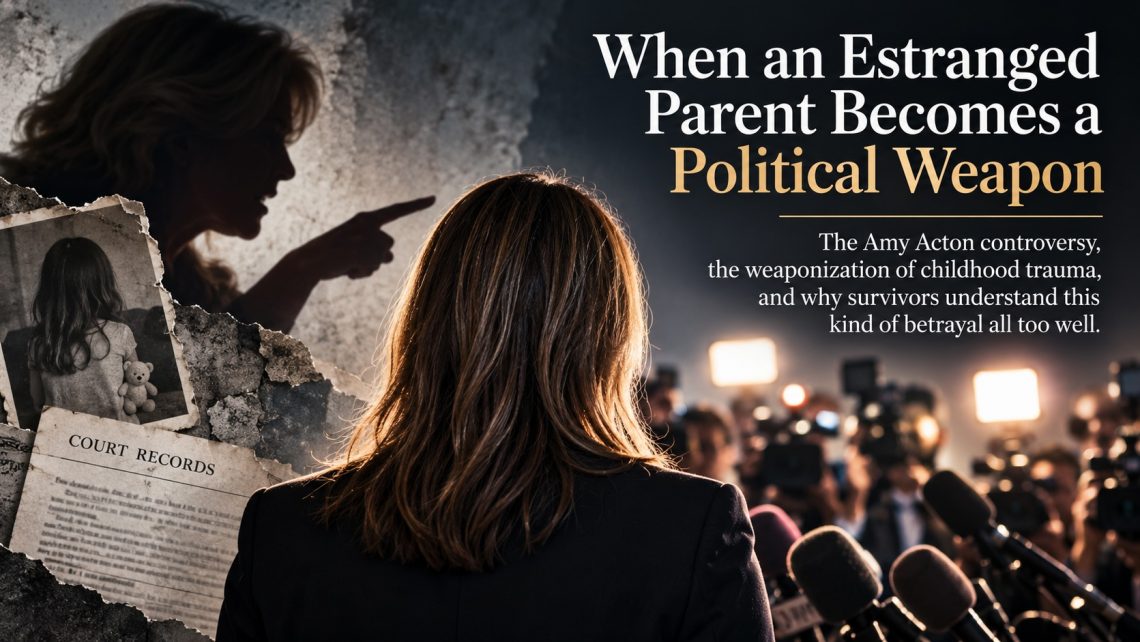
The Amy Acton controversy, the weaponization of childhood trauma, and why survivors understand this kind of betrayal all too well.
There are some stories that transcend politics.
This is one of them.
In Ohio, Republican gubernatorial candidate Vivek Ramaswamy’s campaign has produced an advertisement featuring Donna Arthur, the estranged mother of his Democratic opponent, Dr. Amy Acton.
In the advertisement, Arthur calls her daughter a liar and challenges her accounts of her childhood.
Ordinarily, a political candidate’s credibility is a legitimate subject for scrutiny.
But there’s something profoundly disturbing about this particular attack.
Amy Acton hasn’t seen her mother since 1978.
That’s nearly half a century.
And the reason for that estrangement matters.
The History They Apparently Didn’t Want You to Hear
According to reporting based on historical court records, Acton’s stepfather was arrested and indicted for raping her when she was 12 years old.
Acton and her brother were removed from their mother’s custody.
Her brother, Philip Stearns, has publicly supported her account and condemned the use of their mother in this political advertisement.
The stepfather was never convicted; reporting indicates he fled before trial.
These are not simply competing recollections of an unhappy childhood. There is documentary evidence of serious allegations, criminal proceedings, and intervention by the courts.
And yet, decades later, Acton’s estranged mother has been given a national platform to challenge her daughter’s credibility.
The campaign responsible has reportedly committed $4 million to promoting the advertisement.
Four million dollars.
To amplify the accusations of a mother who hasn’t had a relationship with her daughter in nearly 48 years.
Let that sink in.
When the Parent Controls the Narrative
If you grew up in a dysfunctional family system, you probably recognize something familiar here.
Not necessarily the specific circumstances. Every family’s story is different.
But the dynamic?
Oh, that dynamic.
The parent presents themselves as the reasonable, concerned, credible adult.
The child—even decades into adulthood—is portrayed as dishonest, unstable, difficult, or somehow fundamentally defective.
The parent’s version of events becomes the default narrative, while the child is expected to defend their own reality.
And if the child dares to speak publicly about what happened?
Suddenly, the discussion shifts away from the alleged harm and toward the child’s credibility.
The question stops being, “What happened to this child?” and becomes, “What’s wrong with this child for saying it happened?”
That shift is devastatingly familiar to many survivors.
DARVO on a National Stage?
There’s a term frequently discussed in trauma-recovery circles: DARVO.
It stands for:
- Deny the wrongdoing.
- Attack the person raising the allegation.
- Reverse Victim and Offender, making the person accused of wrongdoing appear to be the injured party.
The term describes a pattern of responses to accountability, not a clinical diagnosis.
I have no way of knowing Donna Arthur’s internal motivations, and I won’t pretend to diagnose someone from a political advertisement.
But the public spectacle raises a legitimate question:
When a parent disputes a survivor’s account of documented childhood trauma, attacks their credibility, and presents themselves as the trustworthy authority, aren’t we seeing elements of the very narrative reversal survivors have spent years learning to recognize?
And what happens when a powerful outside organization decides that narrative is useful?
No Contact Doesn’t Guarantee Silence
This is perhaps the part that hits closest to home for me.
I’ve written extensively about my own decision to go No Contact with my mother in August 2024, following revelations that fundamentally changed my understanding of my childhood and family history.
One of the hardest lessons I’ve learned is that No Contact doesn’t necessarily mean the other person stops talking about you.
It means you stop participating in the relationship.
It means you stop presenting your life for their approval.
It means you no longer volunteer to stand trial in the courtroom of someone else’s distorted narrative.
But you can’t control what that person tells others.
You can’t force them to acknowledge your experiences.
And you can’t guarantee that outsiders won’t believe them.
For many survivors, that’s one of the most difficult parts of estrangement.
You can leave the dysfunctional family system without gaining control over the story that system tells about you.
Now imagine spending nearly five decades apart from a parent, building your own life and career, only to have that parent’s accusations broadcast to millions of people.
Not because you’ve reconciled.
Not because you’ve invited them back into your life.
But because someone else has decided your family trauma makes useful ammunition.
The Second Betrayal: When Outsiders Join In
There’s another dimension to this story that deserves attention.
Institutional betrayal.
In trauma research, institutional betrayal describes situations in which organizations or institutions fail people who depend on them, including through harmful responses to trauma disclosures.
A political campaign is not the same as a school, hospital, or other institution entrusted with protecting a child. But the broader issue of powerful organizations amplifying harmful narratives about survivors is worth examining.
Because the people who enable these attacks don’t necessarily need to have participated in the original harm.
They only need to decide that the survivor’s pain is useful.
A family member supplies the accusations.
An organization supplies the platform.
And suddenly, a person’s childhood trauma becomes public entertainment, political ammunition, or an opportunity for someone else to advance their interests.
The survivor is left defending experiences they may have spent decades trying to heal from.
Again.
Estrangement Is Not Evidence of Dishonesty
This point simply can’t be emphasized enough.
When someone has been estranged from a parent for decades, that parent does not automatically become the most reliable authority on the adult child’s life.
Biology is not a character reference.
Parenthood does not guarantee honesty.
And giving birth to someone does not grant perpetual ownership of their story.
Sometimes estrangement follows abuse, neglect, betrayal, or a long history of failed attempts to establish a healthy relationship.
Sometimes it follows circumstances far more complicated than outsiders understand.
Estrangement alone proves neither abuse nor dishonesty.
But it absolutely should prompt journalists, political campaigns, and the public to ask questions before treating an estranged parent’s accusations as definitive truth.
Especially when documentary evidence contradicts important parts of those accusations.
This Isn’t About Red or Blue
I don’t care whether the politician involved has an R or a D beside their name.
The ethical issue remains the same.
A person’s documented childhood trauma should not become fair game simply because they enter public life.
You can disagree with Amy Acton’s policies.
You can criticize her decisions as Ohio’s former health director.
You can question her qualifications for governor.
Those are legitimate subjects of political debate.
But recruiting an estranged parent to publicly attack the credibility of an adult survivor, while historical court records substantiate significant elements of that survivor’s account?
That deserves scrutiny regardless of which political party is responsible.
And it deserves scrutiny from people who understand what dysfunctional family systems can do to a child’s sense of reality.
To the Survivors Watching This Unfold
If this story brings up something familiar, I understand why.
Maybe your parent told relatives that you were unstable.
Maybe they insisted you were remembering things incorrectly.
Maybe they painted themselves as the victim of an “ungrateful child.”
Maybe people who never bothered to hear your side decided they already knew the truth.
And maybe, even after you walked away, you discovered that your absence didn’t stop the stories.
Here’s what I want you to remember:
You do not need your parent’s agreement for your experiences to matter.
You do not need a family vote to establish your boundaries.
You do not need to reopen a relationship simply because someone else believes reconciliation is always the morally superior choice.
And you certainly don’t owe anyone unlimited access to your life just because you share DNA.
Healing does not require convincing every person who has chosen to misunderstand you.
Sometimes healing means accepting that you cannot control their narrative—and refusing to let it control your future.
The Final Word
What happened to Amy Acton as a child deserves to be treated with seriousness, compassion, and factual accuracy.
Her political positions can and should be evaluated independently.
But her estranged mother’s willingness to publicly criticize her should not be mistaken for proof that her childhood experiences were fabricated.
There’s a difference between legitimate political scrutiny and exploiting a survivor’s family history.
And for those of us who have lived through dysfunctional family systems, this controversy is a painful reminder of something we already know:
Sometimes the person who was supposed to protect you becomes the person whose version of events you spend a lifetime escaping.
And sometimes, the world hands them a microphone.
But a microphone doesn’t make someone truthful.
And being a parent doesn’t make someone right.