Because apparently, estrangement is a mystery that can only be investigated by interviewing the people who were left behind.
Every so often, another article makes its way around the internet about the growing epidemic of grown sons and daughters becoming estranged from their parents.
You know the ones.
Heartbroken parents. Confused grandparents. Families torn apart. Grown offspring who suddenly, inexplicably, and apparently without warning, decide to cut off contact with the very people who raised them.
Cue the sad piano music.
Cue the hand-wringing.
Cue the inevitable question:
“Why are our sons and daughters doing this to us?”
Funny thing about that question.
It assumes the person who walked away is the one who did something to someone.
And right there, before we’ve even gotten through the introduction, we’ve already decided who the victim is.
Convenient, isn’t it?
The Part They Always Leave Out
I recently came across a quote from therapist Stephi Wagner of The Mother Wound Project that stopped me in my tracks:
“Your child walked away because your absence was less painful than your presence.”
Well, damn.
There it is.
The part that somehow never makes it into those tearjerker articles about the poor, bewildered parents whose grown sons and daughters have abandoned them.
Sometimes the relationship became so painful that losing it was actually a relief.
Not because we stopped loving our parents.
Not because we were selfish, ungrateful, brainwashed by TikTok, or whatever explanation happens to be fashionable this week.
But because maintaining the relationship required us to keep sacrificing our own emotional well-being.
And eventually, the price became too high.
Nobody Wakes Up One Tuesday and Says, “You Know What? I Think I’ll Abandon My Family.”
That’s not generally how this works.
For many of us, no contact wasn’t the first option.
It was the last.
There were conversations. Explanations. Attempts to establish boundaries. Opportunities for accountability.
There were years of hoping that maybe, just maybe, this time would be different.
And when those efforts failed?
We tried again.
Because that’s what we were conditioned to do.
Keep the peace. Be the bigger person. Forgive and forget. Respect your elders.
And my personal favorite:
“But she’s your mother.”
Oh, well, shit. Why didn’t somebody tell me?
That changes EVERYTHING.
Apparently, sharing DNA means there’s an unlimited lifetime subscription to tolerating mistreatment.
No cancellation policy. No refunds. And customer service is just your relatives telling you how disappointed they are.
The Missing Years
Here’s something I wish more of these articles would investigate.
What happened BEFORE the estrangement?
Not just the final argument.
Not just the last unanswered phone call.
The years leading up to it.
What did the person who eventually walked away try to communicate?
How many times were their concerns dismissed?
How many boundaries were ignored?
How often were they expected to apologize just to restore the peace, even when they weren’t the ones who broke it?
And here’s a particularly important question:
When a grown son or daughter finally explained why they were leaving, what did the parent do with that information?
Because there’s an enormous difference between genuinely not understanding and refusing to acknowledge an explanation you don’t like.
Those two things can look remarkably similar in an interview.
“I Have No Idea Why My Son or Daughter Won’t Speak to Me.”
This one deserves its own section.
Because I’ve lived it.
In my own family, there were nearly three years between learning a life-altering truth about my parentage and finally going no contact.
Three years.
Not three minutes. Not three days. Not an impulsive decision made during an argument.
Years of opportunities for honesty, accountability, and a meaningful conversation about what had happened.
And yet, the truth remained something to evade rather than confront.
I wasn’t asking for perfection.
I wasn’t expecting anyone to invent a time machine and rewrite the past.
I wanted honesty.
Accountability.
A willingness to acknowledge reality without turning the conversation into another exercise in victimhood.
Apparently, that was a bridge too far.
So when I read another account of a parent who supposedly has absolutely no idea why their grown son or daughter stopped calling, I find myself wondering:
Did nobody explain it? Or did nobody want to hear it?
Those are very different stories.
And only telling one side doesn’t answer the question.
Estrangement Isn’t Always Abandonment
One of the most frustrating things about the public conversation surrounding estrangement is how readily it treats distance as cruelty.
As though the person who finally leaves must automatically be the one responsible for the broken relationship.
But distance can also be protection.
Sometimes it’s the first boundary that actually holds.
Sometimes it’s the first time someone has been able to live without constantly anticipating the next accusation, guilt trip, manipulation, or emotional ambush.
Sometimes it’s the first opportunity they’ve had to discover who they are outside the role their family assigned them.
And sometimes?
It’s the first time their nervous system has been allowed to unclench in decades.
That doesn’t mean estrangement is painless.
It doesn’t mean we don’t grieve.
It doesn’t mean we don’t miss the family we desperately wanted to have.
It means we finally recognized that continuing the relationship as it existed was hurting us more than ending contact.
That’s not a decision most people make lightly.
But What About the Parents?
I’m glad you asked.
Because parents can experience genuine grief over estrangement.
They can feel confused, devastated, ashamed, and deeply lonely.
And yes, sometimes estrangements involve misunderstandings, competing perspectives, or circumstances far more complicated than a single villain and victim.
None of that should be dismissed.
But here’s the thing:
A parent’s pain doesn’t automatically invalidate their grown offspring’s reasons for leaving.
Two people can be hurting while one of them still bears responsibility for the harm that fractured the relationship.
And feeling abandoned doesn’t necessarily mean you were abandoned without cause.
If we’re going to have a serious conversation about estrangement, we need to be willing to examine what happened on both sides of the relationship.
Not just what happened after someone finally said, “Enough.”
The Question We Should Actually Be Asking
Instead of asking why so many grown sons and daughters are walking away from their parents, perhaps we should start asking:
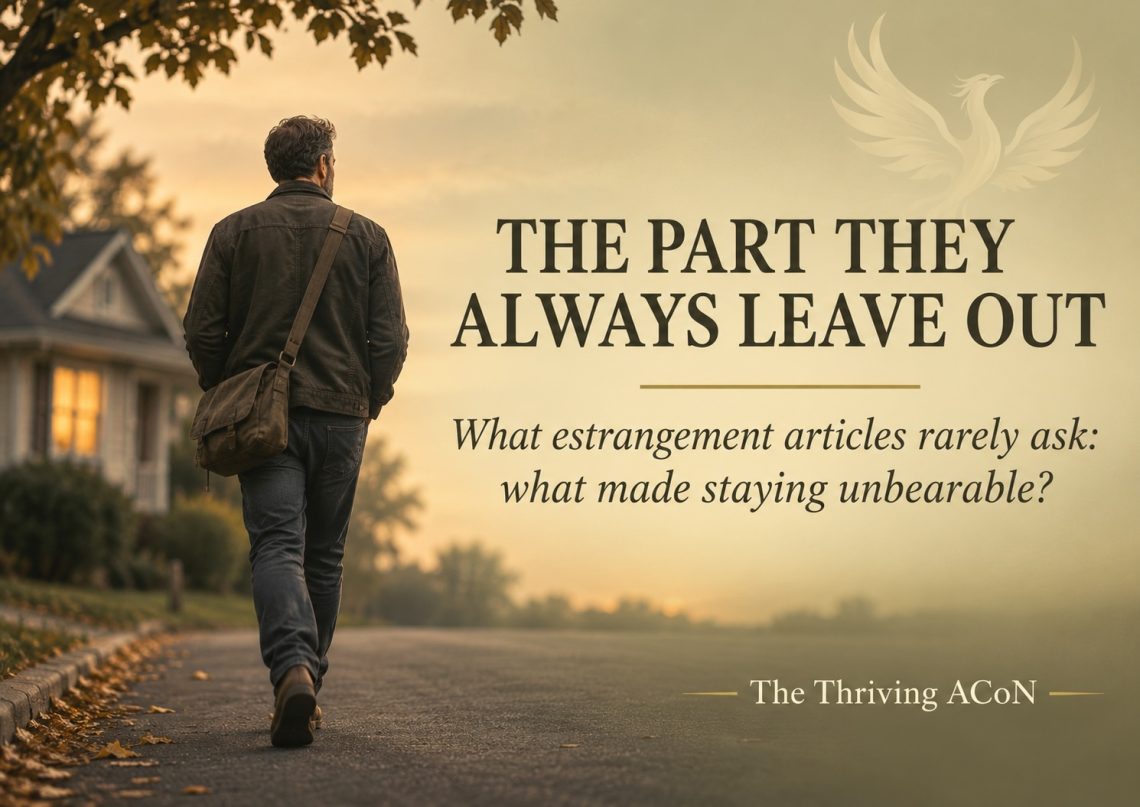
What made staying so unbearable that walking away became the healthier option?
What had to happen for someone to choose the pain of separation over the pain of continued contact?
What did they lose before they finally decided they’d lost enough?
And what would accountability have looked like before the relationship reached that point?
Those questions might lead us somewhere useful.
They might even help families repair relationships before the damage becomes irreversible.
But they require something that all the sad piano music in the world can’t replace.
A willingness to listen to the people who left.
Even when their answers make other people uncomfortable.
The Part They Really Don’t Want to Hear
I didn’t go no contact because I wanted to punish my mother.
I went no contact because I finally understood that I couldn’t keep sacrificing myself to preserve a relationship that required me to deny my own reality.
There is a difference.
A very big one.
And while the estrangement narrative often focuses on the suffering of the parent left behind, it rarely acknowledges the suffering that made someone leave in the first place.
We didn’t necessarily walk away because we stopped caring.
Some of us walked away because we finally started caring about ourselves, too.
And if our absence is now painful to the people we left behind, perhaps it’s worth considering how painful their presence had become for us.
Because that is the part they always leave out.
And it’s long past time we started talking about it.