Because apparently we’re supposed to forgive, forget, and pretend the emotional dumpster fire was just a pleasant family barbecue.
We’ve all heard it.
“Forgive and forget.”
Three little words, usually delivered by someone who either wasn’t there, wasn’t the one who got hurt, or would really prefer that everyone just move on so Thanksgiving doesn’t get awkward.
Because apparently, maintaining the illusion of a happy family is more important than acknowledging why half the family needs therapy.
But here’s the problem with that advice.
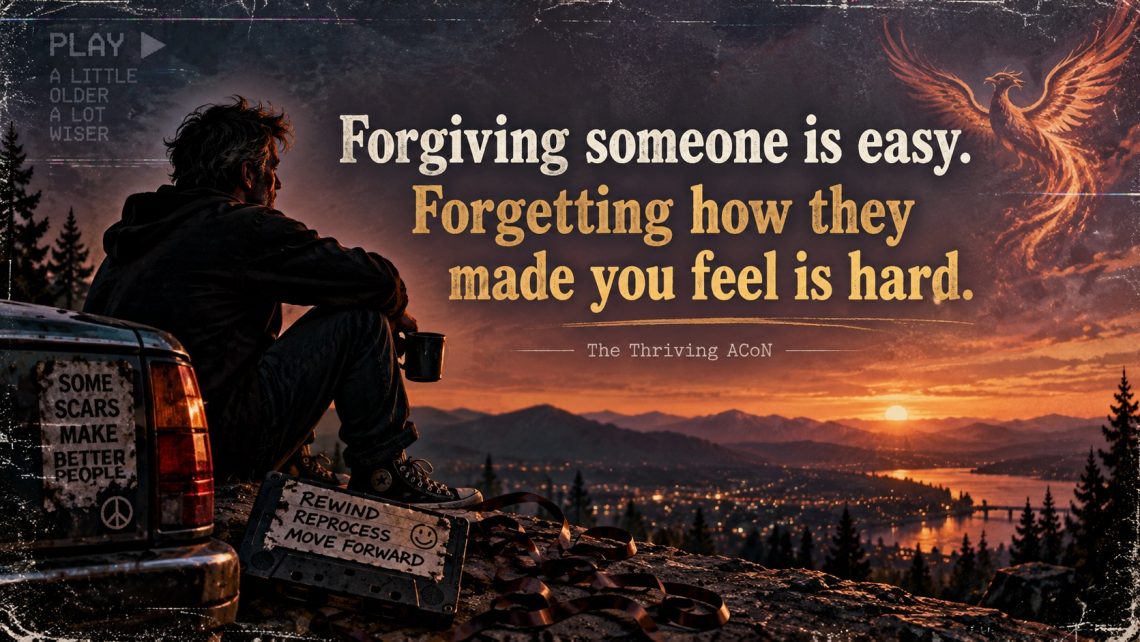
You can forgive someone for what they did. That doesn’t mean you can simply forget how they made you feel.
And sometimes, those feelings are the deepest wounds of all.
The Things We Remember Aren’t Always the Things That Happened
Ask someone who grew up in a dysfunctional family to describe their childhood, and you might hear something interesting.
They may struggle to remember specific conversations. They might not recall exactly what was said during an argument, what started it, or even how old they were when it happened.
But ask them how they felt?
Oh, they’ve got receipts.
Maybe not the kind you can print out and staple to a court filing, but the emotional kind? Those have apparently been archived in a filing cabinet somewhere in the nervous system, complete with an indexing system nobody remembers installing.
They remember feeling small.
They remember feeling like a burden.
They remember walking on eggshells, carefully choosing their words, studying facial expressions, and trying to anticipate which version of their parent was waiting on the other side of the door.
It was like playing emotional Minesweeper.
Except nobody explained the rules, the mines kept moving, and somehow every explosion was your fault.
They remember the loneliness of being surrounded by family but feeling completely alone.
They remember being blamed for things they didn’t do, dismissed when they tried to explain themselves, and made to feel guilty for having perfectly reasonable emotional needs.
And perhaps most painfully, they remember the feeling that no matter how hard they tried, they were never quite enough.
Those feelings don’t necessarily disappear just because the events that created them are decades in the past.
Turns out emotional damage doesn’t come with an expiration date.
Who knew?
When the Apology Never Comes
Here’s where things get particularly complicated for survivors of narcissistic or emotionally immature parenting.
What happens when the person who hurt you refuses to acknowledge that they hurt you at all?
What happens when every attempt to discuss the past is met with denial, deflection, excuses, or the ever-popular accusation that you’re simply remembering things wrong?
Ah, yes. The classic family customer service experience.
“Thank you for bringing your childhood trauma to our attention. Unfortunately, our records indicate that no such incident occurred. Have you tried being less sensitive?”
Suddenly, you’re not just dealing with the original injury.
You’re dealing with someone insisting that the injury never happened.
And if you grew up in an environment where your feelings were routinely dismissed, that denial can feel painfully familiar.
The same person who made you feel invisible as a child is now making you feel invisible as an adult.
Only this time, you recognize what’s happening.
And recognition changes things.
Because once you understand the pattern, it’s awfully difficult to go back to pretending you don’t see it.
And once you see it?
Well, congratulations. You’ve apparently become the family troublemaker.
Funny how that works.
Forgiveness Doesn’t Come With a Memory-Erasing Button
I think one of the most damaging misconceptions surrounding forgiveness is the idea that it should somehow restore a relationship to its original condition.
As though forgiveness were a factory reset.
Just press the button, wipe the history, and everything goes back to the way it was.
As a Gen-Xer, I find this especially amusing.
I grew up with cassette tapes, VHS machines, and computers that occasionally required a firm smack to function properly.
But even back then, we understood something pretty basic.
You can’t just rewind the tape and pretend the recording never happened.
And if the tape got chewed up badly enough, no amount of carefully winding it back together with a pencil was going to make it play like new.
Relationships aren’t much different.
Trust is built through consistent behavior. When that trust is repeatedly violated, the consequences don’t magically disappear because someone says they’re sorry.
And they certainly don’t disappear because someone demands forgiveness.
Forgiveness is not the same thing as restored trust.
You can release resentment without restoring access.
You can understand why someone behaved the way they did without excusing their behavior.
You can wish someone well without wanting them anywhere near your life.
And you can reach a place of peace without ever receiving the apology you deserved.
None of those things are contradictions.
They’re boundaries.
And contrary to what some dysfunctional families seem to believe, boundaries are not a personal attack.
They’re more like a fence.
If you keep getting bitten by the same dog, eventually you stop opening the gate.
Even if the dog insists it never bit you.
Sometimes Your Body Remembers What Your Mind Has Tried to Move Past
For those of us living with complex trauma, there’s another layer to this.
Sometimes the emotional response arrives before the conscious understanding.
A certain tone of voice. A particular expression. Someone becoming irritated because you asked a simple question.
Suddenly, you feel that familiar tension.
Your shoulders tighten. Your stomach drops. You find yourself preparing to defend or explain yourself, even though nobody has actually accused you of anything.
Your brain says, “We’re fine.”
Your nervous system says, “That’s adorable. I’ve already activated the emergency response team.”
It’s like having an overly enthusiastic security system that was installed during childhood and never received a software update.
A door closes a little too loudly?
RED ALERT. ALL HANDS ON DECK.
Someone sounds mildly disappointed?
Apparently we’re at DEFCON 1 now.
You might know intellectually that you’re no longer in the environment where those responses developed.
But your nervous system may still react to reminders of it.
That’s one of the particularly frustrating aspects of complex trauma.
You can understand that the danger is over while still experiencing the feelings you learned when it wasn’t.
And healing involves more than deciding you’re no longer angry with the people responsible.
It involves learning that you don’t have to live in anticipation of the next emotional explosion.
That your needs aren’t unreasonable.
That disagreement doesn’t automatically mean rejection.
That making a mistake doesn’t make you worthless.
And that love isn’t supposed to require abandoning yourself to keep someone else comfortable.
The Difference Between Forgiveness and Reconciliation
This is something I wish more people understood.
Forgiveness and reconciliation are two entirely different things.
But in dysfunctional families, they frequently get bundled together like some terrible cable television package.
Congratulations!
You’ve selected Forgiveness!
Your subscription also includes unlimited access to your personal boundaries, mandatory holiday attendance, and our premium Pretend Nothing Ever Happened service!
No thanks.
I’d like to cancel the whole package.
Forgiveness, when someone chooses it, can be a personal process. It doesn’t necessarily require the participation, permission, or even awareness of the person who caused the harm.
Reconciliation, on the other hand, requires something more.
It requires accountability.
It requires meaningful change.
It requires rebuilding the trust that was damaged.
And most importantly, it requires both people to participate honestly.
You can’t rebuild a healthy relationship with someone who refuses to acknowledge why the relationship broke down in the first place.
You can’t resolve a conflict when one person insists there was never a conflict.
And you can’t establish trust with someone who continues repeating the behaviors that destroyed it.
You can forgive someone and still decide that they no longer get a seat at your table.
That’s not revenge.
That’s recognizing that your peace deserves protection.
Besides, some people have spent enough years flipping the table over every time they didn’t like the conversation.
Eventually, you stop inviting them to dinner.
But What If You Can’t Forgive?
Here’s something else worth saying.
You don’t have to.
I know that might run contrary to a lot of the advice floating around in healing communities, but forgiveness isn’t a mandatory checkpoint on the road to recovery.
There is no cosmic forgiveness department keeping track of whether you’ve completed the paperwork.
No clipboard.
No performance review.
No stern-looking supervisor informing you that your healing application has been denied because you haven’t sufficiently forgiven the person who made your childhood resemble a low-budget psychological thriller.
Some people find genuine peace through forgiveness.
Others find it through acceptance, distance, grief, understanding, or simply deciding that the person who hurt them will no longer dictate how they live.
And sometimes forgiveness itself is complicated.
You may forgive one part of what happened while still struggling with another.
You may let go of anger toward someone while continuing to grieve what their behavior cost you.
You may even discover that the person you’re having the hardest time forgiving is yourself.
For not seeing the manipulation sooner.
For staying as long as you did.
For believing the excuses.
For spending years trying to earn love and acceptance from someone who kept moving the goalposts.
And let’s face it, some of us spent decades playing a game where the rules changed every time we got close to winning.
It wasn’t that we weren’t trying hard enough.
It was that the game was never designed for us to win.
But there’s something important to remember here.
You were making decisions with the understanding, resources, and emotional tools you had at the time.
You don’t have to keep punishing your past self for not knowing what your present self has finally learned.
The Hardest Part Isn’t Always Remembering What They Did
Sometimes the hardest part is remembering who you became while trying to survive it.
The child who learned to stay quiet.
The teenager who stopped asking for help.
The adult who apologized for things that weren’t their fault.
The parent who became terrified of repeating the very patterns they grew up with.
The person who spent years believing that love had to be earned through usefulness, obedience, or self-sacrifice.
Those are not small things.
They can shape how we see ourselves, how we relate to others, and what we believe we deserve.
And when we finally begin to recognize those patterns, we may find ourselves grieving something much bigger than a particular argument or betrayal.
We’re grieving the version of ourselves who never got to feel safe enough to simply exist.
And for those of us who grew up in the “children should be seen and not heard” generation?
Well, some of us took that instruction a little too seriously.
We got really good at being invisible.
At not needing anything.
At handling everything ourselves.
At becoming fiercely independent because depending on someone else came with far too many strings attached.
Society called us resilient.
And sure, we were.
But sometimes what people call resilience is simply a child who learned that asking for help wasn’t going to get them any.
That’s not exactly the heartwarming childhood success story people think it is.
That grief deserves acknowledgment.
Not another lecture about forgiveness.
Healing Isn’t Forgetting. It’s Remembering Without Losing Yourself.
I don’t believe healing means reaching a point where the past suddenly becomes irrelevant.
The past happened.
The consequences were real.
And pretending otherwise doesn’t make us healthier.
But I do believe we can reach a place where those memories no longer have the same authority over our present lives.
Where someone’s disappointment doesn’t automatically become our shame.
Where another person’s anger doesn’t immediately become our responsibility.
Where we can recognize manipulation without feeling compelled to defend ourselves against it.
Where we stop confusing familiarity with safety.
And where we finally understand that the way someone treated us was never an accurate measurement of our worth.
That’s the kind of healing that matters to me.
Not forgetting.
Not pretending.
Not handing someone a clean slate simply because enough time has passed.
And certainly not pretending the whole thing was just a misunderstanding because someone wants to play Happy Families: The Reunion Tour.
Sorry, but I already saw that show.
The reviews were terrible.
The cast refused to acknowledge the script.
And frankly, I’m not interested in buying another ticket.
You Don’t Have to Forget to Move Forward
So yes.
Forgiving someone might be easy for some people.
For others, it may take years. And for some, it may never be part of their journey at all.
But forgetting how someone made you feel?
That’s an entirely different matter.
Because those feelings were real.
The fear was real.
The loneliness was real.
The shame was real.
And the damage doesn’t become imaginary simply because the person responsible refuses to acknowledge it.
You don’t have to erase your memories to prove you’ve healed.
You don’t have to reopen a door just because you’ve stopped being angry at the person standing on the other side.
And you certainly don’t have to sacrifice the peace you’ve worked so hard to build just to make someone else comfortable with the past.
Maybe the goal was never to forget how they made you feel.
Maybe the goal is to finally stop feeling that way about yourself.
And that?
That changes everything.