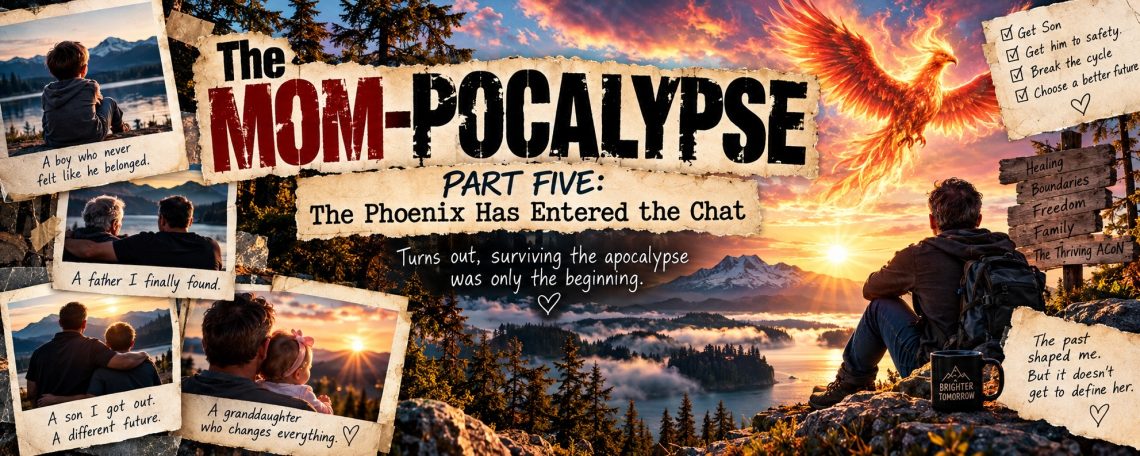
Turns out, surviving the apocalypse was only the beginning.
Well, here we are.
The fifth and final installment of The Mom-pocalypse.
And if you’ve made it this far, congratulations.
You’ve survived four installments of DNA revelations, family secrets, selective amnesia, a hoarded Missouri lake house, one spectacularly expensive moving arrangement, an emotional collapse on a basement floor, and a cross-country rescue mission that just happened to begin on Judgment Day.
Frankly, at this point, you deserve a certificate.
Or a stiff cup of coffee.
Possibly both.
But before we wrap this whole thing up, there’s one rather important part of the story we haven’t talked about nearly enough.
What happens after you escape?
Because here’s something nobody really explains when you’re contemplating going No Contact with a dysfunctional parent.
Leaving is one thing.
Healing from everything that made leaving necessary?
That’s an entirely different adventure.
And apparently, unlike the family relationship, that particular subscription doesn’t come with a cancellation option.
So grab your coffee.
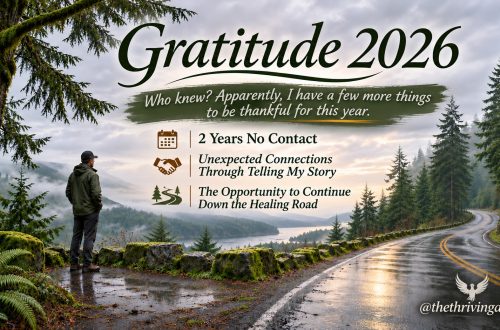
We’re heading to Washington.
And this time, we’re not running from something.
We’re trying to build something worth running toward.
Chapter Thirteen: The Great Pacific Northwest Reboot
Let’s rewind one last time.
August 29, 2024.
Judgment Day.
I’d set out from Texas on a multiday journey through Missouri and on toward Washington.
One very clear objective.
Get my son.
Get him out of the toxic environment he’d found himself trapped in.
And put some serious geographical distance between us and the dysfunction we’d spent far too long trying to manage.
We accomplished that mission.
My son was out.
We were headed west.
And the relationship with my mother had finally reached its permanent conclusion.
No Contact.
Not a temporary cooling-off period.
Not a negotiating tactic.
Not another round of “Maybe if I explain things differently this time…”
Done.
Finished.
Subscription canceled.
Please remove me from the mailing list.
And while you’re at it, delete the account.
Now, I’ll admit that relocating roughly 2,000 miles is a fairly aggressive approach to establishing personal boundaries.
Some people mute the family group chat.
Some stop attending Thanksgiving.
Some decline the occasional phone call.
I crossed multiple state lines.
But after nearly fifty years of living inside the same patterns, I wasn’t particularly interested in half measures anymore.
Welcome to Washington
And so began the next chapter.
Washington State.
Mountains.
Evergreen forests.
The Pacific Northwest.
Enough rain to make brooding introspectively feel like a legitimate recreational activity.
Honestly, if you’re going to spend some time contemplating the wreckage of your entire childhood, you could do worse for scenery.
Five stars.
Would recommend.
Preferably without the accompanying multigenerational family apocalypse.
But the move represented something much more significant than a change of address.
For the first time in my life, I was creating meaningful distance from the family dynamics that had shaped so much of my existence.
No more waiting for the next emotional explosion.
No more trying to predict what might set someone off.
No more explaining why a perfectly reasonable boundary wasn’t actually an act of cruelty.
No more pouring energy into a relationship that seemed to require an endless supply of understanding without much accountability in return.
And for the first time in a very long time, there was room.
Room to think.
Room to grieve.
Room to begin figuring out who I was without constantly reacting to someone else’s chaos.
It was supposed to feel wonderful.
And in many ways, it did.
There was relief.
There was freedom.
There was an undeniable sense that I’d finally made a decision I’d needed to make for a very long time.
But there was also something I hadn’t fully anticipated.
My body apparently hadn’t received the relocation notice.
The War Was Over. Somebody Forgot to Tell My Nervous System.
Here’s a fun little fact about complex trauma.
It doesn’t respect state lines.
Rude, I know.
There I was, thousands of miles away from the dysfunction, and somehow my brain was still behaving like I needed to be prepared for the next crisis.
Hypervigilance.
Second-guessing.
That familiar surge of anxiety when someone sounded irritated.
The instinct to explain myself before anyone had even accused me of anything.
The tendency to anticipate problems before they happened.
And the deeply ingrained feeling that if something went wrong, it was probably going to be my responsibility to fix it.
Now, as a lifelong technical guy, I found this particularly irritating.
Because in my line of work, when a system is malfunctioning, you troubleshoot it.
Find the problem.
Identify the cause.
Apply the fix.
Restart the service.
Verify normal operations.
Done.
Simple enough.
Except apparently the human nervous system doesn’t work like a Linux server.
Who knew?
You can’t just open a terminal and type:
sudo apt purge childhood-trauma
Believe me, if that package existed, I’d have installed it decades ago.
And probably written a shell script to automate the process.
But trauma doesn’t disappear simply because the circumstances that created it are no longer present.
Patterns learned over decades can remain active long after they’re necessary.
Your mind may understand that you’re safe now.
But your body can continue responding as though the next emotional ambush is just around the corner.
And that’s when I began understanding something I’d never fully appreciated before.
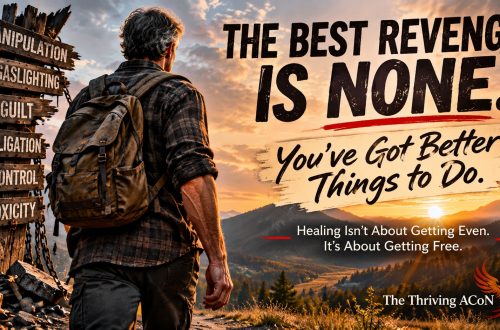
You can leave a dysfunctional environment long before the dysfunctional environment finishes leaving you.
The Strange Discomfort of Peace
Here’s another thing I discovered.
When you’ve spent much of your life dealing with chaos, peace can feel strangely unfamiliar.
You’d think it would be simple.
No drama?
Wonderful!
No manipulation?
Fantastic!
Nobody demanding that you manage their emotions?
Where do I sign?
But when your nervous system has spent decades anticipating problems, the absence of problems can initially feel suspicious.
Like you’re waiting for the other shoe to drop.
And then another shoe.
And perhaps an entire shoe factory.
Because surely things can’t just be… okay?
Surely there’s something I’ve forgotten.
Some crisis I haven’t anticipated.
Some responsibility I’ve neglected.
Some person who’s secretly upset with me.
And there I was, beginning to understand that a significant portion of my life had been organized around surviving circumstances that no longer existed.
The external chaos was gone.
But the internal habits were still running.
Apparently, the system had successfully migrated to Washington.
Unfortunately, it brought all the legacy software.
Wonderful.
Another migration project.
Just what I needed.
Chapter Fourteen: The Phoenix Has Entered the Chat
Over time, I began noticing something.
For nearly fifty years, much of my energy had gone toward trying to understand, accommodate, or survive the people and circumstances around me.
What did Mom want?
What would keep the peace?
How could I explain myself better?
How could I avoid another conflict?
How could I be good enough, helpful enough, understanding enough, or forgiving enough to finally make things work?
Those questions had consumed an extraordinary amount of mental and emotional real estate.
And now?
Suddenly, I didn’t have to keep asking them.
Which left me with a much more interesting question.
Who the hell am I when I’m no longer organizing my life around somebody else’s dysfunction?
That’s a surprisingly difficult question to answer when you’ve spent decades doing exactly that.
Discovering the Man Beneath the Survival Mechanisms
I began looking at myself differently.
Not just my childhood.
Not just my mother’s behavior.
Myself.
The habits I’d developed.
The relationships I’d pursued.
The ways I reacted to criticism.
My tendency to take responsibility for problems that weren’t necessarily mine to solve.
My discomfort with conflict.
My instinct to keep pushing through exhaustion because stopping somehow felt irresponsible.
And perhaps most importantly, the way I’d spent years minimizing my own experiences.
“It wasn’t that bad.”
“Other people had it worse.”
“She probably didn’t mean it that way.”
“Maybe I’m just being too sensitive.”
Ah, yes.
The Greatest Hits of Childhood Emotional Survival.
Available wherever dysfunctional family systems are sold.
But I was beginning to recognize that those explanations had served a purpose.
They allowed me to continue functioning in situations I didn’t know how to change.
They helped me maintain relationships I believed I was obligated to preserve.
They protected me from confronting painful realities before I was ready.
And for a long time, they were the tools I had.
But here’s the thing about survival mechanisms.
Something that helped you survive one chapter of your life can become an obstacle to living the next one.
That realization wasn’t always comfortable.
Because it meant I couldn’t simply point backward and say, “Well, that’s why I am the way I am.”
Understanding the origin of a pattern is important.
But understanding isn’t the same as changing it.
And if I genuinely wanted the next generation to inherit something better, I had to be willing to examine the ways those patterns might still be influencing my own behavior.
That meant accountability.
Not just demanding it from others.
Practicing it myself.
Which, as it turns out, is considerably less entertaining than diagnosing everybody else’s problems.
Very inconvenient.
Would’ve preferred an easier assignment.
The Difference Between Blame and Responsibility
This has become one of the most important distinctions in my healing journey.
I am not responsible for the circumstances of my childhood.
I didn’t choose the secrets.
I didn’t choose the emotional environment.
I didn’t choose the family narratives that shaped how I understood myself.
And I certainly didn’t choose to spend forty-six years believing I knew who my biological father was, only to discover otherwise through a saliva sample.
But I am responsible for what I do with that information now.
For how I treat people.
For the boundaries I establish.
For the patterns I continue.
For the patterns I decide to change.
And for the kind of father, grandfather, brother, and human being I want to become.
That doesn’t mean I have to pretend the past didn’t matter.
Quite the opposite.
It means recognizing that the past mattered enormously while refusing to let it make every decision about my future.
The damage wasn’t mine to choose.
The healing, however, is mine to pursue.
And some days, that work is exhausting.
Some days, old triggers still catch me off guard.
Some days, I recognize a familiar survival response halfway through reacting to something that never actually required it.
Some days, progress looks like a profound realization.
Other days, it looks like noticing that I’m about to apologize for something that isn’t my fault and deciding not to.
Healing isn’t always dramatic.
Sometimes it’s just making one different choice than you would’ve made yesterday.
And then doing it again tomorrow.
And the next day.
And the day after that, and so on.
The Unexpected Gift Hidden in the Wreckage
Now, if this entire story had been nothing but loss, I don’t know that I’d be able to look back on it the way I do today.
But it wasn’t.
Because amid all the deception and emotional upheaval, something extraordinary happened.
I found my father.
Not merely his identity.
Not just a name on a DNA report.
An actual relationship.
The Father I Was Denied
Remember James Pumpelly?
The novelist?
My biological father?
The man I discovered existed because my sister thought DNA testing would be a fun family activity?
Well, what began as one of the most shocking revelations of my life became one of its greatest blessings.
We connected.
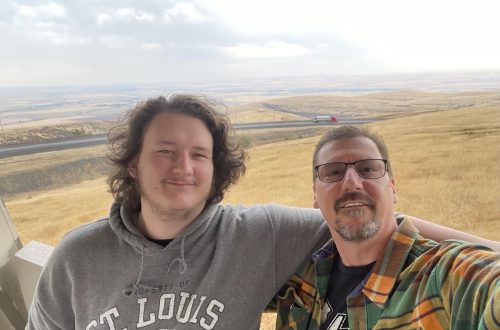
We met in 2022.
And we’ve continued building a relationship that feels remarkably natural.
We talk.
We text.
We share pieces of our lives.
And there’s something about that connection that still amazes me.
For decades, I’d carried this feeling that something about my family relationships didn’t quite fit.
And then, seemingly out of nowhere, I discovered a man with whom connecting didn’t require nearly the emotional effort I’d become accustomed to.
There’s an ease there.
A sense of recognition.
A feeling that I don’t have to continually prove I belong.
And considering the circumstances, that means more than I can adequately explain.
But there’s grief there, too.
Forty-six years.
That’s how long we’d gone without knowing each other.
He missed my childhood.
I missed knowing him as a boy.
There are decades of shared experiences we’ll never get back.
And while I’m profoundly grateful for the relationship we have now, I’m not going to pretend that gratitude erases the loss.
It doesn’t.
Both things can coexist.
I can grieve the father-son relationship I was denied.
And I can celebrate the one we’re building today.
That’s something recovery has taught me.
Life doesn’t always require choosing between two seemingly contradictory emotions.
Sometimes joy and grief sit right beside each other.
And sometimes the most extraordinary gifts arrive wrapped in circumstances you wouldn’t wish on anybody.
My father and I can’t reclaim those missing decades.
But we can decide what to do with the time we have now.
And believe me, I intend to make the most of it.
My Sister: Still My Little Sister
And while we’re talking about relationships, there’s another person who deserves recognition.
My sister.
The woman who bought those DNA kits in the first place.
The one whose simple curiosity launched this entire adventure.
The one who opened her home to our mother.
The one who endured years of chaos before finally establishing her own boundaries.
The one who relayed the Mother’s Day revelation that changed everything.
And the one who has walked through so much of this journey alongside me.
Now, technically, the DNA results revealed we’re half-siblings.
But let’s clear something up.
She’s my little sister.
Always has been.
Always will be.
The percentage of DNA we share doesn’t change that.
We grew up together.
We’ve shared a lifetime of family history.
We’ve taken very different paths through adulthood.
And when the family narrative finally began collapsing, we had each other.
Honestly, that’s one of the more remarkable things about this whole experience.
A secret that could have driven an enormous wedge between us instead became part of a journey through which we came to understand our shared history more clearly.
We’re not identical people.
We don’t approach everything the same way.
And we’ve each had our own experiences with the dysfunction we grew up around.
But when it mattered, we were able to compare what we’d experienced, support each other, and make decisions about what we were no longer willing to tolerate.
The DNA results changed our understanding of our biology.
They didn’t change our relationship.
And for that, I’m grateful.
Of course, I still reserve the right to remind her that she’s the one who bought the damn tests.
Because seriously.
All this from a “just for fun” gift?
Next time, just get me socks.
My Children, My Granddaughter, and the Legacy I Want to Leave
If you’ve followed this series from the beginning, you’ve probably noticed that the story gradually changes direction.
At first, it’s about me.
My childhood.
My identity.
The secrets.
The lies.
The emotional aftermath.
But as the story progresses, something shifts.
My children become part of the decisions I’m making.
My granddaughter enters the world.
And suddenly, the stakes are bigger than my own recovery.
Because the truth is, I can’t change what happened to me.
I can’t go back and give that little boy a different childhood.
I can’t reclaim the father-son relationship I was denied for more than four decades.
And I can’t undo every mistake I made while trying to navigate a world I didn’t fully understand.
But I can change what happens next.
My Son: The Reason I Went Back
On August 29, 2024, I began a journey to get my son out of a situation that had become emotionally harmful.
And while I’ve had plenty of fun with the Terminator references, the reality underneath that story remains profoundly important to me.
He’d stayed behind to help his grandmother.
He’d tried to do something decent.
And when things deteriorated, I went back for him.
Not to win an argument.
Not to punish anyone.
Not to prove a point.
To get my son.
And we got out.
Together.
Now, that doesn’t mean either of us suddenly had life completely figured out.
Not even close.
We’re both human beings with our own challenges, our own responsibilities, and our own work to do.
And being a father to an adult son means learning when to help, when to step back, and how to offer support without trying to control every outcome.
That’s part of my growth, too.
Because breaking generational patterns doesn’t mean becoming a flawless parent.
It means learning to love without manipulation.
Support without controlling.
Establish boundaries without using them as punishment.
And recognize that my son has his own life to build.
My job isn’t to live it for him.
It’s to be a father who helps him recognize that he has the ability—and responsibility—to build something better.
My Daughter: A Different Future
And then there’s my daughter.
The young woman whose pregnancy announcement in November 2023 gave our Missouri house-cleaning project an entirely new sense of purpose.
The one who returned to Texas in June 2024.
The one whose daughter arrived just eight days after my basement breakdown.
Watching my daughter become a mother has given me an entirely new perspective on parenthood.
Because when you become a parent yourself, you begin understanding your own parents differently.
And when you become a grandparent?
You get another opportunity to reflect on what really matters.
Not control.
Not appearances.
Not maintaining some perfect family image.
But connection.
Trust.
Respect.
And the understanding that our children are their own people, not extensions of ourselves.
I want my daughter to build the kind of family life that’s right for her.
One in which she feels safe making her own decisions.
One in which love doesn’t require pretending.
And one in which the next generation has more freedom to simply be themselves.
MJ: The Reason the Cycle Ends Here
And that brings me back to Mavis Joy.
Little MJ.
The smallest person in this entire saga.
And perhaps the one whose arrival gave everything that happened a new meaning.
June 15, 2024.
Eight days after the basement breakdown.
Just over a month after the Mom-pocalypse.
There she was.
A brand-new human being.
Blissfully unaware that Grandpa had just spent the preceding weeks experiencing the emotional equivalent of a complete operating-system failure.
And while she certainly wasn’t responsible for healing me, her arrival helped me recognize why that healing mattered.
Because I don’t want her growing up questioning whether she’s worthy of love.
I don’t want her learning that affection comes with strings attached.
I don’t want her believing that expressing her feelings makes her difficult.
I don’t want her thinking she has to manage the emotional state of the adults around her.
And I certainly don’t want her spending forty-nine years trying to understand why something about her family never quite felt right.
I want her to know she belongs.
Period.
I want her to know that love doesn’t require surrendering her identity.
That boundaries are healthy.
That honesty matters.
That mistakes can be acknowledged.
That apologies don’t need to come with excuses.
And that being part of a family should never mean sacrificing her emotional well-being to preserve somebody else’s illusion.
I know I can’t guarantee every aspect of her future.
No parent or grandparent can.
And I’m not going to pretend that simply declaring “The cycle ends here” magically eliminates every inherited pattern.
The declaration is the easy part.
The work is what comes afterward.
Examining my own behavior.
Recognizing my triggers.
Taking accountability.
Learning healthier ways to communicate.
Respecting the boundaries of the people I love.
And continuing to grow, even when that growth is uncomfortable.
Because I don’t want MJ to remember Grandpa as the guy who had a really compelling story about surviving family dysfunction.
I want her to remember a man who did something meaningful with what he’d learned.
I want to be someone she feels safe with.
Someone she can trust.
Not someone she’ll eventually have to recover from.
And if there’s one thing I’d like to leave behind when my own chapter eventually comes to an end, it’s that.
A different legacy.
Not perfection.
Not some imaginary family in which nobody ever makes a mistake.
Just a family in which love and accountability can exist together.
Where truth is welcomed instead of punished.
And where the next generation doesn’t have to inherit the emotional debts of the last.
Turning the Mess Into a Message
There’s an old saying I’ve believed in for years.
Turn your mess into a message.
And if there’s one thing the past several years have provided, it’s source material.
Good Lord, have they provided material.
I mean, seriously.
A DNA test?
A previously unknown biological father?
A Christmas Eve confrontation featuring selective amnesia?
A Mother’s Day revelation that completely reframed my understanding of the past?
A hoarded lake house?
A basement breakdown?
A granddaughter arriving eight days later?
A cross-country rescue mission beginning on the literal date of Judgment Day?
If I submitted this as a screenplay, somebody in Hollywood would probably tell me to tone it down.
“It’s a little unrealistic, Andrew. Too many coincidences. Maybe cut the Terminator reference.”
Sorry, Hollywood.
I don’t make the rules.
I just lived the damn thing.
But underneath all that absurdity is a question I’ve spent a lot of time considering.
What am I supposed to do with everything I’ve been through?
For years, I looked at my past primarily through the lens of mistakes and losses.
The bad decisions.
The years I couldn’t get back.
The relationships that didn’t work.
The opportunities I’d missed.
The things I’d survived.
The things I’d done that I wished I could undo.
And eventually, I began wondering whether all of it might serve some purpose beyond simply being a collection of painful memories.
Not because suffering is inherently meaningful.
And certainly not because I believe people need to experience trauma to become stronger.
I’d gladly have skipped quite a few of those lessons, thank you very much.
But because once the experiences have happened, you get to decide what you do with them.
And I began realizing that perhaps the most meaningful thing I could do was put words to experiences other people might still be struggling to understand.
Enter The Thriving ACoN
That’s how The Thriving ACoN began taking shape.
A place to talk about narcissistic family dynamics.
About growing up feeling like the outsider.
About emotional manipulation.
About complex trauma.
About No Contact.
About grief.
About boundaries.
About the strange, sometimes bewildering process of discovering who you are after spending decades being told who you’re supposed to be.
And perhaps most importantly, about hope.
Not the shallow, everything-is-wonderful-now kind of hope.
The kind that pretends healing is a straight line from pain to happiness.
I don’t believe in that kind of fairy tale anymore.
I’m talking about the hope that comes from recognizing you have choices.
That you’re allowed to question the stories you’ve been told.
That you can acknowledge the harm you’ve experienced without letting it define your entire identity.
That you can establish boundaries without waiting for someone else’s permission.
And that the circumstances of your childhood do not have to become the blueprint for the rest of your life.
I started The Thriving ACoN because I know there are other people out there still living inside the confusion I spent decades trying to make sense of.
People who feel guilty for recognizing unhealthy family dynamics.
People who are terrified of setting boundaries.
People who have spent years wondering whether they’re imagining things.
People who’ve been told that family loyalty should override almost everything else.
And people who are only beginning to understand that surviving and thriving are two very different things.
If something I write helps even one of those people feel less alone?
If one person reads my story and recognizes something about their own?
If one person finds the courage to ask a question they’ve been afraid to ask?
Or establish a boundary they’ve been afraid to establish?
Then perhaps something good can grow from all that wreckage.
That’s what turning the mess into a message means to me.
Not glorifying the pain.
Not pretending it was necessary.
And certainly not allowing it to become my entire identity.
It means refusing to let those experiences be the final word.
No Contact Was the Beginning, Not the Finish Line
There’s something I want to make absolutely clear before bringing this story to a close.
Going No Contact didn’t fix everything.
It didn’t erase the grief.
It didn’t magically resolve decades of emotional conditioning.
It didn’t turn me into a perfectly regulated, endlessly patient, spiritually enlightened human being.
Believe me.
Some days, I’m still a middle-aged Gen-X guy running Windows 95 emotional drivers on modern hardware.
Compatibility issues are inevitable.
But something fundamental changed on August 29, 2024.
I stopped waiting for someone else to change before allowing myself to move forward.
For years, I’d believed that if I could just explain things clearly enough, perhaps my mother would understand.
Perhaps she’d acknowledge what happened.
Perhaps she’d recognize the harm.
Perhaps we’d finally have an honest conversation about the past.
And maybe then, I could begin healing.
But eventually, I realized something.
I didn’t need her permission to heal.
I didn’t need her agreement about the past.
I didn’t need her validation of my experiences.
And as much as accountability would’ve mattered, I couldn’t keep making my future dependent on whether she ever chose to offer it.
That was one of the most difficult lessons of this entire journey.
Because there’s a particular kind of grief that comes with accepting that the relationship you hoped for may never exist.
Not because you didn’t try hard enough.
Not because you failed to explain yourself properly.
But because a healthy relationship requires participation from both people.
And you can’t do someone else’s part for them.
No matter how hard you try.
No matter how much you love them.
No matter how many chances you offer.
So I stopped.
Not loving.
Not caring about the truth.
Not hoping that people can grow and change.
I stopped participating in a relationship that had become harmful to me.
And I began directing that energy toward the parts of my life where I actually had some influence.
My own healing.
My relationships with my children.
My granddaughter’s future.
My connection with my biological father.
My relationship with my sister.
And the life I was building in Washington.
It wasn’t punishment.
It wasn’t revenge.
It wasn’t an attempt to erase anyone from history.
It was the recognition that someone can be part of your history without being entitled to a place in your future.
And for me, that distinction changed everything.
Epilogue: Would Spit in Tube Again
So here we are.
The end of the Mom-pocalypse.
Or at least the end of this particular five-part retelling.
Because life, as it turns out, keeps going.
And healing?
Well, that’s still very much a work in progress.
But let’s recap this spectacularly ridiculous chain of events one last time.
October 27, 2021.
A DNA test reveals that my sister and I are half-siblings and that the man I’ve believed was my biological father for forty-six years isn’t.
Christmas Eve 2021.
My mother claims she didn’t know.
A conversation with my newly discovered biological father subsequently raises some rather serious questions about that explanation.
I finally meet James Pumpelly, the father I never knew I had.
And discover one of the most wonderful, effortless family connections I’ve ever experienced.
My son and I move into a Missouri lake house and begin an ambitious cleanup project.
November 2023.
My daughter announces she’s pregnant.
I’m going to be a grandfather.
April 1, 2024.
After months of work, the final load of junk leaves the property thirty minutes before my daughter and her fiancé arrive.
And the house begins revealing all the expensive structural problems that had been hiding beneath the clutter.
Because apparently, even the house had secrets.
May 12, 2024.
Mother’s Day.
The Mom-pocalypse.
I discover that the man who raised me hadn’t known the biological truth either.
The remaining illusions collapse.
June 7.
The basement breakdown.
Forty-nine years of suppressed grief finally catch up with me on a concrete floor.
June 15.
Mavis Joy enters the world.
And suddenly, the most important question isn’t simply what happened to me.
It’s what I can do to help ensure the same patterns don’t continue into another generation.
August 29, 2024.
Judgment Day.
I begin a cross-country journey to rescue my son.
We get out.
No Contact becomes permanent.
And the next chapter of my life begins in Washington State.
Now, I ask you.
Does that sound like a reasonable amount of personal development for one middle-aged man to undertake over approximately three years?
Because personally, I think the universe might’ve gotten a little carried away.
Some guys hit middle age and buy a Corvette.
Some get really into golf.
Some start wearing expensive watches and pretending they understand wine.
I discovered a multigenerational family deception, met my previously unknown biological father, cleaned out a hoarded lake house, became a grandfather, had an emotional collapse on a basement floor, rescued my son, relocated across the country, and started writing about complex trauma and narcissistic family dynamics.
You know.
Normal Gen-X midlife crisis stuff.
And yet, despite everything, I wouldn’t go back to not knowing.
I wouldn’t trade the relationship I’ve built with my father.
I wouldn’t trade the clarity I’ve gained.
I wouldn’t trade the opportunity to become a different kind of father and grandfather.
And I certainly wouldn’t trade the freedom to decide what happens next.
Would I have preferred to discover the truth under less catastrophic circumstances?
Absolutely.
Would I have appreciated a little more honesty and a lot less emotional devastation?
You bet your ass.
But I can’t change how the truth arrived.
I can only decide what to do with it.
And that’s what I’ve been trying to do.
One day at a time.
One uncomfortable realization at a time.
One healthier choice at a time.
Not perfectly.
Not effortlessly.
But deliberately.
The Story I Choose to Leave Behind
I started this series by describing a little boy who never quite felt like he belonged.
A kid who grew up with a persistent sense that something about his family didn’t make sense.
A teenager who carried confusion he couldn’t explain.
A young man who made his share of terrible decisions.
An adult who spent decades trying to reconcile the stories he’d been told with the experiences he’d lived.
And eventually, a forty-six-year-old man whose entire understanding of his identity was turned upside down by a DNA test.
For a long time, I thought that was the defining story of my life.
The secrets.
The betrayal.
The lost years.
The damage.
But I don’t believe that anymore.
Because the story didn’t end when I discovered the truth.
It didn’t end on Mother’s Day 2024.
It didn’t end when I collapsed on that basement floor.
And it didn’t end on August 29, 2024.
Those were turning points.
Not final destinations.
Today, I’m still learning.
Still healing.
Still figuring out what it means to build a life that isn’t organized around surviving somebody else’s dysfunction.
And perhaps most importantly, I’m learning that the person I was forced to become in order to survive isn’t necessarily the person I have to remain.
There’s freedom in that.
There’s responsibility in it, too.
But there’s also hope.
Real hope.
The kind that doesn’t require pretending the past was okay.
The kind that doesn’t demand forgiveness on someone else’s schedule.
The kind that allows grief and gratitude to exist together.
The kind that recognizes you can lose decades and still have a future worth building.
And when I look at my granddaughter, that’s the future I want her to know.
Not the family secrets.
Not the manipulation.
Not the generations of emotional confusion.
I want her to know honesty.
Trust.
Safety.
Love without conditions.
And the freedom to become whoever she’s meant to be.
Because at the end of the day, breaking generational cycles isn’t about proving how badly you were hurt.
It’s about deciding that the hurt doesn’t get to keep reproducing itself through the people you love.
It may have reached me.
It may have reached my children.
But it absolutely does NOT get to claim yet another generation.
That’s the promise.
That’s the work.
And that’s why The Thriving ACoN exists.
So, was the Mom-pocalypse the end of the world?
For a while, it certainly felt that way.
But I’ve come to see it differently.
It was the end of a story I hadn’t been allowed to question.
And the beginning of one I finally get to write myself.
Because here’s the thing about Judgment Day.
In the Terminator movies, it’s the day everything ends.
For me?
August 29, 2024, was the day my life finally began again.
And as for that innocent little DNA test that started this whole catastrophe?
Well…
Five stars.
Accurate results.
Customer service was fine.
Completely dismantled my understanding of my family history, triggered a multiyear existential crisis, revealed a previously undisclosed father, and ultimately contributed to an interstate rescue operation.
But hey.
At least I finally know where I came from.
Would spit in tube again.
The Thriving ACoN — Breaking cycles. Reclaiming truth. And occasionally laughing at the sheer absurdity of surviving it all.
This concludes The Mom-pocalypse, a five-part personal series about family secrets, narcissistic family dynamics, identity, estrangement, and the messy, sometimes darkly humorous journey toward healing.
The Mom-pocalypse may be over. But the thriving? That’s just getting started.