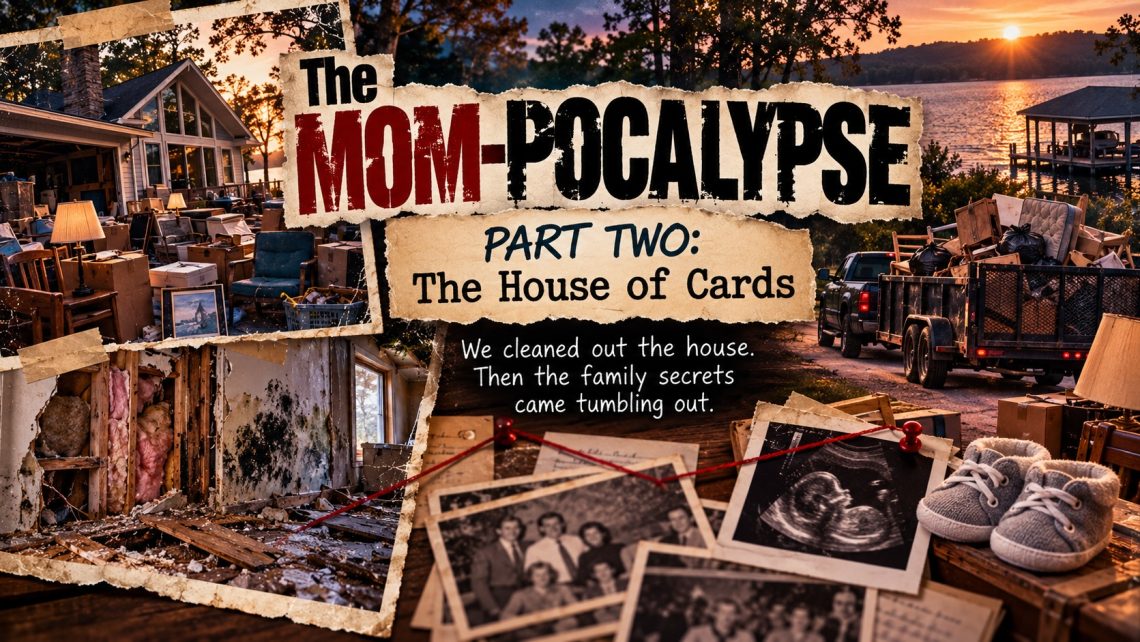
We cleaned out the house. Then the family secrets came tumbling out.
Welcome back to The Mom-pocalypse.
Previously, on the world’s most dysfunctional family documentary…
A seemingly innocent DNA test revealed that the man I’d believed was my biological father for forty-six years… wasn’t.
My sister and I discovered we were actually half-siblings.
I discovered my biological father was novelist James Pumpelly, an extraordinary man with whom I’d begin building the father-son relationship I never knew I was missing.
And my mother, when confronted with the genetic equivalent of a flashing neon sign, offered the rather remarkable explanation:
“I didn’t know.”
Which was interesting, considering that when she subsequently spoke with my biological father, she reportedly remembered the circumstances surrounding my conception quite well.
Apparently, certain memories required the correct caller ID.
But at the time, I wasn’t ready to confront the full implications.
I rationalized.
I minimized.
I found ways to explain away the contradictions.
You know. The usual Dysfunctional Family Loyalty Program benefits.
And life continued.
For a while.
Because as it turned out, the DNA test hadn’t actually caused the Mom-pocalypse.
It had merely lit the fuse.
And by 2023, that fuse was leading directly toward a lake house in Missouri.
A lake house that was about to provide one of the most spectacularly literal metaphors for family dysfunction I’ve ever encountered.
Buckle up.
We’re going dumpster diving.
Literally.
Chapter Five: Missouri — The Hoarder’s Paradise Restoration Project
Fast-forward to 2023.
Remember that lake house in Missouri?
The one our mother had been living in before my sister generously invited her to Washington during the pandemic?
Well, it was sitting unused.
And at the time, my kids were looking for ways to share expenses and establish a little more financial stability.
So an idea emerged.
My son and I could move into the Missouri house, start getting it ready, and eventually my daughter and her fiancé could join us.
A multigenerational household.
Shared expenses.
Family cooperation.
A fresh start.
Mom gave her blessing.
And on paper, it actually made sense.
Which, looking back, should probably have been my first warning.
Because by this point, I’d learned that anything involving my family that looked reasonable on paper was probably missing several important disclosures in the fine print.
But nevertheless, off we went.
Welcome to the Lake House. Please Watch Your Step.
Now, when I say the house needed cleaning, I don’t mean somebody had left a few dishes in the sink.
I don’t mean the carpets needed vacuuming.
And I certainly don’t mean we needed to spend a pleasant Saturday afternoon organizing the pantry.
Oh, no, No, NO…..
This was an entirely different level of domestic archaeology.
Decades of accumulated belongings.
Clutter.
Junk.
Things that had apparently been saved because, somewhere in the distant future, they might conceivably be useful.
You know.
Like that broken appliance from 1987.
Or a mysterious box of unidentified cables.
Or seventeen objects that probably once belonged to something important, although nobody could remember what.
Now, I’m a technical guy.
I understand keeping spare parts.
I’ve got boxes of cables and computer equipment that would make perfectly normal people question my sanity.
But there is a difference between having a reasonable collection of potentially useful equipment and operating what appears to be an unofficial regional storage facility for the entire twentieth century.
This house had apparently crossed that line several decades earlier.
If Marie Kondo had walked through the front door, she would have needed immediate medical assistance.
But my son and I got to work.
Sorting.
Cleaning.
Hauling.
More sorting.
More cleaning.
More hauling.
Eventually, we brought in hired help because apparently the contents of one Missouri lake house could sustain an entire local waste-management economy.
And here’s where the story starts becoming more meaningful than the jokes might suggest.
Because we weren’t simply cleaning a house.
We were trying to create something.
A home.
Something stable.
Something that might offer my kids a little breathing room financially.
Something that could serve as a foundation for the next chapter of our family’s life.
And then, in November 2023, that mission took on an entirely new significance.
Plot Twist: I’m Going to Be a Grandpa
My daughter was pregnant.
I was going to be a grandfather.
Me.
The guy who’d spent a good portion of his younger years treating responsible decision-making like an optional subscription service.
Grandpa.
Let that sink in.
I was still coming to terms with discovering that I had been lied to for my entire life about who my own biological father was, and now I was about to become a grandfather myself.
Apparently, the universe had decided to accelerate the entire family tree renovation project.
But this was wonderful news.
Truly wonderful.
And it changed everything about how I looked at that house.
Suddenly, the cleanup wasn’t merely about convenience or shared expenses.
There was a baby coming.
My granddaughter.
A brand-new human being who deserved a safe, stable place to enter the world.
And I wasn’t about to let a few decades of accumulated junk stand in the way.
So we doubled down.
Every cleared room brought us closer.
Every load hauled to the dump felt like progress.
Every piece of junk removed represented a little more space for the future.
Looking back, there’s something almost painfully symbolic about that.
There I was, physically hauling decades of accumulated family wreckage out of a house, while still carrying around decades of emotional wreckage I hadn’t yet figured out how to unpack.
At least the physical stuff came with a straightforward disposal procedure.
Load truck.
Drive to dump.
Unload.
Repeat.
If only childhood trauma were that cooperative.
April Fool’s Day — Because Apparently the Universe Has Jokes
April 1, 2024.
After months of work, we’d finally reached the finish line.
My daughter and her fiancé were arriving that day.
And approximately thirty minutes before they pulled into the driveway, the final load of junk left the property.
Thirty.
Minutes.
Now, I’m not sure whether Guinness maintains a category for Most Aggressive Last-Minute Household Decluttering, but I feel like we deserved at least an honorable mention.
This wasn’t a carefully coordinated home renovation.
This was a hostage negotiation with a dump truck.
But we’d done it.
We’d cleared the house.
We’d carved out a home.
We’d created the space we’d been working toward for months.
And for one brief, glorious moment, it felt like things were finally coming together.
Unfortunately, the universe had apparently noticed our optimism.
And it wasn’t having any of that.
The very fact that we “completed” the clean out on April Fool’s Day probably should have been the first clue…
The House Starts Telling Its Secrets
Here’s the thing about clearing decades of accumulated junk out of a house.
Eventually, you can actually see the house.
Which is wonderful.
Unless the house has been hiding things.
And ours?
Oh, it had been hiding things.
Structural problems.
Mold.
Decay.
Issues we hadn’t been warned about.
The more we cleared away, the more problems became visible.
It was like peeling an onion.
Except instead of layers of vegetable matter, we found expensive repairs and reasons to question our life choices.
And the worst part?
There was a baby on the way.
A newborn wasn’t going to care how many trips we’d made to the dump.
She wasn’t going to be impressed by the sheer volume of discarded household debris.
She needed a safe environment.
Period.
And it was becoming increasingly clear that this house wasn’t going to provide that long-term.
So we started looking for rentals nearby.
After all the work.
All the cleaning.
All the planning.
We were confronting the possibility that the entire arrangement was falling apart.
And here’s where I have to appreciate the almost absurd symbolism.
For months, we’d been clearing away the visible clutter.
Only to discover hidden damage underneath.
Meanwhile, in my own life, I’d begun uncovering the truth about my biological identity.
And the more I learned, the more I began questioning the foundation of everything I’d been told.
In both cases, the deeper we cleaned, the more rot we discovered.
You really couldn’t write a more heavy-handed metaphor if you tried.
And yet, there I was.
Living it.
Apparently starring in Extreme Makeover: Generational Trauma Edition.
And we were nowhere near the season finale.
Chapter Six: Meanwhile, Back in Washington — The Free Ride Is Ending
While my son and I were busy discovering that the Missouri house needed considerably more than a fresh coat of paint, my sister had been dealing with her own renovation project.
Except hers involved our mother.
Remember how she’d invited Mom to Washington during the pandemic?
Provided a place to live?
Covered her major living expenses?
Given her an opportunity to rebuild some semblance of normalcy?
Well, approximately three years of that arrangement had finally taken its toll.
And I don’t mean the normal inconveniences of having another adult in the house.
I mean the daily drama.
The emotional manipulation.
The chaos.
The constant demands.
The exhausting experience of trying to establish stability around someone who seemed to generate instability wherever she went.
My sister had reached her limit.
And frankly, I couldn’t blame her.
At some point, generosity stops looking like generosity and starts looking like an indefinite hostage situation with complimentary room and board.
So she told Mom it was time to move back to Missouri.
Now, let’s be clear about something.
This wasn’t an overnight eviction.
There was no dramatic tossing of belongings onto the front lawn.
No sheriff standing outside with a clipboard.
No furniture flying through the windows.
Mom was given six months to prepare.
Six.
Months.
She has a pension.
Her major living expenses were being covered.
All she needed to do was save enough money for the move.
A perfectly reasonable arrangement.
She agreed.
Promised she’d start saving.
And then apparently decided that financial planning was more of a philosophical concept than an actual activity.
Because when the time came?
ZERO.
That’s how much she’d saved.
Zero dollars.
Not a dime.
Now, I don’t claim to be a financial wizard.
I’ve made my share of financial mistakes.
Probably enough to justify their own separate chapter.
But even I understand that if somebody gives you six months to prepare for a known expense while covering most of your living costs, you should probably have something to show for it.
A savings account.
An envelope of cash.
A coffee can full of quarters.
Something.
Instead?
Nothing.
Apparently, the retirement plan was called:
“My Adult Children Will Figure It Out.”
An innovative financial strategy featuring unlimited withdrawals from other people’s bank accounts and absolutely no accountability requirements.
And here’s the thing about that particular pattern.
By this point, we’d become accustomed to stepping in.
Solving problems.
Absorbing consequences.
Making arrangements.
Doing whatever needed to be done to prevent the next crisis.
It was practically the family business.
Something went wrong?
Call the kids.
Need money?
Call the kids.
Need someone to resolve a problem created by months of inaction?
You guessed it.
Call the kids.
And for years, we kept responding.
Because she was our mother.
Because that’s what good children supposedly do.
Because family helps family.
And because somewhere along the way, we’d absorbed the idea that saying no was somehow worse than being taken advantage of.
What I didn’t fully understand yet was that this wasn’t simply an inconvenient family arrangement.
It was part of a much larger pattern.
One that I’d spent nearly fifty years minimizing.
And the last remaining pieces of that puzzle were about to fall into place.
On Mother’s Day.
Because apparently our family’s most significant revelations had a contractual obligation to occur on major holidays.
Chapter Seven: Mother’s Day 2024 — The Actual Mom-pocalypse
May 12, 2024.
Mother’s Day.
If you’ve been following this story, you might remember that the initial confrontation about my biological father happened on Christmas Eve 2021.
Apparently, my family had developed a rather unfortunate tradition.
Normal families exchange gifts on holidays.
We exchange life-altering revelations.
And Mother’s Day 2024 was about to deliver the biggest one yet.
The Text Message That Changed Everything
My sister and I were texting that day.
Nothing particularly unusual about that.
We’d been navigating the increasingly complicated family situation together for years.
And somewhere in the conversation, she casually mentioned something.
She’d told her father—the man who raised me—that I now knew he wasn’t my biological father.
And his reaction?
Absolute disbelief.
Wait.
What?
He’d had suspicions over the years.
But according to what my sister relayed to me, he’d never known for certain.
Until now.
And learning the truth had shaken his world, too.
I remember the significance of that realization.
Because up until that moment, there was still a part of me that had assumed he must have known.
That perhaps he’d been involved in keeping the truth from me.
That somehow, the adults had all understood the situation and simply chosen not to share it.
But that wasn’t what my sister was describing.
The man who’d raised me as his son for decades hadn’t known the biological truth either.
He’d had suspicions.
But suspicions aren’t certainty.
And now, after more than forty years, he’d finally learned what the rest of us were only beginning to understand.
He hadn’t been in on it.
He’d been deceived, too.
And THAT changed everything.
Suddenly, There Were Three of Us
Consider what I’d learned by that point.
My biological father hadn’t known he had a son.
I hadn’t known who my biological father actually was.
And now I was discovering that the man who raised me hadn’t known the truth, either.
Three people.
Three lives.
Decades of consequences.
All connected by one extraordinary piece of information that none of us had been given.
And there was my mother’s Christmas Eve response, still echoing in my mind.
“I didn’t know.”
Except when she’d spoken with my biological father, he told me she’d remembered the circumstances surrounding my conception.
A man who, as far as I could determine, had absolutely no incentive to invent that conversation.
He’d been lied to himself.
He wasn’t protecting a decades-old story he’d told me.
He wasn’t defending his role in my childhood.
He was simply another person trying to understand how we’d been separated for nearly half a century.
And now I was learning that even the man who’d raised me hadn’t known.
The pieces weren’t merely falling into place.
They were crashing down.
And suddenly, I couldn’t keep explaining away the contradictions.
I couldn’t keep telling myself there was probably some innocent explanation I hadn’t considered.
I couldn’t keep minimizing the consequences of what had happened.
Because this wasn’t simply about a biological detail.
This was about identity.
Trust.
Family history.
The way I’d understood myself.
The way I’d understood the man who raised me.
The way I’d interpreted relationships and events throughout my childhood.
And perhaps most painfully, the realization that the person who might have been able to clarify so much of that history had instead left me trying to piece it together decades later.
The Moment the Mask Shattered
Here’s the part I need people to understand.
The DNA results in October 2021 were shocking.
But they weren’t the Mom-pocalypse.
The Christmas Eve confrontation raised deeply troubling questions.
But even then, I continued finding ways to rationalize what had happened.
Mother’s Day 2024?
That was different.
That was the moment the remaining explanations I’d been clinging to stopped making sense.
The moment I realized the deception surrounding my identity hadn’t affected just me.
It had affected the man who raised me.
It had affected my biological father.
It had shaped how I understood both of them.
And it had influenced the story I’d told myself about my own life.
For decades.
This wasn’t a small lie.
It wasn’t a harmless omission.
It wasn’t one of those family secrets where everybody laughs about it years later over Thanksgiving dinner.
“Remember that time we forgot to mention who your father was? Pass the mashed potatoes!”
No.
There was nothing remotely funny about what that secrecy had cost.
And the deeper implication was terrifying.
If my mother could keep something this fundamental concealed for more than four decades, what else about the story I’d grown up believing might be wrong?
What other explanations had I accepted without questioning?
What other family relationships had I understood through a distorted narrative?
How many times had I doubted my own perceptions because somebody else insisted their version of events was the correct one?
And how much of my life had I spent trying to solve problems that had never been honestly explained to me?
That’s when the Mom-pocalypse happened.
Not because I’d finally received every answer.
I hadn’t.
And I probably never will.
But because I could no longer look at my childhood, my family, or my own identity the same way.
The mask hadn’t simply slipped.
It had shattered.
Forty-Nine Years
I was forty-nine years old.
Let that sink in for a moment.
Forty-nine.
Not nineteen.
Not twenty-nine.
Forty-nine years of living with a family narrative that was now fundamentally in question.
And here’s something I’ve learned about discovering the truth that late in life.
You don’t simply grieve the revelation.
You grieve the years.
The childhood you can’t revisit.
The relationships you might have understood differently.
The decisions you made with incomplete information.
The decades of wondering why something never quite felt right.
You start thinking about the kid you used to be.
The teenager who felt like an outsider.
The young adult who made terrible decisions while carrying pain he couldn’t explain.
The father who tried to do better without entirely understanding what he’d inherited.
And suddenly, you find yourself grieving for all of them.
Every version of yourself who’d been trying to make sense of a story without having all the pages.
There’s no convenient instruction manual for that.
No emotional troubleshooting guide.
No software update.
Although, as a lifelong computer guy, I would’ve greatly appreciated a notification saying:
CRITICAL SYSTEM ERROR
FamilyNarrative.dll is corrupted.
Identity database contains conflicting records.
Attempting automatic repair…
REPAIR FAILED.
Please contact your system administrator.
Unfortunately, the system administrator was also the primary suspect in the data-integrity problem.
So that wasn’t going to work.
The Realization I Couldn’t Undo
For years, I’d been remarkably skilled at explaining things away.
The emotional distance.
The manipulation.
The guilt.
The way certain family stories never quite lined up.
The feeling that questioning anything made me the problem.
I’d always found a way to minimize it.
Maybe I was being too sensitive.
Maybe I misunderstood.
Maybe I was remembering things incorrectly.
Maybe my mother had her reasons.
Maybe, maybe, maybe.
But something had changed.
For the first time, I was allowing myself to consider an entirely different possibility.
What if I’d spent my entire life trying to make sense of a reality that had been deliberately distorted?
What if the problem wasn’t that I had failed to understand?
What if I’d never been given the information necessary to understand in the first place?
And what if the constant emotional confusion I’d experienced wasn’t evidence that something was wrong with me?
What if it was an understandable response to the environment in which I’d grown up?
Those questions didn’t arrive with comforting answers.
They arrived with grief.
Anger.
Shock.
And a deeply unsettling awareness that I might have to reconsider almost everything I thought I knew about my past.
For nearly fifty years, I’d been carrying an enormous amount of emotional weight without fully understanding where it came from.
And on May 12, 2024, I finally began recognizing just how heavy it was.
The Mom-pocalypse wasn’t an explosion that destroyed my life.
It was the explosion that destroyed the explanations I’d been using to make sense of it.
And once those explanations were gone?
There was no putting them back.
The Beginning of the Aftermath
You might think that a revelation of that magnitude would immediately produce some sort of dramatic, decisive action.
A confrontation.
A declaration.
A cinematic moment where I finally announced that I’d had enough.
But that’s not how it happened.
Because recognizing the truth and emotionally processing what it means are two very different things.
My mind had begun connecting dots that had been scattered across nearly five decades.
But my nervous system?
It was still trying to catch up.
And there were practical realities to deal with.
The Missouri house wasn’t suitable for the future we’d planned.
My daughter was approaching the final weeks of her pregnancy.
My son had decisions to make about his own future.
Our mother still needed to be moved back to Missouri.
And the family arrangements we’d spent months working toward were coming apart.
There were plans to change.
Decisions to make.
People to help.
And somewhere in the middle of all of that, I was trying to absorb the realization that my understanding of my own childhood had just been turned upside down.
So I did what I’d always done.
I kept moving.
Kept thinking.
Kept trying to figure out the next practical step.
Because when you’ve spent most of your life in survival mode, stopping to process your feelings doesn’t necessarily come naturally.
There’s always another problem to solve.
Another crisis to manage.
Another person who needs something.
And as long as you’re busy enough, maybe you can keep the grief from catching up.
At least, that’s what I thought.
But the human nervous system has a funny way of eventually collecting on debts we’ve spent decades refusing to acknowledge.
And mine was about to send one hell of an invoice.
On June 7, 2024, less than four weeks after Mother’s Day, I would find myself alone in the basement of that Missouri lake house.
The same house we’d spent months trying to save.
The same house that had revealed so much hidden damage once we’d cleared away the clutter.
And on the morning I was supposed to leave it behind for good, something inside me would finally give way.
No dramatic confrontation.
No triumphant speech.
No clever Gen-X one-liner.
Just a forty-nine-year-old man.
A concrete floor.
And nearly five decades of grief that could no longer be contained.
I thought the Mom-pocalypse had already broken everything open.
I had no idea what was about to happen when the last person left the house and I was finally alone with the truth.
Coming Next in Part Three: The Fall Before the Rise
The morning I fell apart. The little girl who gave me a reason to rebuild.
In Part Three, the emotional fallout of Mother’s Day finally catches up with me.
With my son gone to Washington, my daughter and her fiancé headed back to Texas, and the Missouri house standing empty, I’ll experience one of the most devastating moments of my life.
The basement breakdown.
But eight days later, on June 15, 2024, a tiny little girl named Mavis Joy will enter the world.
And suddenly, the story won’t just be about what happened to me.
It’ll become about what I’m determined will never happen to her.
Because sometimes, the moment everything falls apart is the moment you finally discover what you’re fighting for.
The Thriving ACoN — Breaking cycles. Reclaiming truth. And occasionally laughing at the sheer absurdity of surviving it all.
This is Part Two of a five-part personal series about family secrets, narcissistic family dynamics, identity, estrangement, and the messy, sometimes darkly humorous journey toward healing.