
When a dysfunctional family teaches you to question your own pain, learning to trust yourself becomes an act of recovery.
There comes a point in healing when you realize something that should have been obvious all along.
Being hurt by someone’s hurtful behavior does not make you crazy.
Being angry about betrayal doesn’t make you unstable.
Being suspicious after repeatedly being lied to doesn’t make you paranoid.
And finally losing your patience after years of having your feelings dismissed doesn’t automatically make you the problem.
But if you grew up in a narcissistic or deeply dysfunctional family, chances are you weren’t taught any of that.
You were taught something very different.
You were taught that the problem wasn’t what someone did to you.
The problem was that you had the audacity to react to it.
And for those of us who spent decades living under that particular set of rules, unlearning it can be one of the hardest parts of recovery.
When Your Feelings Become the Family’s Inconvenience
In a reasonably healthy family, when someone hurts another person, there’s at least the possibility of a conversation.
Maybe someone misunderstood something. Maybe somebody spoke carelessly. Maybe an apology is warranted.
Nobody handles every disagreement perfectly, but there’s room for both people to have feelings, acknowledge mistakes, and work toward understanding.
In a narcissistic family system, however, the rules are often very different.
The person causing the harm may expect unconditional understanding, forgiveness, and loyalty.
The person experiencing the harm is expected to remain quiet, accommodating, and agreeable.
And when that person finally says, “Hey, what you did really hurt me,” something remarkable happens.
Suddenly, the conversation isn’t about the hurtful behavior anymore.
It’s about your tone.
Your attitude.
Your sensitivity.
Your supposed inability to let things go.
Or my personal favorite: “You’re making a big deal out of nothing.”
Funny how something can be nothing when they’re the ones doing it, but become a monumental offense when you dare to object.
It’s almost as if the rules were never designed to be fair.
Imagine that.
The Great Dysfunctional Family Magic Trick: Turning the Victim Into the Offender
One of the most destructive patterns in dysfunctional families is the way accountability gets turned upside down.
Someone lies to you.
You discover the lie.
You confront them.
They deny it, minimize it, change the subject, or attack your character.
You become frustrated because you’re trying to have an honest conversation with someone who refuses to participate in one.
And then comes the grand finale.
“See how angry you get? THIS is why I can’t talk to you!”
Abracadabra! And Poof! Just like that…
The original lie has vanished.
The person who told it is now the “wounded” party.
And you’re standing there trying to defend your emotional reaction instead of discussing the behavior that caused it.
There’s actually a name for one version of this pattern: DARVO — Deny, Attack, and Reverse Victim and Offender.
Not every disagreement involves DARVO, and not every defensive person is a narcissist. But when this reversal becomes a repeated pattern, it can seriously undermine your ability to trust your own judgment.
Because after enough repetitions, you start doing their work for them.
You question yourself before they even have to.
Maybe I was too harsh.
Maybe I shouldn’t have said anything.
Maybe I’m just being overly sensitive.
Maybe I really am the problem.
And that’s where the damage goes far beyond the original incident.
You haven’t just learned to tolerate someone else’s behavior.
You’ve learned to distrust your own response to it.
Fifty Years of Questioning Myself
For much of my life, I lived inside a family narrative that I believed was true.
I trusted the people who were supposed to tell me the truth about my own history.
Why wouldn’t I?
When you’re a child, your parents aren’t merely participants in your understanding of the world.
They’re the people who help construct it.
And when that foundation is built on deception, you don’t necessarily recognize the cracks.
You just learn to live with the instability.
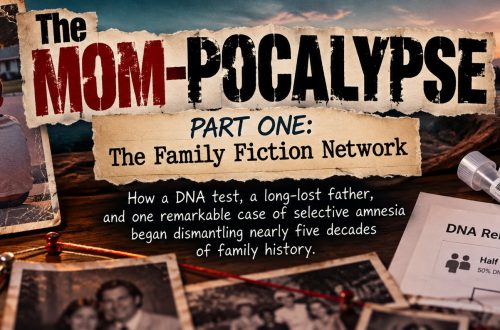
In October 2021, DNA results revealed something that fundamentally changed my understanding of my own origins.
The man I’d grown up believing was my biological father wasn’t.
That revelation was enormous.
But what followed was, in many ways, even more revealing.
Because when I confronted my mother with the information, I wasn’t met with the honesty, accountability, or compassion I’d hoped for.
The response I got instead: feigned ignorance, shifting timelines, and selective amnesia.
And over the following years, as I began examining the broader family dynamics, I started recognizing patterns that had been present for decades.
The evasions.
The manipulation.
The shifting explanations.
The expectation that I should simply accept whatever version of reality was being presented.
And perhaps most damaging of all, the deeply ingrained belief that questioning any of it somehow made me the difficult one.
Then came Mother’s Day 2024.
The Mom-pocalypse.
The moment when decades of cognitive dissonance finally collided with what I could no longer ignore.
And suddenly, I wasn’t just dealing with a painful revelation.
I was confronting the realization that I’d spent much of my life doubting my own perceptions in order to preserve someone else’s version of the truth.
That’s a hell of a thing to come to terms with in your late forties.
When the Reaction Becomes Bigger Than the Original Hurt
Here’s something I’ve come to understand about prolonged emotional abuse.
Sometimes your reaction to an incident isn’t just about that incident.
It’s about the thousand incidents that came before it.
The thousand times you swallowed your frustration.
The thousand times you gave someone the benefit of the doubt.
The thousand times you accepted an explanation that didn’t quite make sense.
The thousand times you told yourself it wasn’t worth arguing about.
Until one day, something happens that might appear relatively small to an outside observer.
And you react.
Strongly.
Maybe you raise your voice.
Maybe you shut down.
Maybe you finally say something you’ve been holding back for years, or even decades.
And someone who hasn’t lived your experience looks at that one moment and wonders why you’re making such a big deal out of it.
What they don’t see is the accumulated weight behind it.
They’re looking at the final straw and wondering why it broke your back.
That doesn’t mean every reaction is automatically justified or healthy.
But it does mean that understanding a reaction requires understanding the history behind it.
And in families where that history is routinely denied or rewritten, you’re often left carrying the entire explanation by yourself.
You Can Own Your Reaction Without Owning Their Behavior
This is where I think healing requires some real honesty.
Because I don’t believe recovery means declaring that every emotional reaction I’ve ever had was appropriate.
I’ve said things out of anger.
I’ve become defensive.
I’ve reacted to situations with an intensity that, looking back, probably had more to do with old wounds than the immediate circumstances.
And I’ve had to learn to recognize those moments.
That’s part of being an adult.
That’s part of taking responsibility for myself.
But here’s the distinction I spent far too many years failing to make:
I can acknowledge that my reaction wasn’t perfect without pretending the behavior that triggered it was acceptable.
Both things can be true.
I can regret raising my voice while still recognizing that I was being lied to.
I can apologize for harsh words without withdrawing the boundary that prompted the disagreement.
I can recognize that my nervous system sometimes responds to old threats while still acknowledging that someone treated me badly in the present.
I can work on becoming a calmer, healthier, more emotionally regulated person without volunteering to become somebody else’s emotional punching bag.
That’s not hypocrisy.
That’s accountability.
Real accountability.
The kind that applies to everyone involved, not just the person who finally got upset.
The Difference Between Insecurity and Earned Distrust
Another accusation that gets thrown around in unhealthy relationships is that you’re simply insecure.
You ask questions because something doesn’t add up?
You’re insecure.
You want consistency between someone’s words and actions?
You’re insecure.
You hesitate to trust someone who has repeatedly broken your trust?
Apparently, you’re insecure again.
But there’s an important difference between insecurity and distrust that’s been earned through experience.
Insecurity can cause us to fear betrayal even when there isn’t evidence of it.
Earned distrust develops when someone’s behavior has repeatedly demonstrated that trust isn’t safe.
Those are not the same thing.
And while past trauma can absolutely make it harder to distinguish between genuine warning signs and old fears, the solution isn’t to dismiss every uncomfortable feeling.
The solution is to examine it.
To ask questions.
To look at patterns.
To consider evidence.
To recognize when an old wound is speaking — and when a current situation genuinely deserves concern.
Healing isn’t learning to ignore your instincts.
It’s learning how to evaluate them without automatically assuming you’re wrong.
The Scapegoat’s Impossible Assignment
For those of us who occupied the scapegoat role in a dysfunctional family, there’s another layer to all of this.
The scapegoat often becomes the person expected to absorb the family’s discomfort.
The one who gets blamed when something goes wrong.
The one who’s accused of creating conflict by pointing out conflict that already existed.
The one who is told they’re destroying the family simply because they’ve stopped pretending everything is fine.
And the cruelest part?
The scapegoat may spend years trying to become good enough to finally earn fair treatment.
More patient.
More forgiving.
More understanding.
Less emotional.
Less demanding.
Less difficult.
As if there’s some magical level of compliance that will finally make the dysfunctional system behave like a healthy one.
But you can’t earn accountability from someone who’s committed to avoiding it.
You can’t explain your pain clearly enough to guarantee empathy from someone who benefits from dismissing it.
And you can’t make a relationship healthy by doing both people’s emotional work.
Believe me.
I spent decades trying.
Why No Contact Became Necessary for Me
When I finally went No Contact with my mother on August 29, 2024, it wasn’t because I’d suddenly decided that every disagreement was abuse.
It wasn’t because I believed I was perfect.
And it certainly wasn’t because I was incapable of forgiving someone who made a mistake.
It was because I had reached a point where I could no longer keep participating in a relationship that required me to disregard my own reality.
The DNA revelation had opened the door.
The events of 2024 had forced me to examine what was behind it.
And by the time I made that decision, I understood something I hadn’t understood for most of my life.
I didn’t need my mother’s agreement that I’d been hurt in order for my hurt to be real.
I didn’t need her to validate my memories before I could trust them.
I didn’t need to win one final argument.
I didn’t need to persuade her that my boundaries were reasonable.
And I certainly didn’t need to continue sacrificing my emotional well-being in pursuit of an acknowledgment that might never come.
No Contact wasn’t a declaration that I would never make another mistake.
It was a decision that I would no longer abandon myself to preserve a relationship.
Those are two very different things.
The Hardest Person to Stop Gaslighting May Be Yourself
Here’s the part that doesn’t get talked about nearly enough.
Even after you leave a dysfunctional family system, the conditioning doesn’t simply disappear.
You can remove yourself from the relationship and still hear the old accusations in your head.
You’re overreacting.
You’re too sensitive.
You’re making something out of nothing.
You should just get over it.
You may find yourself rehearsing explanations for people who aren’t even asking for them.
Defending boundaries that don’t require a courtroom presentation.
Second-guessing decisions you’ve already carefully considered.
Or feeling guilty simply because someone else is unhappy with a choice you made.
That internalized voice can be stubborn.
And for those of us who spent decades being conditioned to question ourselves, learning to recognize it takes time.
I still catch myself doing it.
The difference now is that I’m learning not to automatically believe it.
I can ask myself whether I handled something well without immediately concluding that I had no right to be upset.
I can consider someone else’s perspective without erasing my own.
I can recognize an emotional trigger without dismissing the legitimate issue that brought it to the surface.
And I can give myself the same basic consideration I spent most of my life extending to everybody else.
Imagine that.
Your Feelings Are Information, Not a Crime
One of the most important lessons I’ve learned is that feelings don’t have to be perfect to deserve attention.
Anger can tell you that a boundary may have been crossed.
Sadness can tell you that something meaningful has been lost.
Anxiety can alert you to uncertainty or perceived danger.
Resentment can sometimes reveal that you’ve been giving far more than you’re receiving.
None of those emotions automatically proves that your interpretation of a situation is correct.
But neither does experiencing them mean you’ve done something wrong.
Feelings are information.
They’re worth examining, not automatically obeying and not automatically suppressing.
The goal isn’t to become someone who never gets upset.
The goal is to become someone who can experience difficult emotions, understand them, and respond thoughtfully without being ashamed of having them.
And for an adult child of a narcissistic parent, that can be a radical change.
Because instead of asking, “How do I stop feeling this so nobody gets upset with me?”
You begin asking:
“What is this feeling telling me, and what do I need to do with that information?”
That’s a very different way to live.
I’m Not Doing That to Myself Anymore
I spent far too much of my life explaining, defending, justifying, and questioning my own emotional responses.
Trying to make other people understand why something hurt.
Trying to find the perfect combination of words that would finally make someone acknowledge what they’d done.
Trying to prove that I wasn’t crazy, unreasonable, ungrateful, or overly sensitive.
And somewhere along the way, I lost sight of something incredibly simple.
I was allowed to be hurt.
I was allowed to be disappointed.
I was allowed to be angry.
I was allowed to question behavior that didn’t make sense.
And I was allowed to decide that a relationship was no longer healthy for me, even if the other person disagreed.
Today, I still have work to do.
I’m still learning to recognize old triggers.
Still learning to respond instead of react.
Still learning that I don’t have to defend every feeling or explain every boundary.
But there’s one thing I’m no longer willing to do.
I will not keep teaching myself to tolerate mistreatment just so someone else can remain comfortable with having mistreated me.
If I handle something poorly, I’ll own it.
If I owe someone an apology, I’ll give it.
If I misunderstand a situation, I’m willing to reconsider.
But I will not accept responsibility for someone else’s choices simply because they don’t like how those choices affected me.
And I will not confuse keeping the peace with being at peace.
Because after nearly fifty years of living under someone else’s version of reality, I’ve finally begun learning to trust my own.
Not blindly.
Not arrogantly.
But honestly.
And that, to me, is what healing looks like.
Not becoming someone who never feels hurt.
Not becoming someone who never makes mistakes.
But becoming someone who no longer believes that having a perfectly human reaction to hurtful behavior makes them defective.
I can work on how I react without teaching myself to accept what hurts me.
And so can you.