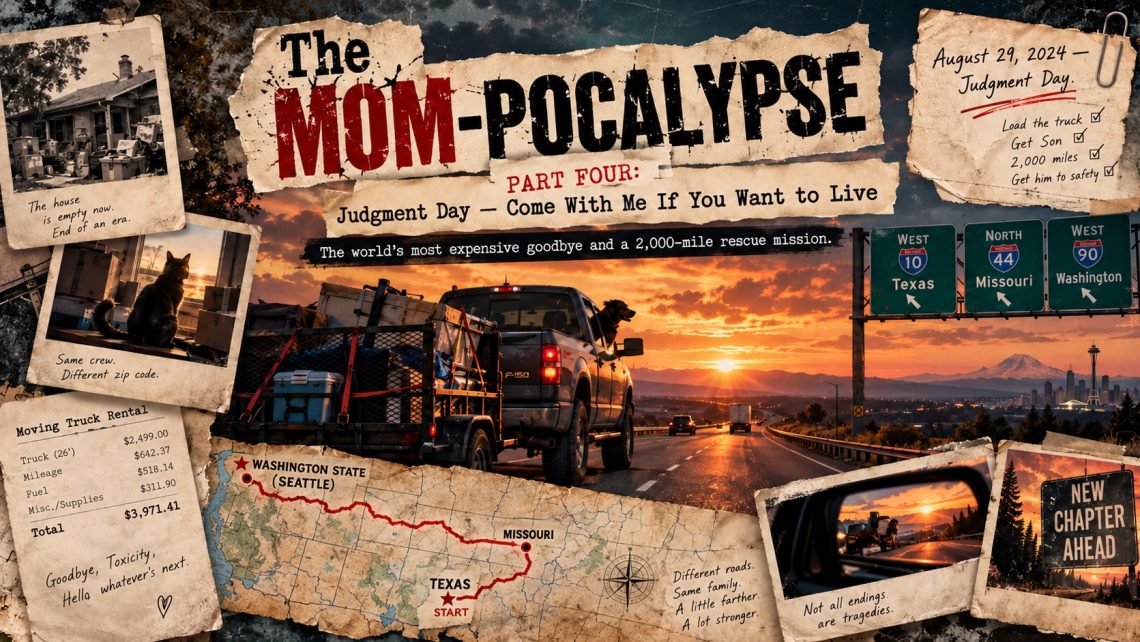
The world’s most expensive goodbye and a 2,000-mile rescue mission.
Welcome back to The Mom-pocalypse.
Previously, on the family saga that apparently couldn’t decide whether it wanted to be a psychological thriller, a disaster movie, or a very expensive sitcom…
A DNA test had revealed that the man I’d believed was my biological father for forty-six years wasn’t.
My actual biological father, novelist James Pumpelly, turned out to be an extraordinary man—and one of the most unexpected blessings of this entire experience.
Mother’s Day 2024 brought the revelation that finally shattered my remaining illusions: the man who’d raised me hadn’t known the biological truth, either.
For more than four decades, multiple people had been living with the consequences of a secret they hadn’t been allowed to understand.
Then came June 7.
The basement breakdown.
The morning I collapsed on the concrete floor of a Missouri lake house and sobbed harder than I had in decades.
And just eight days later, June 15, my granddaughter Mavis Joy entered the world.
MJ.
The little girl whose arrival helped me realize that healing wasn’t simply about recovering from my past.
It was about protecting the future.
The cycle ends here.
At least, that was the plan.
Unfortunately, the family chaos department still had a few outstanding invoices.
And apparently, someone had forgotten to cancel the subscription.
Chapter Eleven: The World’s Most Expensive Goodbye
Let’s rewind slightly.
Remember how my sister had generously invited our mother to live with her in Washington during the pandemic?
Rent-free?
Major living expenses covered?
A safe place to land?
A genuine opportunity to rebuild some stability?
Well, after roughly three years of emotional manipulation, daily drama, and enough chaos to qualify as a full-time occupation, my sister had finally reached her limit.
Mom needed to move back to Missouri.
Now, I want to emphasize something here.
She wasn’t being tossed out on the street with fifteen minutes’ notice and a cardboard box.
She was given six months.
Six entire months to prepare.
She has a pension.
Her major living expenses were covered.
All she needed to do was save enough money to pay for her relocation.
She agreed.
Promised she’d save.
And then, apparently, dedicated the next six months to an intensive study of how to save absolutely nothing.
Not a dime.
Zero dollars.
Now, I’ve made my share of financial mistakes.
Believe me.
There are entire chapters of my life that could reasonably be titled Financial Decisions Best Not Repeated.
But even I understand that when you know an expense is coming six months in advance, and someone else is covering most of your living costs, the general idea is to put at least SOME money aside.
An envelope.
A savings account.
A coffee can.
A jar labeled “PLEASE DON’T MAKE MY CHILDREN PAY FOR THIS.”
Anything.
Instead?
Nothing.
Apparently, Mom had developed a revolutionary new retirement strategy.
The Adult Children Emergency Financial Extraction Plan.
No contributions required.
No account balance necessary.
Unlimited withdrawals.
And best of all, all expenses automatically transferred to the next generation.
I’m fairly certain the Securities and Exchange Commission would have questions.
But Wait! There’s More!
When moving time arrived, the inevitable happened.
My sister and her husband ended up paying for the moving truck.
Because, naturally, the people who’d already provided three years of rent-free accommodation were now responsible for financing the departure.
Think about that for a moment.
They’d opened their home.
Absorbed the disruption.
Covered the living expenses.
Endured years of emotional chaos.
And then got handed the moving bill.
It’s like checking out of a hotel after a terrible stay and being informed that you’re also responsible for purchasing the hotel’s new furniture.
But that wasn’t the end of it.
Oh, no.
There was still the car.
Mom had left her vehicle behind in Washington.
And somehow, that now needed to become somebody else’s financial responsibility, too.
So my sister and I split the cost of shipping it back to Missouri.
At this point, I was seriously beginning to suspect the entire family relationship operated on a subscription-based billing model.
MOM PREMIUM PLUS — FAMILY PLAN
Your subscription includes:
- Unlimited guilt and emotional manipulation.
- On-demand family emergencies.
- Financial responsibility automatically transferred to adult children.
- Complimentary selective memory.
- Twenty-four-hour access to unnecessary drama.
- No refunds.
- No accountability.
- Cancellation requires interstate relocation.
And the cancellation fee?
Apparently, whatever the moving company happened to charge.
Now, I’m not going to pretend we were happy about paying.
We weren’t.
The money mattered.
The unfairness mattered.
The sheer audacity of the arrangement mattered.
But by this point, something else mattered more.
We wanted out.
Not another argument.
Not another round of promises.
Not another conversation about why our boundaries were supposedly unreasonable.
We wanted the situation over.
And sometimes, escaping a dysfunctional arrangement means accepting that the final transaction is going to be expensive.
Not because the other person deserves the money.
Not because you owe them another rescue.
But because peace has become worth more than the amount you’re being asked to surrender.
We weren’t paying for a truck and a car shipment.
Not really.
We were buying distance.
And for perhaps the first time, that distance had become more valuable than keeping the family illusion intact.
There was just one problem.
We weren’t all out yet.
My son was still there.
And the final chapter of our escape was about to begin.
Chapter Twelve: August 29, 2024 — Judgment Day
Now, if you’re a fellow Gen-X movie fan, this date should immediately ring a bell.
August 29.
Judgment Day.
In the Terminator franchise, August 29, 1997, was the day Skynet launched its nuclear attack on humanity.
The machines became the enemy.
Civilization went up in flames.
And Arnold Schwarzenegger eventually found himself traveling through time, stealing clothing, and delivering some of the most quotable lines in cinematic history.
A defining piece of 1980s and 1990s science fiction.
And apparently, somewhere in the universe’s cosmic scheduling department, somebody decided that date needed a sequel.
Because twenty-seven years later, on August 29, 2024, I began my own version of Judgment Day.
No nuclear missiles.
No killer robots.
No futuristic cyborgs demanding my clothes, boots, and motorcycle.
Although, frankly, after the preceding three years, I probably would’ve just handed over the keys and asked whether Skynet accepted passengers.
Instead, there was a pickup truck.
A long stretch of American interstate.
And one very clear objective.
Get my son.
Get out.
Don’t look back.
How We Got Here
Remember June 4?
My son had flown to Seattle to help his grandmother move back to Missouri.
Despite everything we’d experienced, he’d wanted to help.
And I respected that.
He was trying to do something decent.
Something compassionate.
Something that, in a healthier family, probably would’ve been an entirely ordinary act of kindness.
Help Grandma move.
Get her settled.
Figure out his own next steps.
Simple enough.
But as I’d spent nearly five decades learning, ordinary family interactions had a remarkable tendency to become anything but ordinary in our world.
By the time the rest of us had stepped away from the chaos, my son was still caught in it.
And from what he was experiencing, he was becoming the available target for the anger and resentment surrounding our departure.
The manipulation.
The hostility.
The emotional punishment.
The same patterns that had taken me decades to recognize.
Except now they were being directed at my child.
And here’s where something fundamental changed.
For years, I’d been willing to minimize what happened to me.
Explain it away.
Give another chance.
Find another reason to believe things might improve.
I’d absorbed an extraordinary amount of emotional dysfunction because I’d been conditioned to treat it as normal.
But watching those patterns reach my son?
That was different.
Because whatever I’d been willing to tolerate for myself, I wasn’t willing to simply stand by and watch the same cycle continue through another generation.
My son had stayed behind to help.
He didn’t deserve to become the emotional dumping ground for the fallout of everyone else’s decisions.
And I was done pretending this was just another complicated family disagreement.
This was the line.
Not another generation.
Not if I could do something about it.
Come With Me If You Want to Live
So on August 29, 2024, I got behind the wheel and began a multiday journey.
Texas.
Missouri.
Washington.
Roughly 2,000 miles of highway, determination, and the growing realization that I had finally reached the end of my tolerance for this particular family adventure.
Now, if this were an actual Terminator movie, there would have been dramatic music.
Explosions.
A menacing red glow on the horizon.
Perhaps Arnold standing beside the truck, adjusting his sunglasses and announcing:
“Come with me if you want to live.”
In reality?
It was just me.
A truck.
A lot of interstate.
And a very tired father who knew exactly what he needed to do.
No soundtrack.
No special effects budget.
No stunt doubles.
Just miles of road between the life I was leaving behind and the future I was trying to reach.
And somewhere along that drive, I began recognizing just how different things had become.
Three months earlier, I’d been standing in the wreckage of everything I thought I knew about my childhood.
I’d discovered that the man who raised me hadn’t known the truth about my biological identity.
I’d finally confronted the possibility that much of my life had been shaped by explanations I could no longer trust.
Then I’d collapsed on a basement floor, overwhelmed by grief I hadn’t allowed myself to feel for decades.
And eight days later, my granddaughter had arrived.
A new generation.
A different future.
A reason to keep doing the uncomfortable work of healing.
And now?
I was driving back toward the very dysfunction I’d spent months trying to escape.
But this time, something was different.
I wasn’t going back to fix my mother.
I wasn’t going back to persuade her.
I wasn’t going back to argue.
I wasn’t going back to offer another opportunity for accountability.
I’d spent enough of my life doing that.
I was going back for my son.
Period.
And that’s a very different kind of mission.
The Rescue
There’s something I want to make clear about this part of the story.
I can joke about Terminator.
I can laugh at the absurd coincidence of the date.
I can imagine Arnold sitting in the passenger seat of my truck, offering deeply unhelpful navigation advice in an Austrian accent.
But underneath those jokes was something profoundly serious.
My son was in a situation that had become emotionally harmful.
And I wanted him out.
That’s it.
No grand philosophical debate.
No elaborate family intervention.
No attempt to convince everyone that my interpretation of the past was the correct one.
I had already spent enough time trying to explain things to people who weren’t willing to hear them.
This was about taking action.
And eventually, after all the miles and all the emotional exhaustion of the preceding months, we got him out.
We got him out.
Those four words matter more to me than any dramatic flourish I could attach to them.
Because the entire summer had been building toward a recognition that I could no longer keep repeating the same patterns.
I couldn’t continue sacrificing myself to maintain an illusion of family harmony.
And I wasn’t going to leave my son trapped in the fallout while I built a new life somewhere else.
He’d gone there to help.
I went back to help him.
And we left.
Together.
The Longest Unsubscribe Process in Human History
August 29, 2024.
That’s the date I mark as the beginning of permanent No Contact with my mother.
Not because I suddenly stopped caring about the past.
Not because the grief disappeared.
Not because I felt some overwhelming sense of victory.
And certainly not because I’d finally won some imaginary family argument.
There was no winner.
Not in the conventional sense.
Decades had been lost.
Relationships had been damaged.
Truths had been concealed.
And multiple generations had been affected by dynamics that could no longer be ignored.
But for the first time, I was making a decision based on what was actually healthy for me and my family, rather than what might keep someone else comfortable.
I wasn’t trying to punish my mother.
I was protecting my peace.
I wasn’t trying to force an apology.
I was accepting that I might never receive one.
I wasn’t trying to rewrite the past.
I was refusing to let it dictate the future.
And perhaps most importantly, I was no longer confusing loyalty with unlimited access.
Being someone’s son does not obligate you to remain available for mistreatment.
That was a lesson it had taken me nearly fifty years to learn.
And by August 29, I was finally ready to act on it.
The decision wasn’t impulsive.
It wasn’t the result of one argument.
It wasn’t something I’d arrived at because I was temporarily angry.
It was the culmination of years of questions, repeated opportunities for honesty, mounting contradictions, emotional exhaustion, and a growing recognition that the relationship was causing real harm.
I had spent years trying to understand.
Trying to make allowances.
Trying to find some explanation that would allow the relationship to continue.
And eventually, I reached a point where the evidence of my own experience mattered more than the hope that things might someday be different.
No Contact wasn’t a weapon.
It was a boundary.
A final acknowledgment that I could not continue participating in a relationship that required me to minimize my own reality.
And the boundary wasn’t up for negotiation.
Judgment Day, Indeed
Now, I have to admit.
The date still makes me laugh.
August 29.
Of all the days in the calendar.
The exact date associated with humanity’s near-destruction in one of the defining movie franchises of my generation.
And there I was, embarking on my own escape mission.
Except in this particular story, the machines weren’t the enemy.
The enemy was the old programming.
The guilt.
The manipulation.
The learned obligation to keep participating in harmful dynamics.
The belief that being a good son meant endlessly absorbing the consequences of someone else’s behavior.
For most of my life, I’d been operating according to rules I hadn’t consciously chosen.
Rules that had been installed so early I barely recognized they were there.
Keep the peace.
Don’t question the narrative.
Don’t make Mom uncomfortable.
Take responsibility for other people’s feelings.
Make allowances.
Give another chance.
Repeat indefinitely.
And somewhere in the spring and summer of 2024, I finally began questioning those rules.
Then, on August 29, I stopped following them.
Skynet became self-aware and tried to destroy humanity.
I became self-aware and decided to stop answering the phone.
Same date.
Slightly different outcome.
Although, given the sheer amount of emotional destruction involved, I suppose there were some similarities.
But here’s the distinction that matters.
In the movies, Judgment Day is the beginning of the apocalypse.
For me, it marked the end of one.
Judgment Day wasn’t about destroying my family.
It was about finally refusing to let the dysfunction destroy another generation.
And we were leaving.
For good.
The Road Out
There’s something about a long-distance drive that gives you a lot of time to think.
Especially when you’ve just made one of the most consequential decisions of your life.
Mile after mile.
State after state.
The landscape changing around you.
And somewhere along the way, the realization that the life waiting for you at the other end of the journey is going to be very different from the one you left behind.
I wasn’t under any illusion that everything would suddenly be easy.
I knew there would be grief.
Questions.
Difficult days.
The complicated business of rebuilding a life after nearly five decades of family dysfunction.
I knew I couldn’t simply cross a state line and expect my nervous system to forget everything it had learned.
And I knew that whatever healing looked like, it wasn’t going to happen overnight.
But something had changed.
For the first time, the distance between myself and the dysfunction wasn’t merely emotional.
It was physical.
Real.
Measurable in miles.
And every mile was taking us farther from the situation we’d been struggling to escape.
There was no dramatic movie ending.
No explosion in the rearview mirror.
No Terminator rising from the wreckage for one final confrontation.
Thank God.
I’d had quite enough sequels already.
There was just a father and son heading toward Washington.
Toward something different.
Toward a future we hadn’t fully figured out yet.
And that was okay.
We didn’t need to have everything figured out.
We just needed to be out.
Because sometimes freedom doesn’t announce itself with fireworks.
Sometimes it looks like an interstate highway.
A truck pointed west.
And the quiet realization that you don’t ever have to go back.
Coming Next in Part Five: The Phoenix Has Entered the Chat
Turns out, surviving the apocalypse was only the beginning.
In the final installment of The Mom-pocalypse, we’ll arrive in Washington and confront a truth that doesn’t get discussed nearly enough in conversations about going No Contact.
Leaving the dysfunction doesn’t automatically erase what it did to you.
There will be hypervigilance.
Grief.
Second-guessing.
The uncomfortable work of rebuilding an identity after spending nearly fifty years living inside someone else’s narrative.
But there will also be freedom.
A father-son relationship I never knew was possible.
A sister who weathered the storm alongside me.
A son with the opportunity to build something different.
A granddaughter whose future helped give my recovery a greater purpose.
And, eventually, a little project called The Thriving ACoN.
Because sometimes the greatest thing you can do with the mess you’ve survived is turn it into a message of hope for someone else.
The apocalypse is over.
Now comes the rebuilding.
And this time?
I’m writing my own damn story.
The Thriving ACoN — Breaking cycles. Reclaiming truth. And occasionally laughing at the sheer absurdity of surviving it all.
This is Part Four of a five-part personal series about family secrets, narcissistic family dynamics, identity, estrangement, and the messy, sometimes darkly humorous journey toward healing.