There was a time when being unreachable wasn’t something you had to fight for.
It was just… how things worked.
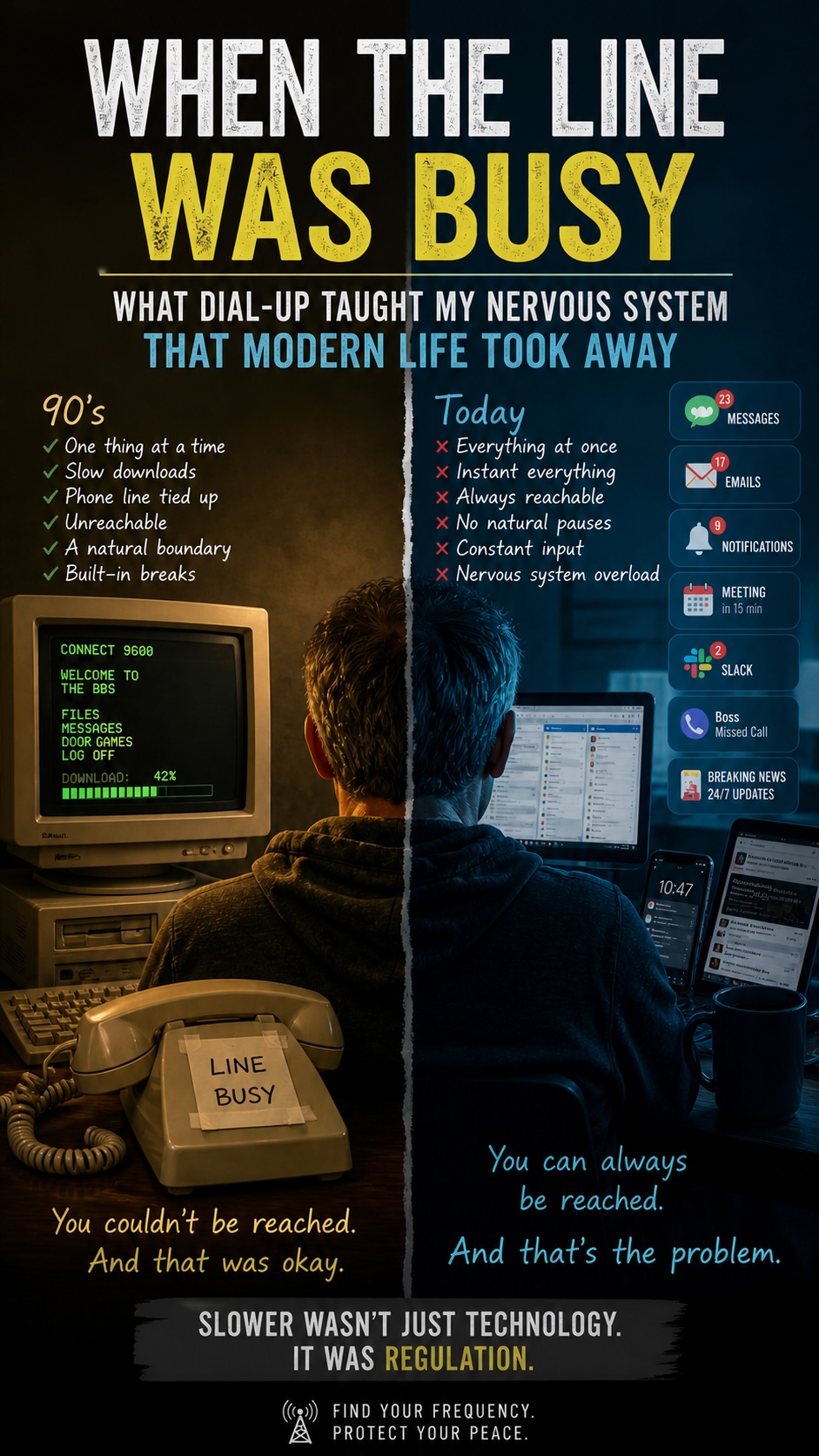
If you were online in the 90s, you remember it. That screech of the modem. The slow crawl of a download. Logging into a BBS or early internet connection and committing to one thing at a time.
And most importantly?
Your phone line was tied up.
No calls. No interruptions. No one could reach you.
You didn’t have to explain it. You didn’t have to justify it. You were just… unavailable.
One Thread at a Time
Back then, life forced you into a kind of rhythm that most people today have never experienced.
You did one thing at a time.
One download.
One conversation.
One task.
If you were grabbing a file, that was it. You weren’t scrolling something else. You weren’t answering messages. You weren’t half-working while half-distracted.
You waited.
And without realizing it, your nervous system waited with you.
The World Changed—Our Wiring Didn’t
Fast forward to now.
You can be downloading a full OS image while installing a tool to flash it, watching a video about it, answering a text, and getting pinged by work… all at the same time.
No waiting. No pause. No natural stopping point.
Just constant input.
And on the surface, that sounds like progress.
But there’s a cost—especially if you grew up in an environment where your nervous system was already under pressure.
For Those of Us Who Grew Up in Chaos
If you were raised in a narcissistic or emotionally unstable home, you didn’t get to develop a calm baseline.
You learned something else instead.
You learned to scan.
To anticipate.
To stay ready.
To be available.
Because being unavailable wasn’t safe.
So your system adapted.
It became efficient at detecting changes, moods, shifts in tone. It learned to stay “on.”
That wasn’t a flaw.
That was survival.
Then We Plugged That System Into a 24/7 World
Here’s the part that doesn’t get talked about enough.
We took a generation that was already wired for hyper-awareness…
and dropped it into a world that never stops demanding attention.
Today, there is no built-in “off.”
Your phone is always on.
Messages always come through.
Work can reach you anytime.
The world has constant access.
And not only are you reachable…
You’re expected to be.
What We Lost When the Line Was Busy
That dial-up connection did more than give us internet access.
It created a boundary.
A real, physical, system-level boundary that said:
“You cannot be reached right now.”
Think about that for a second.
For a nervous system that was always scanning for the next demand, the next interruption, the next emotional shift…
That was relief.
Not something you had to ask for.
Not something you had to defend.
It was built in.
Now We Have to Build It Ourselves
That’s the shift.
What used to happen automatically now has to be done intentionally.
And if you’re an Adult Child of a Narcissist, that’s not a small ask.
Because setting boundaries was never something you were taught to do safely.
Turning off your phone can feel wrong.
Not responding right away can feel unsafe.
Silence can feel like something bad is about to happen.
So instead?
We stay on.
We stay available.
We keep the system running… until it overloads.
“Gasket-Blowing” Isn’t Random
When it feels like everything suddenly becomes too much…
It’s not random.
It’s a nervous system that never got a break finally hitting its limit.
Not because you’re weak.
But because the environment removed the natural pauses that used to exist.
Why Old Interests Come Back
There’s a reason so many of us start circling back to older hobbies.
Things like radio. Tinkering. Building. Listening.
They’re slower.
They’re focused.
They don’t demand ten things from you at once.
They give your attention somewhere to land… without pulling it in ten different directions.
That’s not regression.
That’s regulation.
We Can’t Go Back—But We Can Learn From It
We’re not going back to dial-up.
But maybe there’s something we need to bring forward from that era.
The idea that being unreachable isn’t neglect.
It’s necessary.
That doing one thing at a time isn’t inefficient.
It’s stabilizing.
That silence isn’t dangerous.
It can be where healing starts.
Final Thoughts
Back then, the system only let us process one thing at a time.
Today, the world expects us to process everything at once.
And for those of us who were already overwhelmed as kids…
Learning how to slow life back down isn’t weakness.
It’s necessary.