There’s a moment in recovery that nobody really prepares you for. It’s not the anger, and it’s not the grief. It’s not even the relief. It’s something quieter than that—the moment you catch yourself thinking, “Wait… I used to love this.”
And it doesn’t show up as a memory.
It shows up as a signal.
Faint at first. Easy to miss if you’re not paying attention.
When Something Old Starts Calling You Back
For me, that signal came back in the form of HAM radio. And here’s the part that made me stop and really look at it: I’m 51 years old, and I’m finally sitting for my license exam on May 12th.
That’s not a small thing when you really think about it.
Because this isn’t something new. This is something that’s been broadcasting in the background of my life for decades—I just couldn’t hear it clearly.
How Trauma Drowns Out Your Identity
When you grow up in a toxic environment, especially in a narcissistic family system, your internal world starts to sound a lot like a badly tuned radio. There’s noise everywhere—static, interference, signals overlapping each other. You don’t get silence. You get confusion.
And over time, you adapt to that.
You start scanning constantly, trying to find something stable. You learn to pick up on the smallest changes in tone, mood, and energy, because that’s what keeps you safe.
That’s hypervigilance. It’s like living your life with the dial constantly moving, trying to lock onto something that won’t suddenly turn on you.
But there’s a cost to that.
When you’re always scanning for external signals, you lose your own—not because it’s gone, but because it’s buried under the noise.
Interests get pushed aside. Curiosity gets filtered. The things that light you up slowly fade into the background, drowned out by what’s expected, what’s allowed, and what feels safest.
Sometimes you’re told directly that something isn’t worth your time.
Other times, you just learn it, without anyone saying a word.
You learn that being fully yourself creates interference, so you turn the squelch up, and the volume down.
That’s survival.
And it works—until it doesn’t.
Why Healing Feels Like Tuning a Signal
Eventually, something changes.
Maybe it’s going No Contact. Maybe it’s distance, or therapy, or just enough healing that your nervous system finally starts to settle.
And for the first time, the static begins to fade.
It doesn’t disappear overnight, but the noise gets lighter. The interference drops just enough that something else starts to come through.
If you’re paying attention, you notice it.
A signal.
Weak at first, but consistent.
And this is where something else clicked for me.
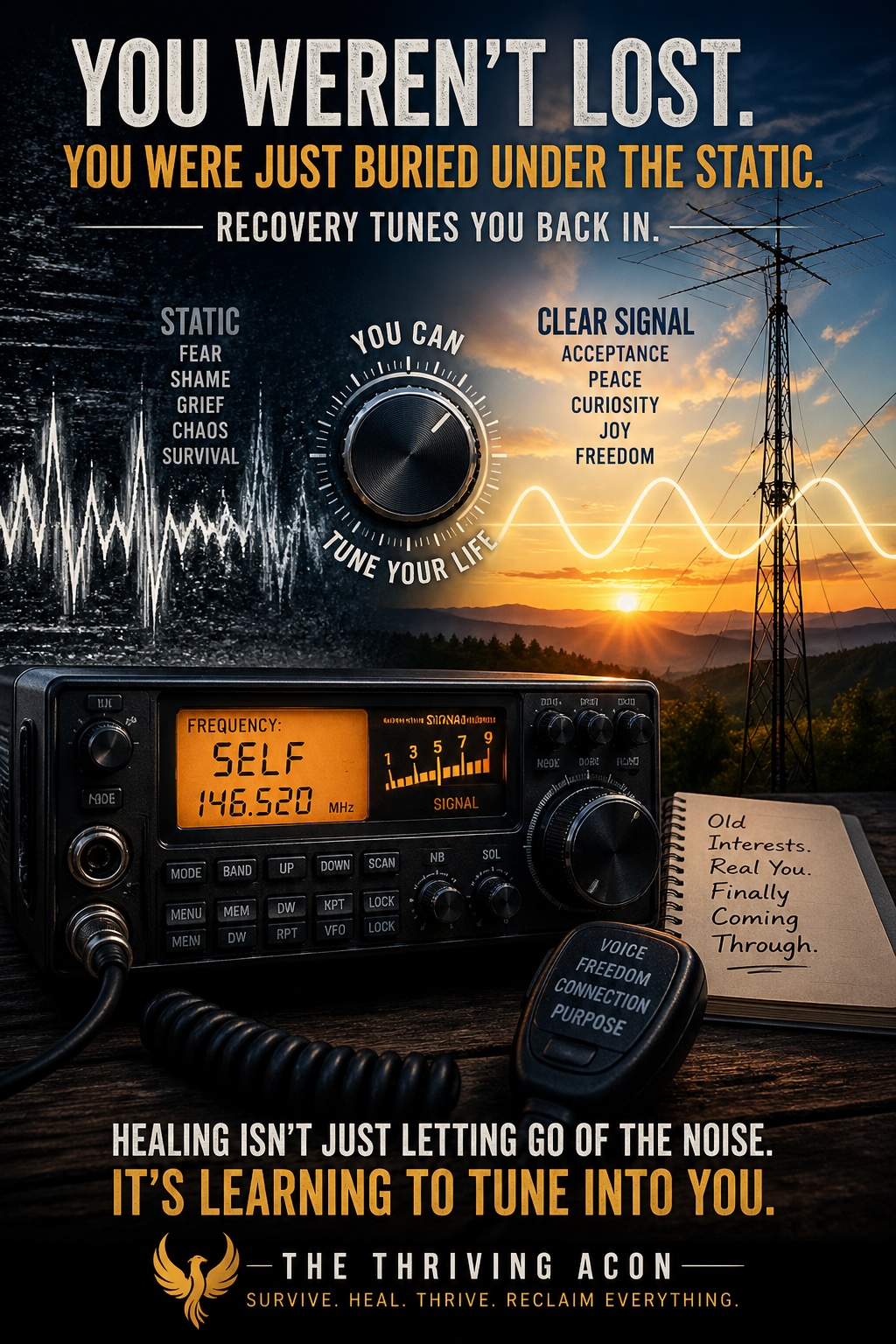
There’s a concept in recovery work—sometimes called an emotional frequency chart—that maps out different emotional states almost like levels. At the low end, you’ve got things like fear, shame, and grief. At the higher end, you move into acceptance, peace, curiosity, even joy.
What struck me is how much that mirrors radio itself.
Lower emotional states feel like trying to receive a signal buried in static. Everything is noisy, distorted, and hard to make sense of.
As you heal, it’s not that life suddenly becomes perfect. It’s that the signal gets clearer. You’re operating on a different “band,” where there’s less interference, less distortion, and more clarity.
And once you experience that shift, even briefly, you can’t un-hear it.
That’s what this has felt like for me.
Sitting here at 51, studying for a HAM radio exam, I can’t ignore the irony. I spent years surrounded by noise I didn’t choose, and now I’m learning how to tune into signals on purpose.
Because that’s what healing actually is.
It’s not just feeling better—it’s learning how to tune your life differently.
You’re Not Behind—You Were Blocked
Those old interests aren’t random.
They’re not nostalgia, and they’re not you trying to go backward.
They’re signals that were always there, finally coming through clearly.
In fact, what many people experience as old interests returning after trauma is really a sign that something deeper is happening—your identity is no longer being suppressed.
And here’s the part I’ve had to make peace with:
I couldn’t have done this sooner.
Not because I wasn’t capable.
Because I didn’t have a clear channel.
We tend to look at our lives in terms of delay. We tell ourselves we’re behind, that we missed it, that we should have done this years ago.
But when your entire system was flooded with interference, there was nothing to tune into.
So if something from your past has been showing up lately—if there’s something you “used to love” that keeps coming back around—don’t ignore it.
Don’t write it off.
Tune into that signal.
Try listening a little closer.
It might be faint.
But if it’s still there after everything you’ve been through, it’s probably real.
Some parts of you didn’t disappear.
They were just buried under the static, waiting for you to finally tune back in.