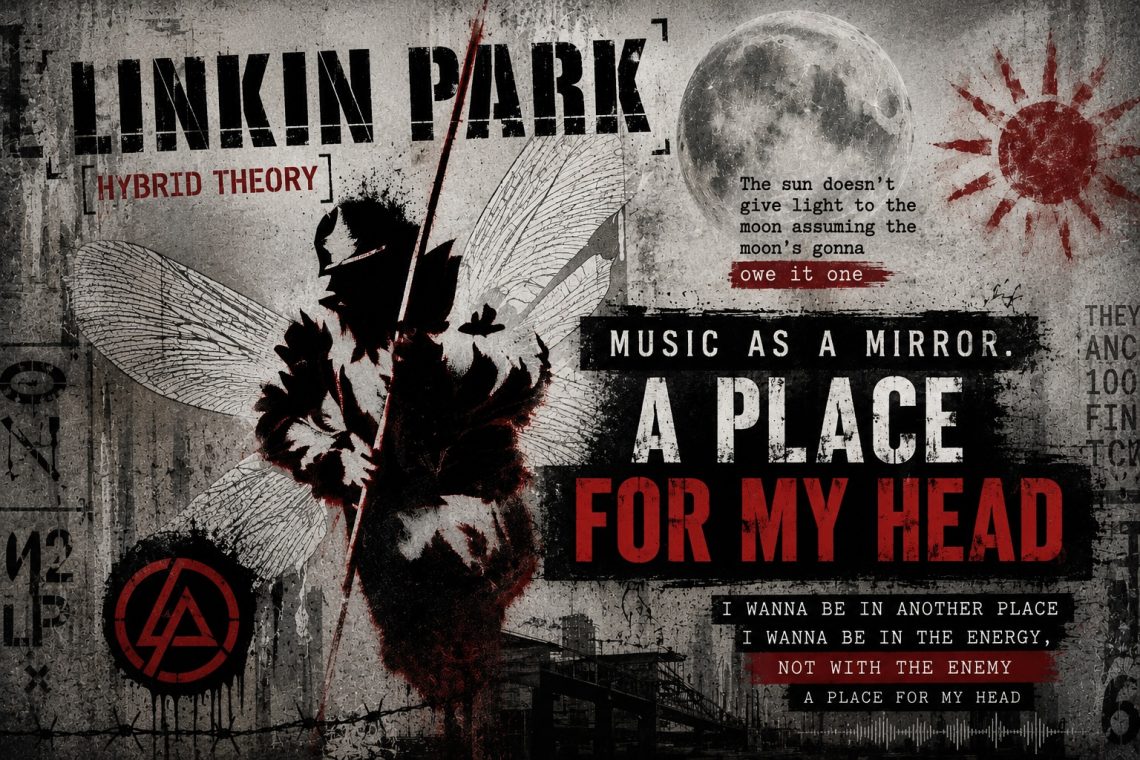
There are some songs you don’t fully understand until trauma recovery forces you to revisit them with older eyes.
A Place for My Head by Linkin Park is one of those songs for me.
Back when Hybrid Theory first exploded onto the scene, most of us connected to the raw anger of it. The distortion. The screaming. The emotional intensity. For a lot of Gen X and older Millennial kids carrying invisible wounds, Linkin Park felt like emotional truth finally escaping the speakers.
But trauma recovery changes the way you hear music.
Especially once you begin understanding concepts like emotional enmeshment, conditional love, covert narcissism, cPTSD, and nervous-system survival patterns.
Because suddenly, songs that once sounded like “anger” reveal themselves as something much deeper:
Exhaustion.
The exhaustion of trying to survive relationships built on emotional debt.
And honestly?
“A Place for My Head” may be one of the clearest emotional snapshots of that experience ever written.
The Moon and the Sun: Conditional Love in Four Lines
That opening verse still hits me like a freight train:
“I watch how the moon sits in the sky in the dark night
Shining with the light from the sun
And the sun doesn’t give light to the moon assuming
The moon’s gonna owe it one”
Those four lines alone, perfectly capture the difference between healthy love and transactional love.
Healthy love gives because it wants to give.
Toxic love gives while quietly opening a ledger.
That distinction is life-changing once you finally see it.
For many Adult Children of Narcissists, “help” often came attached to invisible contracts:
- obedience
- loyalty
- emotional compliance
- guilt
- silence
- access
- control
The favor was never free.
The kindness was never unconditional.
And the moment you stopped performing gratitude correctly — or started developing boundaries, independence, or your own identity — the emotional invoices arrived.
That’s why so many trauma survivors struggle with guilt even when they’ve done nothing objectively wrong.
We were conditioned to believe love had to be earned continuously.
And worse:
that receiving care meant we now owed ourselves back in return.
“You Do Favors… Then Ask for Things Back”
Mike Shinoda follows the opening metaphor with lines that feel painfully familiar to anyone raised inside emotionally manipulative systems:
“It makes me think of how you act for me,
You do favors then rapidly,
You just turn around and start asking me,
About things that you want back from me.”
That isn’t generosity.
That’s leverage.
One of the hardest realizations in trauma recovery is recognizing that some people don’t help because they genuinely care.
They help because helping creates future control.
And that realization is deeply destabilizing for survivors because externally, these relationships often look loving.
Other people see:
- the gifts
- the support
- the sacrifices
- the “good parent”
- the “helpful family member”
But internally, the child feels owned.
Emotionally indebted.
Like their existence itself requires repayment.
That creates an incredibly confusing nervous-system experience because the survivor learns to associate “love” with obligation, tension, guilt, and hypervigilance.
Which is why this line cuts so deeply:
“I’m so sick of the tension, sick of the hunger,
Sick of you acting like I owe you this,
Find another place to feed your greed,
While I find a place to rest”
That line isn’t rebellion.
It’s awakening.
The Moment the Nervous System Hits the Wall
One thing I think people outside trauma recovery misunderstand about No Contact is this:
Most survivors do not walk away because they want to.
They walk away because eventually their nervous system can no longer survive the environment.
There’s a huge difference.
By the time many survivors choose No Contact, they’ve usually spent years — sometimes decades — trying:
- explaining
- minimizing
- forgiving
- rationalizing
- over-functioning
- appeasing
- shrinking themselves
- managing everyone else’s emotions
- hoping things will improve
And eventually the body says:
“No more.”
That’s what this song sounds like to me now.
Not rage.
Collapse.
The kind of emotional exhaustion where your soul finally realizes:
“I cannot heal inside the environment that keeps harming me.”
Which makes the chorus devastatingly accurate:
“I wanna be in another place
I hate when you say you don’t understand
I wanna be in the energy,
Not with the enemy
A place for my head”
That isn’t just about wanting distance from a toxic person.
It’s about wanting psychological safety.
A place where your nervous system can finally stop preparing for impact.
For trauma survivors, “a place for my head” can mean:
- the first peaceful apartment
- the first quiet holiday
- the first phone call you don’t dread
- the first week without emotional chaos
- the first relationship where you don’t feel monitored
- the first time silence stops feeling dangerous
People who grew up in healthy systems often take that feeling for granted.
Survivors know how sacred it actually is.
“Maybe Someday I’ll Be Just Like You”
There’s another line in this song that hits differently once you understand trauma patterns:
“Maybe someday I’ll be just like you
And step on people like you do”
That fear lives in a lot of survivors.
Especially Adult Children of Narcissists.
Because when manipulation, guilt, emotional scorekeeping, rage, or conditional love were normalized during childhood, survivors often become hyper-aware of their own behavior as adults.
Sometimes painfully so.
We second-guess ourselves constantly:
- “Am I selfish?”
- “Am I manipulative?”
- “Am I becoming them?”
- “Did I overreact?”
- “Am I the toxic one?”
But here’s the important distinction:
Narcissists rarely sit awake terrified of becoming narcissists.
Empathetic survivors do.
The very fact that you deeply examine your behavior, your impact on others, and your own healing is often evidence that you are actively trying not to repeat the damage.
And that matters.
“You Try to Take the Best of Me”
By the end of the song, Chester Bennington’s vocals stop sounding like anger to me.
They sound like boundary enforcement finally reaching critical mass.
“You try to take the best of me
Go away”
There comes a point in recovery where survivors simply run out of polite language for chronic harm.
Not because they’re cruel.
Because they’re depleted.
Because trauma survivors are often taught to endlessly explain, justify, soften, and cushion their pain for the comfort of the people hurting them.
Eventually, some survivors reach a point where the boundary becomes incredibly simple:
“Stay away from me.”
Not out of hatred.
Out of self-preservation.
And honestly?
That can be one of the healthiest moments in recovery.
Why Linkin Park Still Resonates So Deeply
A lot of people dismiss early Linkin Park as “angsty teenager music.”
I don’t think that’s true at all.
I think millions of trauma survivors connected to something emotionally real before they had the vocabulary to explain it.
Before we knew words like:
- gaslighting
- enmeshment
- dysregulation
- hypervigilance
- emotional neglect
- trauma bonding
- cPTSD
We just knew:
“Something feels wrong.”
“Something feels unsafe.”
“Something inside me is exhausted.”
And somehow these songs understood that feeling.
That’s why so many of us still revisit Hybrid Theory decades later.
Not because we’re stuck in the past.
But because these songs captured emotional truths we hadn’t fully uncovered yet.
Final Thoughts
What strikes me most now about “A Place for My Head” is that underneath all the intensity… the song is actually about rest.
About finally wanting peace more than approval.
About recognizing that survival mode is not the same thing as living.
About realizing you cannot build a healthy identity inside relationships that constantly demand pieces of your humanity as payment.
And maybe that’s why this song still matters so much for trauma survivors.
Because eventually healing stops being about convincing unsafe people to understand you.
And starts becoming about finding environments where your mind, body, and soul no longer have to fight so hard just to exist.
Sometimes recovery really is that simple.
Finding a place for your head.