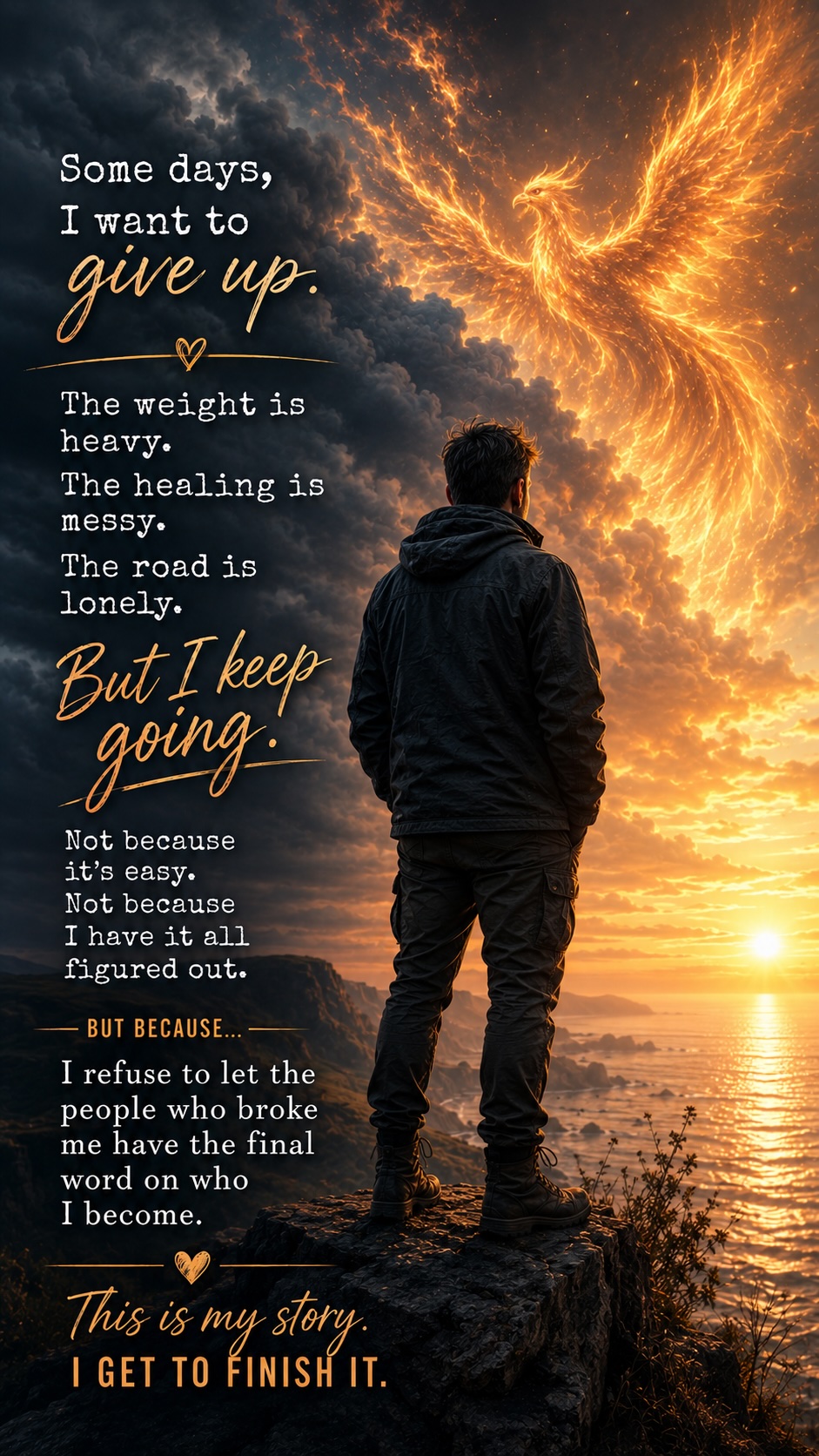
One of the hardest parts of unmasking a narcissistic parent and going No Contact is realizing that freedom does not immediately feel like peace.
Sometimes it feels like collapse.
People on the outside often imagine No Contact as some dramatic mic-drop moment where the survivor finally breaks free and instantly starts thriving. But many of us know the truth is far messier than that.
Sometimes the unmasking feels less like liberation and more like surviving a psychological earthquake.
Because when the illusion finally breaks… everything attached to that illusion breaks, too.
Your memories.
Your identity.
Your understanding of your childhood.
Your sense of safety.
Your nervous system.
Your ability to trust yourself.
Even your vision of the future.
And what makes it especially brutal is this:
Even if the family dynamic was toxic…
even if the abuse was covert…
even if you were constantly walking on eggshells…
…it was still the only emotional reality you had ever known.
So when you finally step away from it, your nervous system doesn’t always celebrate.
Sometimes it panics.
Sometimes it grieves.
Sometimes it feels like you’ve been emotionally dropped into deep water without knowing how to swim.
I think that’s the part many survivors are ashamed to admit.
The exhaustion.
The depression.
The emotional numbness.
The moments where you quietly think:
“What’s the point of any of this?”
And if I’m being truthful, I’ve had those thoughts, too.
Not because I want my life to end.
But because trauma this deep changes your relationship with hope for a while.
Especially after the unmasking.
Especially after realizing the people who were supposed to protect you were often the very people shaping your self-doubt, hypervigilance, guilt, fear, and emotional exhaustion from the beginning.
That realization changes a person.
It changes you at the cellular level.
And yet…
At the exact same time I’ve wrestled with those feelings, I’ve also noticed something else inside me:
A fierce determination to not let my narcissistic mother have the final word on how my story ends.
That part surprised me.
Because despite all the exhaustion…
despite the grief…
despite the moments where I’ve wanted to disappear from the world for a while…
there is still something in me that refuses to fully surrender.
Not out of revenge.
Not out of hatred.
But out of reclamation.
Because I think many Adult Children of Narcissists eventually realize something painful:
We were trained to abandon ourselves.
Trained to stay quiet.
Trained to minimize our pain.
Trained to suppress our needs.
Trained to carry emotional burdens that were never ours to carry.
Trained to believe our worth depended on how useful, compliant, invisible, or emotionally manageable we were to other people.
So choosing to keep going after the unmasking becomes more than survival.
It becomes an act of defiance.
Every healthy boundary.
Every honest conversation.
Every new hobby rediscovered.
Every peaceful moment.
Every therapy session.
Every song that helps you process grief.
Every day you refuse to return to dysfunction just to make other people comfortable…
…it matters.
More than most people realize.
Because healing after narcissistic abuse is not just about “moving on.”
It’s about slowly learning that your life actually belongs to you.
And honestly?
That realization can feel terrifying before it feels freeing.
For many of us, predictable chaos felt safer than unfamiliar peace.
We knew how to survive emotional instability.
We knew how to anticipate moods.
We knew how to shrink ourselves to avoid conflict.
But building an authentic life after all that?
That’s unfamiliar territory.
And unfamiliar territory is exhausting for a trauma-built nervous system.
That’s why survivors often feel frustrated with themselves years into recovery.
They think:
“Why am I still anxious?”
“Why am I still depressed sometimes?”
“Why am I still grieving this?”
Because this wasn’t just a bad relationship.
This was your developmental foundation.
You aren’t just recovering from isolated moments.
You’re recovering from years — sometimes decades — of emotional conditioning.
That takes time.
A lot more time than most people understand.
And maybe that’s why I wanted to write this today.
Because I know I’m not the only survivor who has found themselves caught between exhaustion and determination.
Between grief and growth.
Between wanting to disappear…
and wanting to finally live.
If that’s where you are right now, I want you to know something:
The fact that you’re tired does not mean you’re failing.
The fact that you’re struggling does not mean No Contact was the wrong decision.
And the fact that part of you still wants a meaningful life after all this?
That matters.
Deeply.
Sometimes healing isn’t loud.
Sometimes it doesn’t look inspiring.
Sometimes it’s just waking up another day and quietly deciding:
“They don’t get to decide who I become.”
And honestly?
For some of us, that decision is the first real act of self-love we’ve ever known.