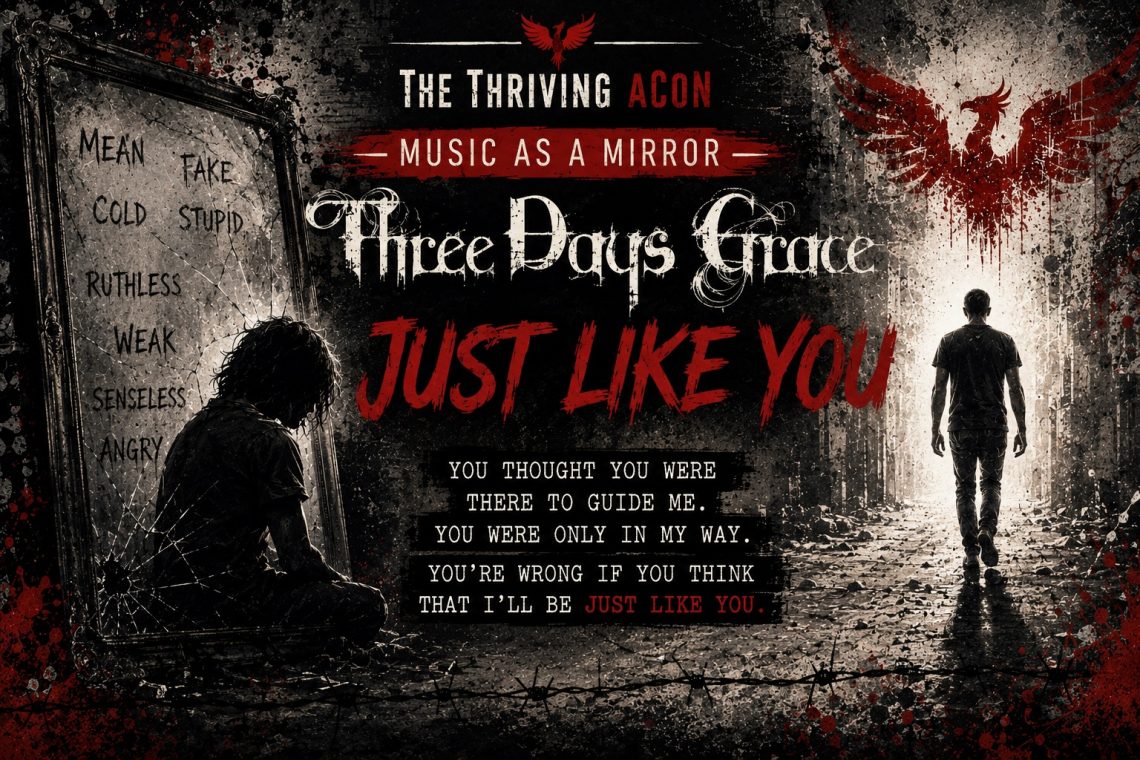
There’s a particular fear that follows many survivors of narcissistic or emotionally abusive parents into adulthood:
What if I become just like them?
We recognize their anger in our own temper.
We hear their sharpness in something we say during an argument.
We catch ourselves becoming cold, defensive, controlling, or emotionally unavailable—and suddenly, the fear takes over.
Maybe they got inside us more deeply than we realized.
Maybe the damage became part of our personality.
Maybe, despite everything we’ve done to escape them, we’re simply destined to repeat them.
That’s the tension running through “Just Like You” by Three Days Grace.
The song doesn’t pretend the singer is incapable of cruelty, anger, weakness, or emotional distance. In fact, it acknowledges the opposite.
I could be those things.
I could become cold.
I could become ruthless.
I could act exactly like the person who hurt me.
That possibility exists.
But possibility is not destiny.
The Traits We Learned to Survive
Children raised in toxic homes seldom leave them completely untouched.
We learn behaviors.
We develop defenses.
We adapt to whatever emotional environment is necessary to survive.
Some of us learn to become quiet and invisible.
Some learn to fight.
Some learn to lie because telling the truth is dangerous.
Some become hyper-independent because asking for help always came with strings attached.
Some become emotionally numb because feeling everything would have been unbearable.
Others become angry because anger was the only emotion strong enough to protect the wounded child underneath it.
These responses don’t mean we’re inherently bad people.
They mean we adapted.
The problem comes when survival behaviors outlive the danger that created them.
The guardedness that once protected us can become isolation.
The anger that once defended us can spill onto innocent people.
The independence that kept us alive can make intimacy feel threatening.
The ability to read every shift in someone’s mood can become constant hypervigilance.
We may have learned these patterns from them.
But learning a behavior is not the same as becoming the person who taught it to us.
“You Thought You Were There to Guide Me”
Toxic parents often rewrite obstruction as guidance.
They say they were only trying to help.
They were protecting us.
They knew what was best.
They were preparing us for the real world.
But what they called guidance often felt more like control.
They didn’t teach us how to trust ourselves. They taught us to doubt ourselves.
They didn’t help us discover who we were. They told us who we were allowed to be.
They didn’t stand beside us while we learned to walk. They positioned themselves between us and the direction we wanted to go.
Then, when we struggled, they pointed to the struggle as evidence that we needed them.
That’s one of the most powerful ideas reflected in the song:
Someone can genuinely believe they were guiding you while spending years standing in your way.
Their intentions—real, imagined, or rewritten after the fact—do not erase the impact.
A parent may insist they were helping while repeatedly undermining your confidence.
They may claim they were protecting you while preventing you from developing independence.
They may call it love while demanding obedience, silence, loyalty, and access.
Eventually, healing requires us to stop judging the relationship solely by what they claimed to be doing and begin acknowledging what their behavior actually did.
I Had to Leave to Discover Who I Was
For many survivors, distance is not punishment.
It’s the first environment in which an authentic self can finally develop.
When you spend your life being monitored, criticized, guilted, manipulated, or emotionally managed, you’re rarely given room to discover who you are outside the family system.
You know who you’re expected to be.
The obedient child.
The family fixer.
The scapegoat.
The peacekeeper.
The dependable one.
The difficult one.
The ungrateful one.
The one who absorbs everyone else’s discomfort so nobody has to face the truth.
But who are you when nobody is assigning you a role?
That question can be terrifying.
Freedom can initially feel like isolation because we were trained to experience control as connection.
Being alone may hurt, but sometimes it’s in that solitude that we finally hear our own thoughts without someone else correcting them.
We begin making decisions without first calculating how they will react.
We develop preferences without defending them.
We discover that boundaries are not cruelty.
We learn that saying no does not make us abusive.
We realize that another person’s disappointment is not automatically proof that we’ve done something wrong.
Sometimes we have to leave the environment that shaped us before we can decide which parts of ourselves are truly ours.
The Difference Is Self-Awareness
One of the deepest fears survivors carry is that having harmful traits makes us identical to the people who harmed us.
But there is an important difference.
We question ourselves.
We reflect.
We apologize.
We feel remorse.
We examine our behavior and ask whether we’re hurting someone.
We try to repair the damage when we get it wrong.
A narcissistic parent may use anger as a weapon and then blame everyone else for provoking it.
A survivor may become angry, recognize that the anger caused harm, take responsibility, and work to respond differently next time.
Those are not the same thing.
Self-awareness does not make us perfect.
It simply makes change possible.
The goal of healing is not to become someone who never gets angry, never becomes defensive, never makes mistakes, and never hurts anyone.
That standard would be impossible—and ironically, it would keep us trapped in shame.
The goal is to become someone who notices.
Someone who takes ownership.
Someone who remains willing to grow.
Someone who refuses to make other people pay indefinitely for wounds they did not create.
Breaking the Cycle Is an Active Choice
We often talk about breaking generational cycles as though it happens automatically once we recognize the abuse.
It doesn’t.
Recognition opens the door.
Then the real work begins.
Breaking the cycle means pausing before reacting.
It means learning emotional regulation when nobody taught us how.
It means apologizing to our children without turning the apology into a demand for reassurance.
It means allowing them to disagree with us without interpreting disagreement as betrayal.
It means respecting their boundaries—even when those boundaries bring up our own abandonment wounds.
It means refusing to use fear, obligation, guilt, money, silence, or affection as tools of control.
It means becoming curious about the impact we have on others instead of insisting that our intentions should excuse everything.
Sometimes breaking the cycle means admitting:
I reacted like my parent today.
I used a tone I hated hearing as a child.
I became controlling because I felt afraid.
I shut down because vulnerability felt unsafe.
That admission is not proof that we have failed.
It is often the moment the cycle is interrupted.
They repeated the pattern and called it normal.
We recognize the pattern and choose to work on it.
That difference matters.
“I Could Be Just Like You”—But I Choose Not To Be
The strength of this song is not found in pretending we’re nothing like the people who raised us.
Most of us carry something from them.
A mannerism.
A defense mechanism.
A flash of anger.
A habit of withdrawing.
A tendency to catastrophize, control, criticize, or assume the worst.
Healing is not denying that inheritance.
Healing is deciding what we do with it.
We can acknowledge:
I inherited your anger, but I am learning how to express it without destroying people.
I inherited your fear, but I will not use it to control my children.
I inherited your distrust, but I am learning that safe people exist.
I inherited your emotional distance, but I am practicing vulnerability.
I learned how to survive from you.
Now I am teaching myself how to live.
That may be the ultimate act of defiance for an adult child of a narcissistic parent.
Not revenge.
Not becoming colder.
Not proving we can hurt them as deeply as they hurt us.
But refusing to let their example become our identity.
The Fear Itself Is Evidence
Survivors often need to hear this:
The fact that you’re afraid of becoming like them is usually evidence that you are already moving in a different direction.
You’re paying attention.
You care about your impact.
You’re willing to question your behavior.
You don’t assume that being the parent, the elder, or the wounded person automatically makes you right.
That fear should not be allowed to become another weapon you use against yourself.
You may occasionally sound like them.
You may react like them.
You may recognize pieces of them inside you.
But a trauma response is not an identity.
A learned behavior is not a life sentence.
A mistake is not a personality disorder.
And resemblance is not destiny.
You Still Get to Choose
Our parents may have shaped the first chapters of our lives.
They may have taught us how to fear, hide, fight, appease, or disappear.
They may have stood in our way while insisting they were standing beside us.
They may have expected us to become extensions of themselves.
But they do not get the final word.
We do.
Every boundary we hold is a choice.
Every apology we offer is a choice.
Every time we pause instead of repeating the old reaction is a choice.
Every time we allow our children to become themselves instead of forcing them into a role is a choice.
Every time we choose accountability over defensiveness, connection over control, and healing over denial, we become less like the people who hurt us and more like the people we were always capable of becoming.
I could be angry.
I could be cold.
I could repeat everything that was done to me.
I could be just like you.
But I am not obligated to be.