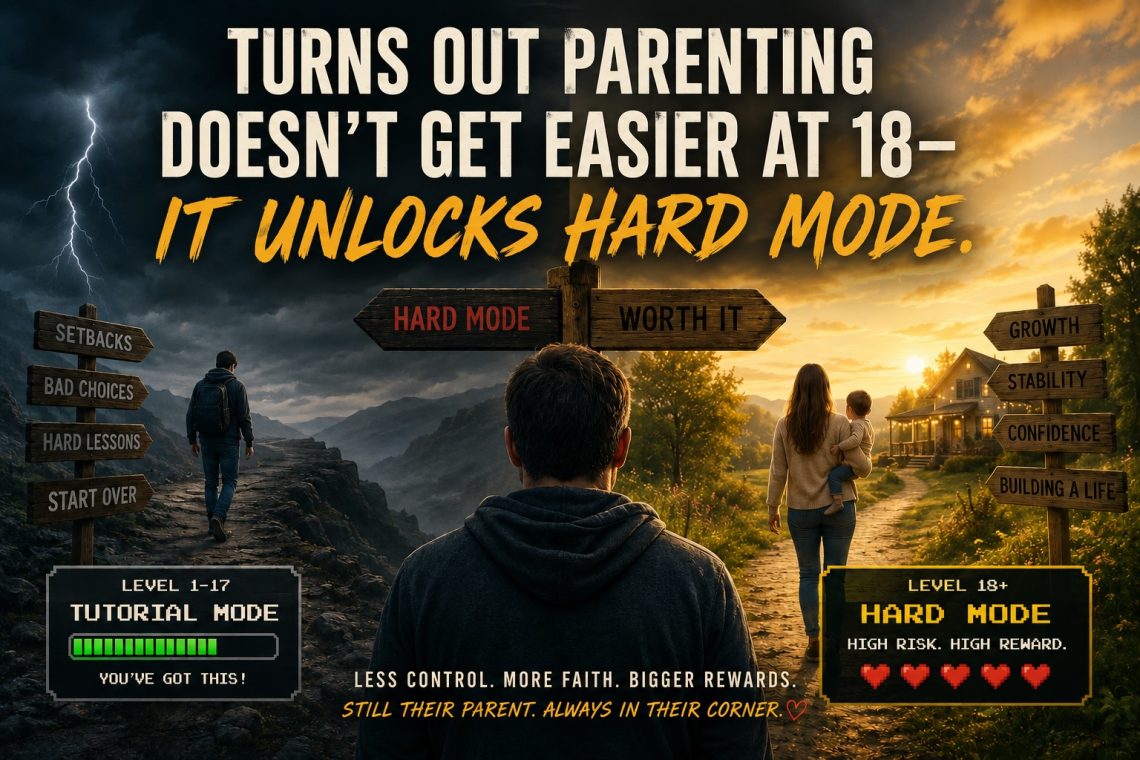
If you’ve ever played a video game, you know how it works.
You spend hours learning the mechanics, figuring out the controls, beating increasingly difficult levels… and just when you think you’ve gotten pretty good at the game…
Congratulations.
Hard Mode unlocked.
That’s parenting.
People always tell you how hard parenting little kids is.
And they’re not wrong.
Keeping toddlers alive is practically a full-time contact sport.
Teenagers? They’re busy testing every rule you’ve ever made while convincing you they already know everything.
Those years are exhausting.
But here’s what nobody told me…
Turns out parenting doesn’t get easier at 18.
It unlocks Hard Mode.
Because once they’re adults, everything changes.
You lose the controller.
You can’t ground them.
You can’t make them go to work.
You can’t stop them from making a decision you know is going to end badly.
You can’t protect them from every consequence, no matter how desperately you want to.
The stakes somehow feel higher than ever…
…and yet you have less control than you’ve ever had.
That’s a difficult combination for any parent.
Over the past couple of years, I’ve found myself experiencing both sides of parenting adult offspring at exactly the same time.
I’ve watched one of my children fight through setbacks, learn difficult lessons, and slowly begin finding solid ground beneath his feet. There have been plenty of moments where every instinct in me wanted to step in and solve the problem for him.
But adulthood doesn’t work that way.
Sometimes the lessons that change us are the ones no parent can shield us from.
At the very same time, I’ve watched my other child build a marriage, become a parent herself, and create the kind of peaceful, stable family every father hopes his children will one day have.
Those two realities have existed side by side.
One has taught me patience.
The other has reminded me why the patience is worth it.
Because every now and then…
Something clicks.
A driver’s license gets earned.
A steady paycheck starts arriving.
Bills begin getting paid.
Confidence slowly replaces chaos.
You start catching glimpses of the adult they’ve been growing into all along.
Those moments don’t erase the sleepless nights or the worry.
They don’t erase the setbacks.
But they remind you that growth almost never happens on your timeline.
It happens on theirs.
And when it finally does…
Those victories feel different.
Not because they’re bigger.
Because you know how hard they were earned.
Ironically, I feel my own healing journey has made me a better parent during this stage of life.
Growing up in an unhealthy family taught me that love often looked like control.
Or guilt.
Or obligation.
Or rescuing people from every consequence of their choices.
Healing taught me something entirely different.
Healthy parenting isn’t measured by whether your adult offspring never struggle.
It’s measured by whether they know they have someone in their corner while they’re learning to stand on their own.
Sometimes the greatest act of love isn’t preventing the fall.
Sometimes it’s refusing to abandon them while they figure out how to get back up.
Maybe that’s what breaking generational cycles really looks like.
Not raising children who never stumble.
But raising adults who know they are deeply loved…
…who are free to make their own choices…
…and who never have to question whether someone believes they’re capable of finding their footing.
So yes…
People say parenting is hard.
I agree.
I just think the difficulty setting quietly changes the day they turn eighteen.
You don’t stop being their parent.
You simply trade control for influence.
You trade fixing for encouraging.
You trade protecting for trusting.
Hard Mode isn’t harder because your children need you more.
It’s harder because they need you differently.
And somehow…
When something finally clicks into place…
When you watch them stand back up after life knocks them down…
When they begin building a life that is truly their own…
Those victories are worth every difficult level that came before.
Maybe Hard Mode isn’t the game’s punishment after all.
Maybe it’s the level where all the lessons you’ve both been learning finally start paying off.