Why Luthen Rael’s Monologue Hits Differently as I Approach Two Years No Contact
August 29 is getting closer.
Two years.
Two years since I went No Contact with my toxic mother. Two years since my son and I pointed ourselves west and left that twisted dysfuction behind. Two years since I finally stopped trying to repair something that could only continue existing if I agreed to keep being damaged by it.
And lately I’ve found myself thinking about one of my favorite monologues from Andor.
If you’ve seen the show, you probably know exactly which one.
Lonni Jung asks Luthen Rael what he has sacrificed.
Luthen’s answer is brutal.
“Calm. Kindness. Kinship. Love.”
Those four words alone hit differently when you’ve survived a dysfunctional family.
Because those are exactly the things we’re told family is supposed to provide.
Calm.
Kindness.
Kinship.
Love.
Yet for many trauma survivors, those things become complicated.
Calm can feel suspicious because you’ve spent years waiting for the next explosion.
Kindness can make you wonder what someone wants from you.
Kinship can become synonymous with obligation.
Love can become something you’re expected to prove through endurance.
And when you finally begin dismantling all of that, you discover something nobody really warns you about:
Leaving the dysfunction doesn’t immediately remove the dysfunction from you.
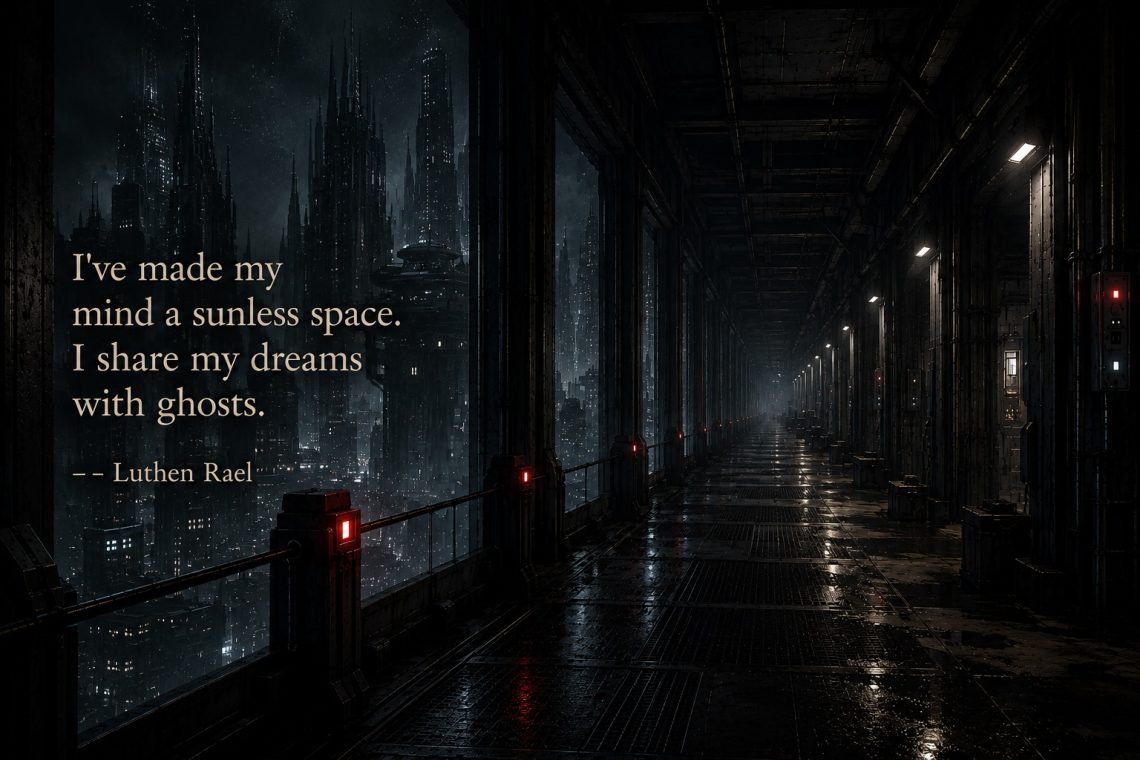
“I’ve made my mind a sunless space. I share my dreams with ghosts.”
That one hurts.
Because there absolutely are ghosts in trauma recovery.
Not necessarily ghosts of people who have died.
Sometimes they’re ghosts of people who never actually existed.
The mother I thought I had.
The childhood I thought I understood.
The family history I believed for most of my life.
The person I thought I was before a DNA test on October 27, 2021 began unraveling things I couldn’t put back together again.
There are ghosts of possibilities, too.
The apology that never came.
The accountability that never happened.
The conversation where everything finally made sense.
The fantasy that somehow, someday, if I found exactly the right words, I could make another person understand what they’d done.
Eventually you realize you’re having conversations in your head with people who aren’t in the room.
You’re explaining yourself to people you’ve stopped speaking to.
You’re defending decisions that don’t require their permission.
You’re grieving relationships that technically never existed, at least not in the sense you thought they did.
You share your dreams with ghosts.
“My anger, my ego, my unwillingness to yield, my eagerness to fight…”
This part requires some uncomfortable honesty.
Because anger kept me alive.
For a long time I thought anger was something I needed to get rid of.
Now I understand it differently.
Anger was the part of me that eventually said:
Enough.
Enough gaslighting.
Enough rewriting history.
Enough obligation disguised as love.
Enough moving the goalposts.
Enough sacrificing myself because somebody else believed being my mother entitled her to unlimited access to me.
And when my son became the target?
That anger became something else entirely.
Papa Bear showed up.
There are times when refusing to yield isn’t stubbornness.
There are times when refusing to yield is finally developing a boundary.
But there’s a cost to living in fight mode.
Your nervous system doesn’t necessarily get the memo when the battle ends.
That’s one of the strangest parts of approaching two years No Contact.
The war can be over while some part of you is still standing guard.
“I yearned to be a savior against injustice without contemplating the cost…”
Trauma survivors know something about trying to save people.
We save parents.
We save siblings.
We save children.
We save relationships.
We save holidays.
We save everyone’s feelings.
We become mediators, rescuers, peacekeepers, providers and emotional shock absorbers.
Sometimes we become incredibly competent adults because competence was how we survived.
And then one day we look down and realize just how much of ourselves we’ve spent keeping everything else standing.
That was one of the hardest realizations for me.
I couldn’t save my mother.
I couldn’t make her tell the truth.
I couldn’t make her take responsibility.
I couldn’t make her understand.
I couldn’t love her into becoming someone capable of giving me what I had spent decades hoping to receive.
There comes a point where trying to save someone becomes participating in your own destruction.
So eventually I stopped.
“What is my sacrifice?”
That’s the question I’ve been sitting with as August 29 approaches.
Because No Contact absolutely required sacrifice.
I sacrificed the possibility—however unrealistic—that someday everything might somehow be fixed.
I sacrificed familiarity.
I sacrificed the role I’d occupied in my family for decades.
I sacrificed the comfort of believing the story I’d been given about my own life.
I sacrificed relationships with people who could only remain comfortable with me as long as I remained in my assigned place.
And perhaps most painfully, I sacrificed hope in a particular outcome.
Not hope itself.
That’s an important distinction.
I stopped hoping she would change.
I started hoping I could.
“I burn my life to make a sunrise that I know I’ll never see.”
This may be the line that hits me hardest.
But it’s also where my story diverges from Luthen’s.
Because I will see some of that sunrise.
In fact, I already have.
My children aren’t required to carry the same family mythology I carried.
My granddaughter entered this world without ever being placed inside that dysfunctional system.
She doesn’t have to unlearn it.
She doesn’t have to spend decades figuring out why something always felt wrong.
She doesn’t have to discover someday that the people who were supposed to protect her were also the people teaching her not to trust her own perception.
That cycle stopped before it reached her.
And if breaking it required me to become the villain in somebody else’s version of the story?
So be it.
Because one of the strangest things about generational healing is that sometimes you’ll never personally experience the childhood you’re trying to create.
I’ll never know what it feels like to grow up without this baggage.
I’ll never know who I would have become if certain things hadn’t happened.
That sunrise isn’t mine.
It’s hers.
And knowing that makes the cost worth paying.
“The ego that started this fight will never have a mirror or an audience or the light of gratitude.”
There’s another lesson buried there for survivors.
You may never be vindicated.
The person who hurt you may never admit what happened.
Some relatives may never understand why you left.
Some people will hear a carefully edited version of the story in which you are cruel, ungrateful, bitter or unforgiving.
There may never be a courtroom where all the evidence is presented and someone pounds a gavel and announces:
Yep. You were right.
Healing eventually requires becoming okay with that.
Because boundaries aren’t court cases.
I don’t need a unanimous verdict.
I don’t need applause.
I don’t need the person I went No Contact with to agree that No Contact was necessary.
And I certainly don’t need gratitude for breaking a cycle that should have been broken generations before it reached me.
The people who benefit most may never completely understand what it cost.
That’s okay.
Maybe that’s part of the job.
“So what do I sacrifice?”
Luthen answers:
“Everything.”
Two years ago, I might have understood that answer differently.
Because when your entire understanding of family collapses, it can absolutely feel like everything.
But approaching two years No Contact, I don’t think everything is my answer anymore.
I sacrificed almost everything I thought I had.
But I didn’t sacrifice everything I actually had.
I didn’t sacrifice my children.
I didn’t sacrifice my granddaughter.
I didn’t sacrifice my sister.
I didn’t sacrifice my ability to love.
I didn’t sacrifice my compassion.
I didn’t sacrifice my future.
And despite some mornings when I still wake up thinking, Ugh. Another day. Really?—I haven’t sacrificed the possibility of peace.
If anything, No Contact finally gave peace a fighting chance.
That’s the difference between Luthen’s sacrifice and mine.
He burns himself to create a sunrise he believes he’ll never see.
I’m still here.
I get to watch the sky change.
Maybe that’s what these approaching anniversaries are really about.
Not celebrating the destruction of a relationship.
Not pretending the last two years have been rainbows, bubblegum and unicorns.
Not claiming I’ve healed everything or reached some magical destination where none of it hurts anymore.
It’s simply looking backward long enough to understand what the decision actually accomplished.
August 29, 2024 wasn’t the day I stopped loving.
It wasn’t the day I stopped caring.
And it wasn’t the day I became bitter.
It was the day I finally decided that love did not require surrendering myself.
It was the day I accepted that No Contact was the final boundary—not the first.
It was the day I stopped trying to create peace with someone else at the expense of peace within myself.
And maybe most importantly:
It was the day I decided my children and granddaughter weren’t going to inherit the night.
Two years later, I’m still learning how to live in the sunrise.
But they already are.