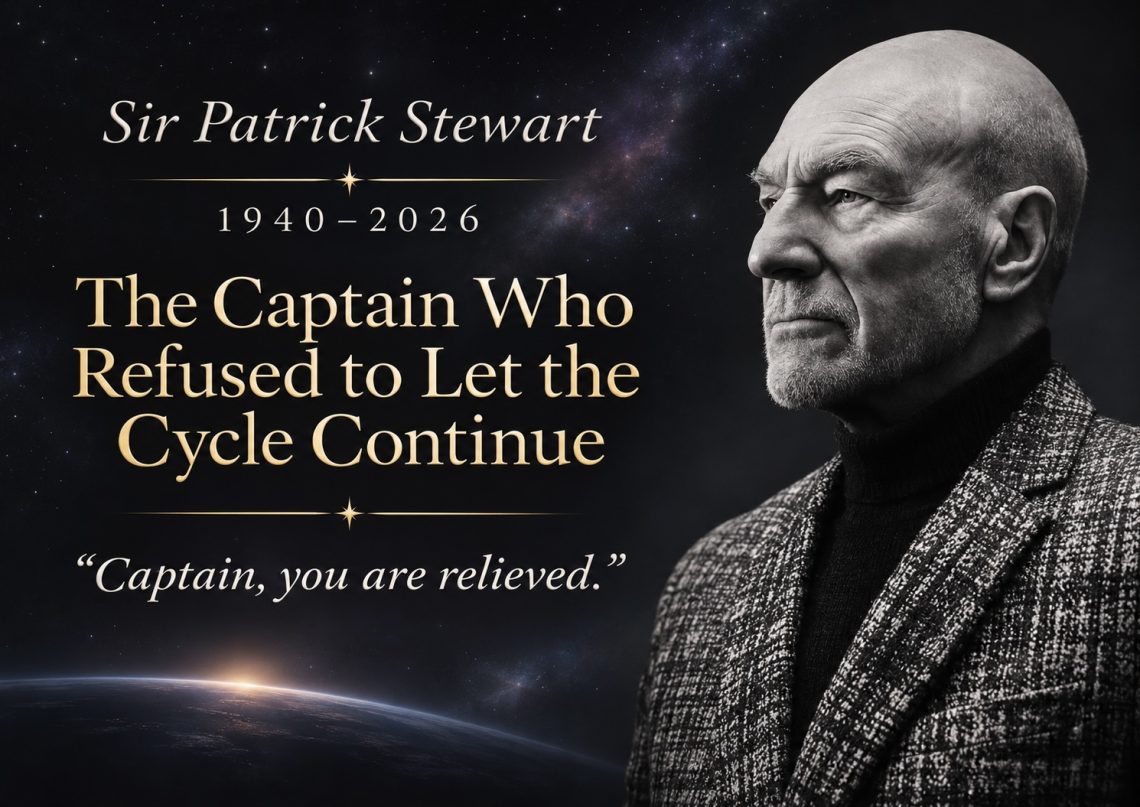
Remembering the man behind Jean-Luc Picard, and a legacy far greater than the bridge of the Enterprise.
There are actors who play heroes.
And then there are actors who remind us that heroism doesn’t require a starship, a uniform, or a particularly impressive collection of Shakespearean monologues.
Sometimes, it simply requires the courage to stand up and say:
What happened in my family was wrong. And I refuse to remain silent about it.
On October 28, 2026, the world lost Sir Patrick Stewart at the age of 86.
For millions of us, especially those of us who grew up watching Star Trek: The Next Generation, he will forever be Captain Jean-Luc Picard.
For others, he was Professor Charles Xavier, the wise and compassionate leader of the X-Men.
But for survivors of domestic violence, childhood trauma, and dysfunctional families, Stewart represented something else entirely.
He was one of us.
And he used his voice to make sure others would be heard.
Before the Enterprise, There Was a Frightened Little Boy
Long before he commanded the USS Enterprise, Patrick Stewart grew up in a household where violence was a recurring reality.
His father, Alfred Stewart, was a decorated British Army veteran whose experiences during World War II left lasting scars.
At home, Alfred was violent toward Patrick’s mother, Gladys.
Young Patrick witnessed the abuse. He learned to recognize the warning signs. He learned to listen for changes in his father’s mood. He even physically placed himself between his parents in attempts to protect his mother.
Think about that for a moment.
A little boy, trying to protect his mother from the very person who was supposed to help keep their family safe.
That’s not childhood.
That’s survival.
And it’s an experience that far too many survivors of dysfunctional families recognize, even when the abuse in their own homes wasn’t physical.
The constant monitoring of moods. The fear of setting someone off. The feeling that somehow, keeping the peace was your responsibility.
The childhood that became an exercise in emotional threat detection.
Sound familiar?
The Silence Was Part of the Abuse
One of the most disturbing aspects of Stewart’s childhood wasn’t simply his father’s violence.
It was how the adults around his family responded.
Police officers, medical professionals, and other authority figures sometimes suggested that his mother must have provoked the violence.
Imagine being a frightened little boy, watching someone hurt your mother, only to hear the supposed grown-ups imply that she was somehow responsible.
The people who should have intervened helped normalize the abuse instead.
And that is something survivors of narcissistic and dysfunctional families understand all too well.
The relatives who knew but said nothing.
The neighbors who looked the other way.
The family members who insisted that everything stay behind closed doors.
The people who seemed more concerned with protecting the family’s reputation than protecting the people being harmed.
Different families. Different circumstances.
Same devastating lesson:
Sometimes the people who enable the abuse leave wounds of their own.
He Understood That Explanation Is Not Excuse
Later in life, Stewart came to understand that his father’s wartime experiences and psychological injuries may have contributed to his behavior.
But he refused to turn that understanding into an excuse.
That distinction matters enormously.
Especially in families where survivors are routinely pressured to excuse harmful behavior because someone else had a difficult childhood.
How many of us have heard some variation of these?
- “That’s just how they were raised.”
- “They had a hard life.”
- “You have to understand what they went through.”
- “They did the best they could.”
Understanding someone’s trauma can help explain their behavior.
It does not erase the damage they caused.
And it certainly doesn’t transfer responsibility for that damage onto the people they hurt.
Your trauma may explain your behavior. It does not give you permission to traumatize someone else.
Stewart understood that distinction, and he carried it into his advocacy.
He Turned His Pain Into a Voice for Others
Stewart could have spent his life keeping his childhood private.
He was internationally famous. Universally recognizable. A celebrated Shakespearean actor with a career spanning decades.
He didn’t owe the public his painful memories.
But he chose to speak.
He supported Amnesty International’s campaign against violence toward women and became a patron of Refuge, a British charity supporting survivors of domestic abuse.
He spoke publicly about his experiences, challenged victim-blaming, supported awareness campaigns, and helped bring attention to the lasting effects of domestic violence on children.
In a 2013 appearance at Comicpalooza, Stewart explained his advocacy with words that reveal just how deeply his childhood remained with him:
“I do what I do in my mother’s name because I couldn’t help her then.”
There is an entire lifetime of grief, love, and determination in that sentence.
He couldn’t change what happened.
He couldn’t go back and protect the little boy he once was.
He couldn’t rewrite his mother’s experiences.
But he could use the voice he had earned to help protect someone else.
And he did.
The Man Behind the Captain
As a lifelong fan of Star Trek: The Next Generation, I always admired Jean-Luc Picard.
Not because he commanded a powerful starship.
Not because he could deliver a speech that made an entire room reconsider its life choices.
Although, let’s face it, the man could make ordering tea sound like a matter of interstellar diplomacy.
I admired Picard because of what he stood for.
Integrity.
Compassion.
Accountability.
The willingness to challenge authority when authority was wrong.
The belief that strength wasn’t measured by how much power you could exercise over someone else, but by how responsibly you used the power you had.
And knowing what Stewart experienced growing up makes his portrayal of Picard even more meaningful to me.
A man who grew up witnessing the misuse of power became famous for portraying a leader who understood the responsibility that came with it.
Then he spent decades demonstrating that same responsibility offscreen.
There is something profoundly beautiful about that.
Breaking the Cycle Doesn’t Mean the Past Disappears
One of the biggest misconceptions about healing from childhood trauma is that eventually we reach some magical point where the past no longer affects us.
As though recovery comes with a factory reset.
Wouldn’t that be nice?
Unfortunately, human beings don’t come with a convenient little button marked Restore Default Settings.
Stewart spoke openly about the lasting emotional effects of his childhood, including anger, shame, and feelings of isolation.
His experiences didn’t simply disappear when he became successful.
Fame didn’t erase them.
Money didn’t erase them.
Worldwide admiration didn’t erase them.
He still had to confront what happened.
And that’s an important message for survivors.
Healing doesn’t necessarily mean forgetting.
It doesn’t mean pretending the damage never occurred.
It means learning how to live differently despite what happened.
It means recognizing the patterns you inherited and deciding which ones end with you.
It means refusing to let someone else’s harmful choices become the blueprint for your own life.
And sometimes, it means using what you’ve learned to help someone else find their way out.
A Legacy Worth Carrying Forward
There will be countless tributes to Sir Patrick Stewart.
People will remember the Shakespearean performances, the commanding voice, the iconic roles, and the extraordinary career.
And they should.
He earned every bit of that admiration.
But here at The Thriving ACoN, I want to remember something else.
I want to remember the little boy who learned to recognize danger in his own home.
The grown man who found the courage to speak about it.
And the advocate who refused to let silence protect the people causing harm.
Because that is a legacy survivors can carry forward.
We may not have Stewart’s fame, his resources, or his extraordinary voice.
But we can speak the truth.
We can challenge the normalization of abuse.
We can refuse to participate in the silence.
We can protect the next generation from the patterns that harmed ours.
And we can remind other survivors that the family they came from does not have to determine the family, relationships, or life they build.
We can’t change where our stories began. But we can decide what we carry into the chapters that follow.
Thank you, Sir Patrick Stewart.
For the stories you told.
For the courage you demonstrated.
For the survivors you stood beside.
And for reminding us that the greatest measure of a person’s character isn’t the authority they command.
It’s what they choose to do with it.
Rest in peace, Captain.
Your watch is over.
The mission continues.
— The Thriving ACoN
Sources and further reading
- Patrick Stewart, The Legacy of Domestic Violence, The Guardian, November 2009.
- The Guardian, It’s a Man’s Problem: Patrick Stewart and the Men Fighting to End Domestic Violence, December 2018.
- The Guardian, His Honesty Gave Courage to Survivors, October 2026.
- Associated Press, obituary of Sir Patrick Stewart, October 2026.