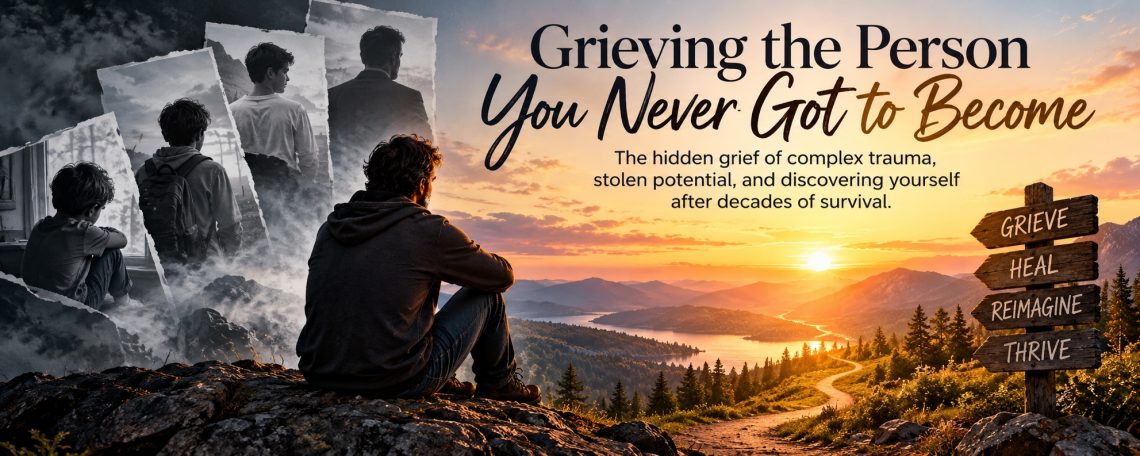
The hidden grief of complex trauma, stolen potential, and discovering yourself after decades of survival.
There’s a particular kind of grief that doesn’t come with a funeral.
Nobody sends flowers. Nobody brings casseroles. Nobody offers condolences.
Hell, most people don’t even recognize it as grief.
It’s the grief of realizing that the person you might have become never really got a fair shot at existing.
Not because you lacked intelligence. Not because you lacked ambition, talent, determination, or potential.
But because, long before you were old enough to understand what was happening, someone else’s dysfunction became the environment in which you were expected to develop.
And instead of learning how to thrive, you learned how to survive.
There’s a difference. A tremendous one.
And for those of us who grew up in narcissistic or otherwise dysfunctional family systems, understanding that difference can fundamentally change how we look at our entire lives.
The Childhood That Wasn’t
Think about what childhood is supposed to provide.
Safety. Encouragement. Exploration. Mistakes without humiliation. Love that doesn’t have to be earned. The freedom to develop your own personality without worrying about how someone else will react to it.
A child raised in a reasonably healthy environment gets to spend much of their energy discovering who they are.
What do I enjoy? What am I good at? What interests me? What kind of person do I want to become?
But a child growing up in a dysfunctional family often has an entirely different set of questions.
What kind of mood is Mom in today?
What did I do wrong this time?
How do I keep everyone happy?
What do I need to hide?
How do I avoid becoming the next target?
Notice something?
Not one of those questions has anything to do with discovering who you are.
They’re all about managing someone else.
And when managing someone else’s emotions becomes your childhood occupation, your own development can take a back seat.
You become exceptionally good at reading a room.
You learn to anticipate conflict before it happens.
You become responsible, accommodating, useful, and perhaps even remarkably independent.
From the outside, people might describe you as mature for your age.
What they don’t necessarily see is the price you paid for that maturity.
You weren’t simply growing up.
You were adapting to an environment in which being yourself didn’t always feel safe.
The Years You Didn’t Know You Were Losing
Here’s where this gets particularly painful.
For many survivors, the realization doesn’t happen during childhood.
It happens decades later.
Maybe you’re 35. Maybe you’re 45. Maybe you’re in your fifties or sixties.
You’ve spent your entire adult life believing that your childhood was relatively normal. Perhaps difficult in places, sure, but nothing especially unusual.
After all, it was the only childhood you knew.
You built a career. Raised children. Had relationships. Paid bills. Made mistakes. Experienced successes and failures.
You did what adults do.
And then something happens.
A revelation. A betrayal. A confrontation. A series of events that finally makes the old explanations impossible to believe.
Suddenly, the story you’ve been telling yourself about your own life starts falling apart.
Things you once dismissed as normal begin looking very different.
The constant criticism.
The guilt.
The emotional manipulation.
The expectation that you would put someone else’s needs ahead of your own.
The way you learned to question your own perceptions.
The feeling that no matter how much you accomplished, it was never quite enough.
And perhaps most painfully, the realization that some of the very characteristics you’ve struggled with throughout adulthood weren’t necessarily inherent flaws.
They may have been adaptations to the environment in which you were raised.
That’s an extraordinary thing to discover halfway through your life.
And it’s not always a pleasant discovery.
Because once you understand what happened, another question inevitably follows.
Who might I have become if it hadn’t?
The Ghost of the Person You Could Have Been
This is the part that can really knock the wind out of you.
You start looking backward.
Not necessarily with regret over every decision, but with a growing awareness that you weren’t always making those decisions from a place of freedom.
Maybe you avoided opportunities because failure felt dangerous.
Maybe you stayed in relationships far longer than you should have because you were conditioned to tolerate mistreatment.
Maybe you became so skilled at taking care of everyone else that you never learned how to prioritize yourself.
Maybe you spent decades chasing approval from people who were never going to give it.
Or maybe you built an entire professional identity around being the person who could fix everything, handle every crisis, and absorb everyone else’s problems.
Sound familiar?
Those abilities can be genuinely valuable.
But there’s a difference between choosing to become the dependable person and believing, somewhere deep inside, that your worth depends on being indispensable.
And sometimes the most unsettling realization is that the life you built may have been shaped as much by what you were trying to avoid as by what you actually wanted.
That’s where the grief lives.
In the opportunities you never explored.
The confidence you never developed.
The relationships you might have approached differently.
The creative interests you never pursued.
The peace you didn’t know was possible.
And perhaps most of all, the years you spent believing there was something fundamentally wrong with you.
You weren’t given the same starting line. Yet you spent years judging yourself as though you had been.
When the Truth Finally Arrives
I know something about discovering the truth later in life.
In my own case, the unraveling began with a revelation about my biological identity in 2021.
That discovery eventually led to a much larger reckoning with my family history, culminating in what I’ve come to call the Mom-pocalypse in 2024.
And I can tell you something about having your understanding of your own life fundamentally rewritten in your late forties.
It’s one hell of an experience.
Because you’re not simply learning new information.
You’re revisiting decades of memories with an entirely different understanding of the people and dynamics involved.
Things that never quite made sense suddenly do.
Behavior you once excused becomes harder to excuse.
And the person you believed yourself to be starts looking less like a collection of inexplicable shortcomings and more like someone who spent an extraordinary amount of energy adapting to circumstances he didn’t create.
There is relief in that realization.
But there’s also anger.
And sadness.
And a very legitimate sense of loss.
Because understanding why you struggled doesn’t erase the struggles.
Knowing that certain patterns were learned doesn’t automatically undo them.
And recognizing that you deserved better doesn’t give you back the years in which you didn’t receive it.
Clarity is a gift. But sometimes it arrives carrying a bill for everything that came before it.
The Grief Nobody Sees
One of the strangest aspects of this experience is that the world doesn’t necessarily recognize what you’re mourning.
You’re not grieving someone who died.
You’re grieving possibilities.
A childhood that might have been different.
A younger version of yourself who might have felt safe enough to take risks.
An adulthood that might have involved less fear, less guilt, less self-doubt, and fewer years spent trying to earn something that should never have been conditional in the first place.
How do you explain that to someone who hasn’t experienced it?
How do you explain that you can be grateful for the life you have while simultaneously mourning the life you might have had?
How do you explain that you love your children, value your accomplishments, and appreciate the people you’ve met, yet still feel sorrow over the circumstances that shaped your journey?
The answer is that these feelings aren’t mutually exclusive.
You can love the person you’ve become and still grieve what it cost you to become that person.
You can be proud of surviving without being grateful for what you survived.
You can appreciate the strengths you developed without pretending the suffering that helped produce them was necessary.
And you can acknowledge that your life has contained wonderful things without minimizing the damage done along the way.
That’s not self-pity.
That’s allowing yourself to recognize the full truth of your experience.
The Second Loss: Discovering That Survival Mode Followed You Into Adulthood
Here’s something I wish more people understood about complex trauma.
Leaving the environment doesn’t necessarily mean leaving the adaptations behind.
You can move across the country.
You can end relationships.
You can establish boundaries.
You can go No Contact.
And you can still find yourself responding to ordinary situations as though you’re back in the environment that taught you to survive.
For some people, this looks like hypervigilance.
For others, people-pleasing, perfectionism, difficulty relaxing, or feeling disproportionately responsible for things beyond their control.
Sometimes it’s an intense reaction to interruptions, criticism, or situations where you feel powerless.
Sometimes it’s the inability to enjoy an accomplishment because your mind has already moved on to the next potential problem.
And sometimes it’s realizing that you’ve spent so much of your life responding to other people’s emergencies that you barely know what it feels like to pursue something entirely for yourself.
That last one deserves particular attention.
Because when you’ve spent decades being useful, being needed, being responsible, and being available, the simple act of asking “What do I want?” can feel almost foreign.
Not because you don’t have desires.
But because you’ve had so little practice treating them as important.
And there’s another layer of grief in recognizing that.
You may have escaped the original environment years ago.
Yet parts of your life can still be organized around the rules you learned there.
Physical freedom and psychological freedom don’t always arrive on the same day.
The Anger That Comes With Understanding
Let’s talk about anger.
Because I don’t think we do survivors any favors by pretending that healing is always peaceful, gentle, and full of inspirational quotes.
Sometimes healing involves getting absolutely furious.
Furious that the adults responsible for protecting you failed to do so.
Furious that your needs were treated as inconveniences.
Furious that you spent years blaming yourself for patterns you never consciously chose.
Furious that the people who contributed to the damage may never acknowledge it.
And furious that you’re now responsible for doing the work of healing wounds you didn’t create.
That last part can be especially difficult.
Because it feels profoundly unfair.
And frankly, it is unfair.
You didn’t choose the circumstances.
You didn’t write the rules.
You didn’t create the dysfunction.
Yet you’re the one left trying to untangle the consequences.
Anger in response to that realization isn’t automatically unhealthy. It can be an understandable response to recognizing that your boundaries were violated and your needs went unmet.
What matters is what happens next.
Because while anger can help us recognize what was wrong, we also deserve a life that isn’t permanently organized around the people who hurt us.
They’ve already occupied enough of our time.
But What About the Person I Am Now?
There’s an important distinction I want to make here.
When we talk about lost potential, it’s easy to imagine some perfect alternate version of ourselves.
The successful entrepreneur.
The confident artist.
The emotionally secure partner.
The person who never struggled with anxiety, self-doubt, or trauma responses.
But we need to be careful.
That imaginary person isn’t someone we can actually know.
We can’t prove what our lives would have looked like under different circumstances.
A healthier childhood wouldn’t have guaranteed a perfect adulthood. Life would still have brought disappointment, loss, mistakes, and challenges.
And I think that’s important to acknowledge.
Because the point isn’t that we were guaranteed some extraordinary destiny that someone stole from us.
The point is that we deserved the opportunity to discover our potential without having to spend so much energy protecting ourselves.
That’s what was lost.
Not a guaranteed outcome.
A fairer opportunity.
And there’s a world of difference between the two.
You Are Not Starting From Zero
Now for the part that matters most to me.
Because healing was never meant to be only about identifying what happened to us.
It’s about what comes afterward.
And I refuse to accept the idea that discovering your trauma in middle age means the rest of your life is nothing more than damage control.
Yes, there are years we cannot recover.
Yes, there are opportunities that may have passed.
Yes, there are things we might have experienced differently if we’d grown up in healthier environments.
We don’t need to pretend otherwise.
But here’s something else that’s true.
The person who survived all of that is still here.
And that person has accumulated experience, knowledge, perspective, abilities, and resilience along the way.
Not every strength came from trauma, and we certainly didn’t need trauma to become valuable people.
But neither does trauma erase everything we’ve learned or accomplished.
We’re not blank slates.
We’re people with histories.
And for perhaps the first time, we have an opportunity to make choices with a clearer understanding of what shaped us.
That’s not the same thing as getting our childhoods back.
But it is an opportunity worth taking seriously.
From Surviving to Choosing
For me, one of the biggest changes has been learning to ask a different question.
For much of my life, the question was effectively:
What needs to be done?
What problem needs fixing?
Who needs help?
What responsibility needs handling?
What crisis needs resolving?
And don’t misunderstand me. Responsibility isn’t a bad thing.
But when your entire existence becomes an endless series of obligations, something important gets lost.
Your own direction.
Your own interests.
Your own sense of purpose.
These days, I’m increasingly interested in another question.
What do I want the rest of my life to look like?
Not what someone else expects.
Not what would make me useful to somebody.
Not what would earn approval.
What would actually make my life feel like my own?
That’s part of why The Thriving ACoN exists.
It’s a creative endeavor born from experiences I wouldn’t wish on anyone, but it’s also something I’m choosing to build because I want to.
Something that allows me to take what I’ve learned and potentially help other people recognize patterns in their own lives.
Not because I’m obligated to rescue anyone.
Not because my worth depends on how useful I am.
But because I find meaning in doing it.
And that distinction matters enormously.
For someone who spent much of his life responding to other people’s needs, learning to pursue something because it matters to me is a meaningful change.
It’s a different way of living.
One that I’m still learning.
You Have Permission to Mourn
If you’re reading this and recognizing pieces of your own life, I want you to understand something.
You don’t have to immediately turn your grief into a motivational success story.
You don’t have to find a silver lining in every painful memory.
You don’t have to forgive someone before you’re ready, or at all.
You don’t have to pretend that discovering the truth makes everything better overnight.
And you certainly don’t have to be grateful for what happened because it supposedly made you stronger.
You are allowed to be sad about what you missed.
You’re allowed to be angry about what happened.
You’re allowed to wonder who you might have been.
You’re allowed to feel the weight of decades spent adapting to circumstances that were never yours to control.
And you’re allowed to take time figuring out what comes next.
Grief doesn’t operate on a schedule.
Neither does healing.
But I would encourage you not to confuse mourning your past with surrendering your future.
Those are two very different things.
The Person You Never Got to Become — and the Person You Still Can
I can’t go back and give my younger self the childhood he deserved.
I can’t hand him the confidence, security, and freedom that might have changed the trajectory of his life.
I can’t undo decades of conditioning with a single realization.
And I can’t tell you exactly who I would have become if things had been different.
But I can tell you this.
I’m no longer willing to let the circumstances of my childhood dictate every chapter that follows.
I can grieve the opportunities I lost while still creating new ones.
I can recognize the ways I was shaped by dysfunction without allowing that dysfunction to define my entire identity.
I can acknowledge the damage without making it the only story I tell about myself.
And I can continue learning what it means to live rather than simply survive.
Maybe I won’t become the person I would have been under different circumstances.
That person belongs to a life that never happened.
But there’s another person I haven’t finished becoming.
Me.
Not the version of me someone else needed.
Not the version trained to keep the peace, absorb the blame, or carry everyone else’s burdens.
The version who gets to decide what matters now.
And while I may have arrived at that opportunity much later than I should have, I’m not going to dismiss it simply because it came late.
The years behind me matter.
But so do the years ahead.
And for the first time in a very long time, I want those years to belong to me.
The past may explain how we learned to survive.
It doesn’t have to dictate how we choose to thrive.