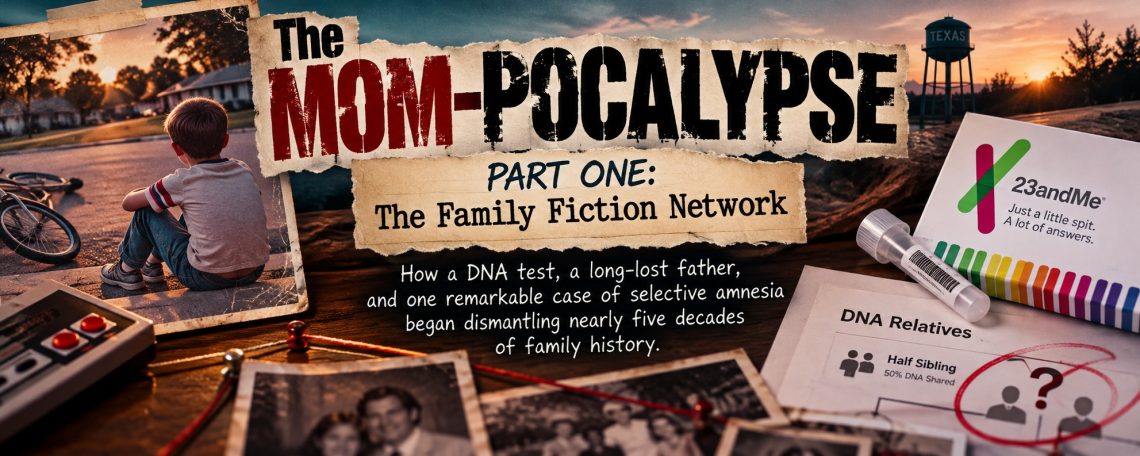
How a DNA test, a long-lost father, and one remarkable case of selective amnesia began dismantling nearly five decades of family history.
There are moments in life when you realize that everything you thought you knew might be complete bullshit.
For some people, it’s discovering their spouse has been cheating.
For others, it’s finding out their retirement savings have disappeared.
For me?
It was a DNA test.
Yep. One of those innocent little spit-in-a-tube affairs. The kind people take because they’re curious whether they’re 12% Irish or have enough Viking ancestry to justify purchasing a battle axe.
I wasn’t looking to dismantle nearly five decades of family history.
I wasn’t looking for a new father.
And I certainly wasn’t planning to spend the next three years discovering just how much dysfunction one family could pack into a relatively small number of human beings.
I just wanted to know where the hell I came from.
Apparently, that was a loaded question.
Welcome to The Mom-pocalypse.
Population: One thoroughly confused Gen-X guy.
Casualties: Pretty much everything I thought I knew.
This is Part One of a five-part journey through family secrets, manipulation, unexpected revelations, and the roller-coaster ride that was the process of finally discovering the truth.
Buckle up.
Oh, wait….
Apparently, nobody in my family bothered installing seat belts.
Chapter One: The Childhood That Came Without an Instruction Manual
Let’s rewind a few decades.
I grew up in Texas, where the summers are hotter than Satan’s driveway and emotional vulnerability wasn’t exactly a required subject in school.
I was a Gen-X kid.
We drank from garden hoses, rode bicycles without helmets, disappeared until the streetlights came on, and somehow survived an era when parental supervision largely consisted of being told not to bleed on the furniture.
My parents divorced when I was fifteen.
My sister and I stayed with our mother.
And somewhere in that arrangement, I became intimately familiar with the peculiar experience of feeling like an outsider in my own family.
There was always this low-grade static running in the background of my life. A sense that something wasn’t quite right, but no obvious explanation for what it was.
My mother was emotionally distant. Manipulation was subtle. Affection and attention weren’t necessarily things you could count on.
But when you’re a kid, you don’t have the language for that.
You don’t say, “Good heavens, I appear to be experiencing the developmental consequences of a dysfunctional attachment environment.”
You say, “Whatever. I’m going outside.”
And because it was the 90s, nobody particularly noticed.
The man I grew up believing was my father? Well, that relationship came with its own complicated history.
For much of my life, I understood him through a narrative in which he was the problem.
The narcissist.
The difficult parent.
The source of so much of what had gone wrong.
And while our family history was certainly complicated, what I didn’t understand at the time was just how much of my perception had been shaped by the stories I’d been told.
That’s an important distinction.
Because when you’re a child, you generally assume the adults are giving you something at least loosely resembling an accurate account of reality.
You don’t have a forensic accounting department.
You don’t subpoena family records.
You don’t hire a private investigator to verify whether the stories around the dinner table are factually sound.
You believe the people responsible for raising you.
And when something doesn’t make sense?
Well, kids have a remarkable tendency to assume the problem must somehow be them.
I certainly did.
For years, I carried this vague, persistent feeling of not quite belonging.
Not really understanding why.
Just knowing that something seemed off.
Of course, hindsight is a remarkable thing.
Especially when it eventually arrives in the form of laboratory results.
But we’ll get to that.
Two Kids, Two Very Different Roads
My sister and I eventually took wildly different paths into adulthood.
She pursued college, built a career, and generally approached life like someone who’d actually read the instruction manual.
I, on the other hand, apparently decided to take the scenic route through the School of Exceptionally Questionable Decisions.
Trouble?
Check.
Drugs?
Check.
A collection of hard-earned life lessons that could probably fill a separate memoir?
Oh, absolutely.
And before anyone starts polishing their judgmental spectacles, let me say this: I take responsibility for the choices I made.
I made them.
I lived with the consequences.
But one thing I’ve come to understand through recovery is that taking responsibility for your decisions doesn’t require pretending the environment that shaped you had no influence.
Both things can be true.
I made mistakes.
And I was also a kid who grew up carrying pain he didn’t understand.
Eventually, becoming a father in 2000 gave me a powerful reason to start getting my act together.
Mostly.
I mean, I’m still Gen-X.
Sarcasm is practically a vital organ.
But the dysfunction I’d grown up with didn’t magically disappear when I became an adult.
It followed me.
Into relationships.
Into my understanding of myself.
Into the way I responded to conflict, criticism, and emotional uncertainty.
And because I’d never really known anything different, I largely accepted it as normal.
That’s one of the more insidious aspects of growing up in a dysfunctional environment.
You don’t necessarily recognize dysfunction when dysfunction is the only operating system you’ve ever known.
And mine had apparently been running an outdated version for decades.
With no security patches.
And some very questionable administrative privileges.
Chapter Two: The Pandemic, the Lake House, and the World’s Most Expensive Free Roommate
Fast-forward to the COVID pandemic.
Our mother was living alone in Missouri, in a lake house left to her by her final companion.
She seemed vulnerable.
Isolated.
In need of family support.
And my sister, being the compassionate, responsible, functioning-adult member of our sibling duo, decided to help.
Mom could come live with her in Washington.
Rent-free.
A fresh start!
A chance to reconnect!
A beautiful opportunity for family healing!
What could POSSIBLY go wrong?
Narrator: Everything.
But I’m getting ahead of myself.
At the time, we still believed there was something worth rebuilding.
We still believed that if we just offered enough support, enough patience, enough understanding, perhaps things would finally become normal.
Ah, yes.
The Dysfunctional Family Loyalty Program.
Keep making emotional deposits.
Receive absolutely no interest.
Withdrawals subject to guilt, manipulation, and a 400% service fee.
And apparently, membership is lifelong unless you discover the cancellation department.
Which, as it turned out, was about three years and a DNA test away.
Now, to understand how deeply ingrained this whole arrangement was, you have to understand something about family obligation.
When you’ve spent most of your life being conditioned to prioritize someone else’s emotional needs, helping them doesn’t necessarily feel like a choice.
It feels like an assignment.
They’re family.
They need you.
You do the right thing.
And you certainly don’t spend too much time examining whether the relationship is reciprocal.
Because that would be selfish.
Or ungrateful.
Or disrespectful.
Or whatever other label happens to be most convenient when you start asking uncomfortable questions.
My sister’s decision to help came from a genuine place of compassion.
She opened her home.
She provided stability.
She gave our mother an opportunity to rebuild some semblance of normalcy.
And at the time, neither of us fully understood what the next few years would reveal.
For now, though, Mom was safely situated in Washington.
The Missouri lake house was still there.
And life continued.
Until my sister came up with an innocent little idea.
DNA testing.
Just a fun family activity.
What a delightful way to learn about our ancestry!
Surely nothing could possibly go wrong with that.
Right?
RIGHT?!
Chapter Three: 23andMe — Now With Complimentary Family Demolition
October 27, 2021.
The day science walked into my family history, took one look around, and said:
“Well, THIS doesn’t add up.”
My sister had purchased 23andMe kits for herself, our mother, and me.
Just a fun gift.
Some families do puzzles.
Some play board games.
We apparently preferred genetic Russian roulette.
My sister and I submitted our samples.
Mom never quite got around to hers.
In hindsight, that’s a rather interesting coincidence.
Anyway, the results arrived.
And there it was.
My sister and I were only HALF-SIBLINGS.
Excuse me?
I beg your finest pardon?
Because, as far as I’d known for my entire life, we had the same mother AND father.
Except we didn’t.
The man I’d grown up believing was my biological father… wasn’t.
And suddenly, at forty-six years old, I discovered that one of the most fundamental facts about my existence had been wrong.
Now, this is a rather inconvenient time in life for an identity crisis.
At forty-six, you’re supposed to be worrying about cholesterol, retirement savings, and why getting out of bed sometimes sounds like someone stepping on bubble wrap.
You’re not supposed to be Googling the biological equivalent of:
“Who the hell am I, and does anyone have the original documentation?”
But there I was.
Staring at the results of a test that had just turned my entire family tree into a crime-board diagram.
You know the kind.
Photographs.
Red string.
Question marks everywhere.
Except instead of solving a murder mystery, I was trying to solve the rather awkward question of my own conception.
And here’s the thing.
The DNA results didn’t simply introduce a new fact into my life.
They called an enormous number of old assumptions into question.
That feeling I’d carried since childhood?
That persistent sense of being different?
Of not quite fitting in?
Suddenly, there was at least one very real piece of information that had been missing from my understanding of myself.
It didn’t explain everything.
But it changed the questions I was asking.
And perhaps most importantly, it opened a door I hadn’t even known existed.
The Father I Never Knew I Had
My biological father turned out to be novelist James Pumpelly.
An author.
A storyteller.
Which, given the circumstances, has a certain poetic irony to it.
Apparently, storytelling runs in the family.
Although, thankfully, Dad prefers to put his fiction in books.
We connected after the DNA revelation and finally met in 2022.
And you know what?
He’s amazing.
We talk.
We text.
We have this natural, effortless connection that I never knew I was missing.
And that last part is difficult to put into words.
Imagine spending your entire life wondering why something about your family relationships never quite felt right.
Then, well into adulthood, you discover someone who shares your biology, your history, and pieces of an identity you never knew you had.
And somehow, the connection just… works.
No elaborate emotional negotiations.
No endless attempts to prove yourself worthy of attention.
No feeling like you’re constantly trying to solve a puzzle just to maintain a relationship.
Just a father and son getting to know each other.
Forty-six years late.
But getting to know each other nonetheless.
There’s grief in that, of course.
We lost decades we can never get back.
He missed my childhood.
I missed knowing him while I was growing up.
There are birthdays, milestones, ordinary conversations, and countless small moments we’ll never have the opportunity to share.
And yet there’s also something genuinely wonderful about discovering that the father you never knew existed is everything you’d spent a lifetime wishing a dad could be.
That’s one of the strangest silver linings of this entire catastrophe.
In a story filled with loss, I gained something extraordinary.
A father.
A relationship.
And a connection to a part of myself that had been missing for almost half a century.
Of course, there was still one rather significant question hanging over everything.
How the hell did nobody tell me?
And that question was about to make Christmas Eve 2021 considerably more interesting than usual.
Chapter Four: Christmas Eve and the Miracle of Selective Amnesia
December 24, 2021.
Christmas Eve.
Because apparently the family drama department had decided the holidays weren’t already stressful enough.
My sister and I sat down with our mother.
We weren’t aggressive.
We weren’t trying to humiliate her.
We had genetic evidence, some very legitimate questions, and an understandable desire to know the truth.
Her response?
“I didn’t know.”
Ah.
The old I had absolutely no idea defense.
Now, to be fair, human memory is imperfect.
People forget appointments.
They misplace their keys.
They walk into the kitchen and forget why they went there.
Hell, I’m Gen-X. I’ve opened the refrigerator three times in a row, looking for something that wasn’t food.
But forgetting the circumstances surrounding the conception of an entire human being?
That’s a pretty impressive commitment to forgetfulness.
Nevertheless, I gave her my biological father’s contact information.
And they spoke. For the first time in forty-six years.
A few days later, Dad relayed something rather interesting.
According to him, she remembered the circumstances of my conception quite clearly.
Well, well, well.
Apparently, the memory banks weren’t as corrupted as advertised.
Biological father detected. Memory unlocked.
Son detected. Access denied.
But there’s another important detail.
Dad had been lied to, too.
That’s right.
This wasn’t some elaborate scheme cooked up by two men to discredit my mother’s recollections.
My biological father had also been deprived of the truth.
He hadn’t spent decades raising me under a false story.
He hadn’t been the one maintaining a narrative that the DNA evidence had now contradicted.
And as far as I could determine, he had absolutely nothing to gain by lying to me.
Nothing.
He was discovering the consequences of those long-buried secrets, right alongside me.
Two people, separated by decades, suddenly discovering that neither had been given the complete story.
So when I had to decide whose account I found more credible, the choice wasn’t particularly difficult.
We weren’t two men conspiring to rewrite her history. We were a father and son trying to recover the history we’d both been denied.
And while the DNA established the biological truth, that conversation raised a much more troubling question.
If Mom genuinely hadn’t known, why did she reportedly remember so much when speaking to him?
I couldn’t read her mind.
I couldn’t establish exactly what she’d known or when she’d known it.
But I could recognize that the explanations I was receiving didn’t seem to line up.
And yet, believe it or not, I let the whole thing slide.
Yep.
I did.
I rationalized.
Maybe she was ashamed.
Maybe she had buried the memory.
Maybe it was generational trauma.
Maybe there was some explanation I hadn’t considered.
I was still operating under the old family programming:
When reality becomes uncomfortable, find a way to make it less uncomfortable for Mom.
That software had apparently been running since childhood.
And unfortunately, I hadn’t yet discovered the uninstall command.
The Lie I Still Wasn’t Ready to Confront
Looking back, this is one of the parts of the story I find most revealing.
Not simply my mother’s response.
Mine.
Because I had evidence that the family narrative I’d grown up believing was fundamentally wrong.
I had a biological father who’d also been denied the truth.
I had conflicting accounts that deserved serious questions.
And somehow, I still found ways to avoid fully confronting what those contradictions might mean.
Why?
Because acknowledging the truth about a parent isn’t always as simple as recognizing a fact.
Sometimes it means questioning your entire understanding of childhood.
It means reconsidering relationships.
Reexamining memories.
Wondering whether things you accepted as normal were ever normal at all.
And perhaps most painfully, it means confronting the possibility that someone whose love and honesty you depended on, may not have been the person you believed them to be.
At forty-six, I wasn’t ready for all of that.
Not yet.
So I did what I’d been conditioned to do.
I made allowances.
I offered the benefit of the doubt.
I minimized my own questions.
And I carried on.
For the next couple of years, life continued.
I got to know my biological father.
My sister continued trying to make things work with our mother in Washington.
And that lake house in Missouri sat waiting for what would become the next chapter of this increasingly ridiculous family saga.
At the time, I believed the DNA revelation was the biggest bombshell our family would ever experience.
I mean, how do you top finding out at forty-six that the man who raised you wasn’t your biological father?
Surely we’d reached peak family dysfunction.
Surely there couldn’t be anything left that would fundamentally change how I understood my entire life.
Oh, you sweet, naive, middle-aged fool.
The DNA test hadn’t caused the Mom-pocalypse.
It had merely lit the fuse.
And two years later, a Missouri lake house, a pregnancy announcement, and one Mother’s Day conversation would finally detonate everything.
Coming Next in Part Two: The House of Cards
We cleaned out the house. Then the family secrets came tumbling out.
In Part Two, we’ll head to Missouri, where my son and I attempted to transform a hoarded lake house into a home for a growing family.
There will be dump runs.
There will be structural damage.
There will be a spectacularly inconvenient financial situation.
And on Mother’s Day 2024, I’ll discover something that finally destroys the last remaining explanations I’d been using to make sense of my mother’s behavior.
Because apparently, the man who raised me had been kept in the dark, too.
And that’s when the real Mom-pocalypse began.
The Thriving ACoN — Breaking cycles. Reclaiming truth. And occasionally laughing at the sheer absurdity of surviving it all.
This is Part One of a five-part personal series about family secrets, narcissistic family dynamics, identity, estrangement, and the messy, sometimes darkly humorous journey toward healing.