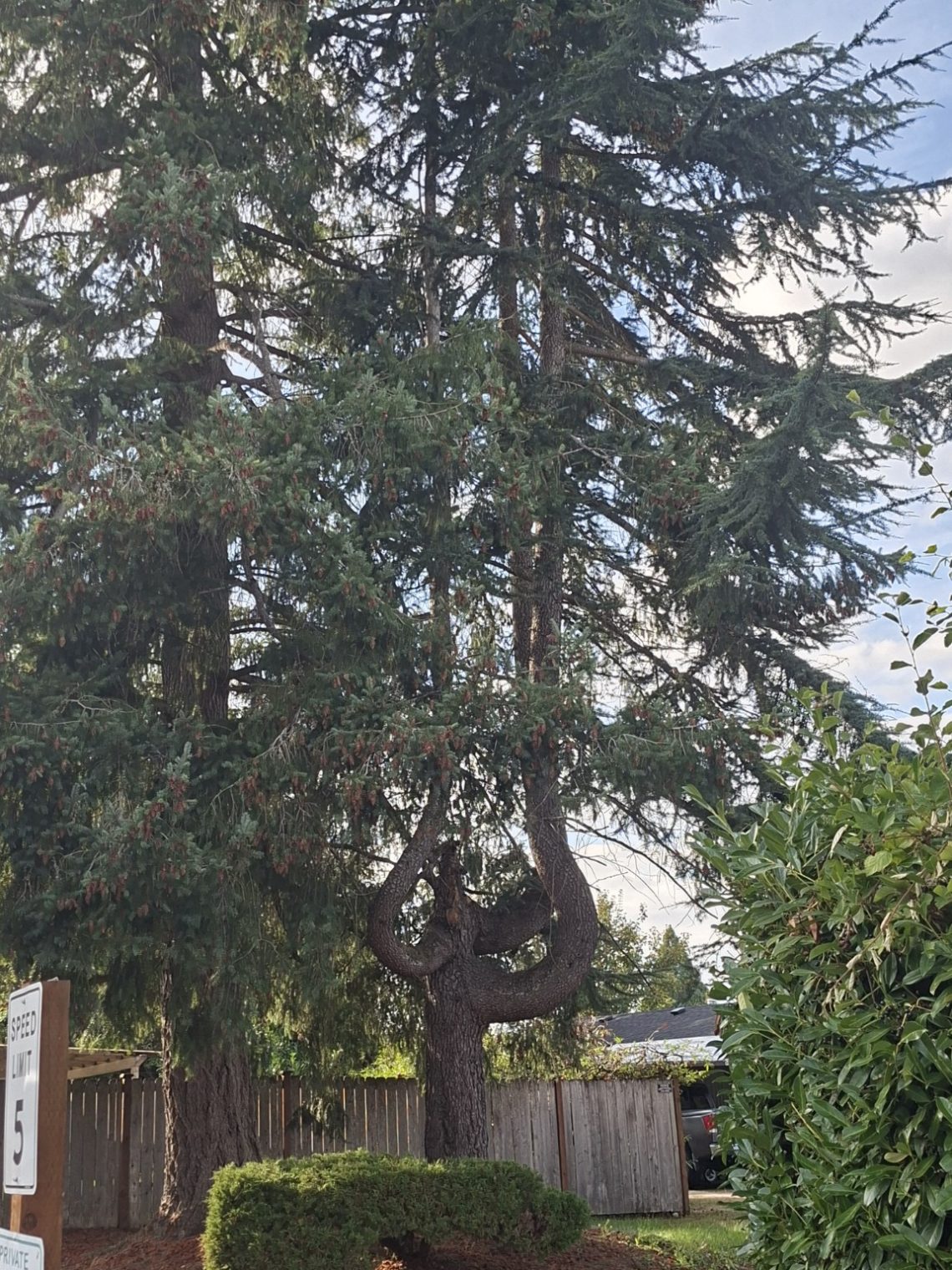
I was walking past this tree recently when something about it stopped me.
At first, it was the shape.
You don’t need to be an arborist to look at those enormous bends in the trunk and realize that this tree did not grow according to plan.
Something happened.
Maybe the original trunk was damaged in a storm. Maybe it broke. Maybe something interfered with its growth when it was younger. I don’t know the tree’s history, and honestly, I don’t need to.
Because whatever happened, the evidence is still there.
The tree carries it.
Those massive curves aren’t scars that eventually faded away. They became part of the structure of the tree itself. Decades later, you can still look at it and see the place where its story changed direction.
And standing there looking at it, I couldn’t help thinking:
I know something about that.
The Tree Didn’t Straighten Itself Out
We talk about healing as though eventually we’re supposed to get everything put back the way it was.
Heal enough and the anxiety disappears.
Heal enough and the triggers stop.
Heal enough and anniversaries become ordinary dates on the calendar.
Heal enough and someday you’ll wake up as the person you would have been if none of it had happened.
Except I’m increasingly convinced that’s not what healing actually looks like.
That tree didn’t straighten itself out before it was allowed to continue growing.
It grew from where it was.
The bends remained.
And it grew anyway.
For those of us recovering from childhood trauma, addiction, abusive relationships, dysfunctional families, or any of the thousand other things capable of changing the trajectory of a human life, I think there’s something important in that.
Sometimes there isn’t a road back to the person we were “supposed” to become.
Sometimes the only road available is forward.
Then I Looked Closer
And that’s when this tree really got me.
Above the place where everything went sideways, there isn’t simply one new trunk reaching toward the sky.
There are three.
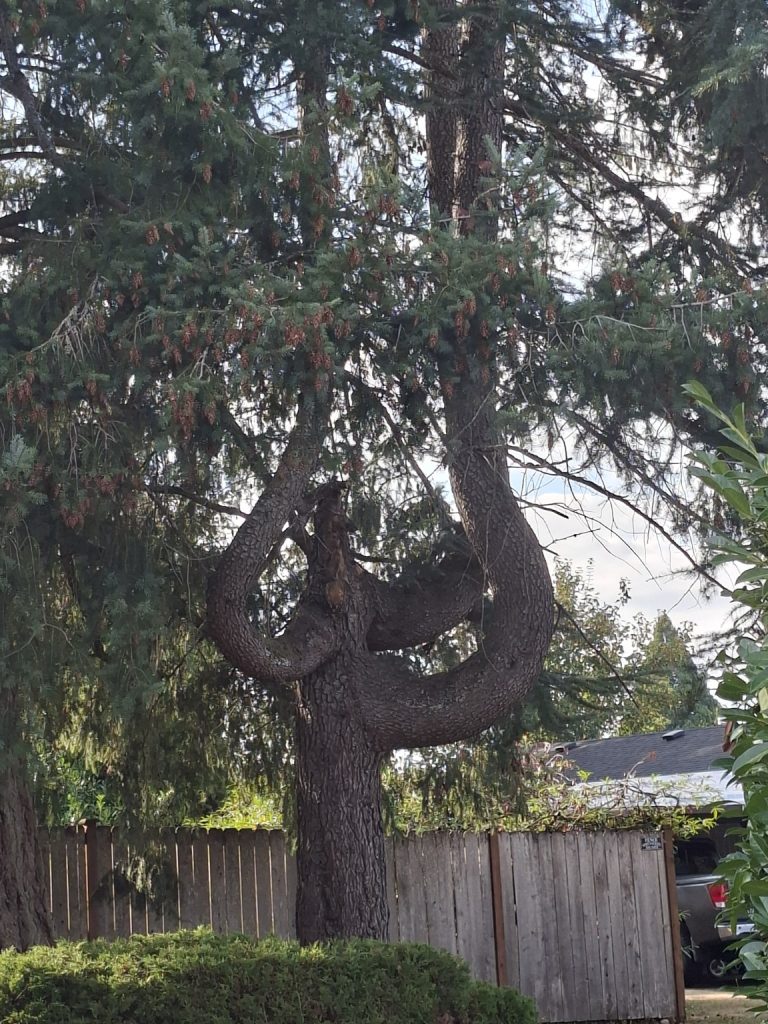
What had once been one path upward became three.
Somewhere after whatever happened to this tree, it adapted.
It found another route.
And another.
And another.
That’s where the metaphor stopped being merely interesting to me and became something I needed to write about.
Because isn’t that recovery?
My life didn’t continue along the trajectory I once imagined for it.
There are bends.
There are scars.
There are places where you can practically point and say:
Right there. Something happened there.
I don’t need to pretend those places don’t exist.
I don’t need to call them blessings.
I don’t need to thank the people who caused some of them.
And I absolutely don’t need to embrace the tired idea that everything happens for a reason.
Some things simply should not have happened.
Trauma Doesn’t Get the Credit
There’s a particular kind of recovery language I’ve never been comfortable with.
“It made you stronger.”
Maybe.
But I think that gives the injury too much credit.
Whatever happened to this tree didn’t deserve to happen simply because the tree eventually adapted to it.
Likewise, the things that happened to us weren’t somehow good because we eventually figured out how to survive them.
Trauma doesn’t get credit for what I built afterward.
I do.
Recovery does.
The people who stood beside me do.
Every boundary I learned to hold does.
Every time I chose one more day instead of oblivion does.
Every new interest I discovered when survival stopped consuming quite so much of my life does.
Every time I realized I was allowed to build a life that belonged to me does.
The damage explains some of my shape.
It does not get to claim everything that grew afterward.
Look Above the Bend
There’s something else these pictures captured that I didn’t notice until afterward.
Look at the tree up close and your attention immediately goes to those bizarre, enormous bends.
They’re impossible to miss.
But step farther back.
Look at the whole tree.
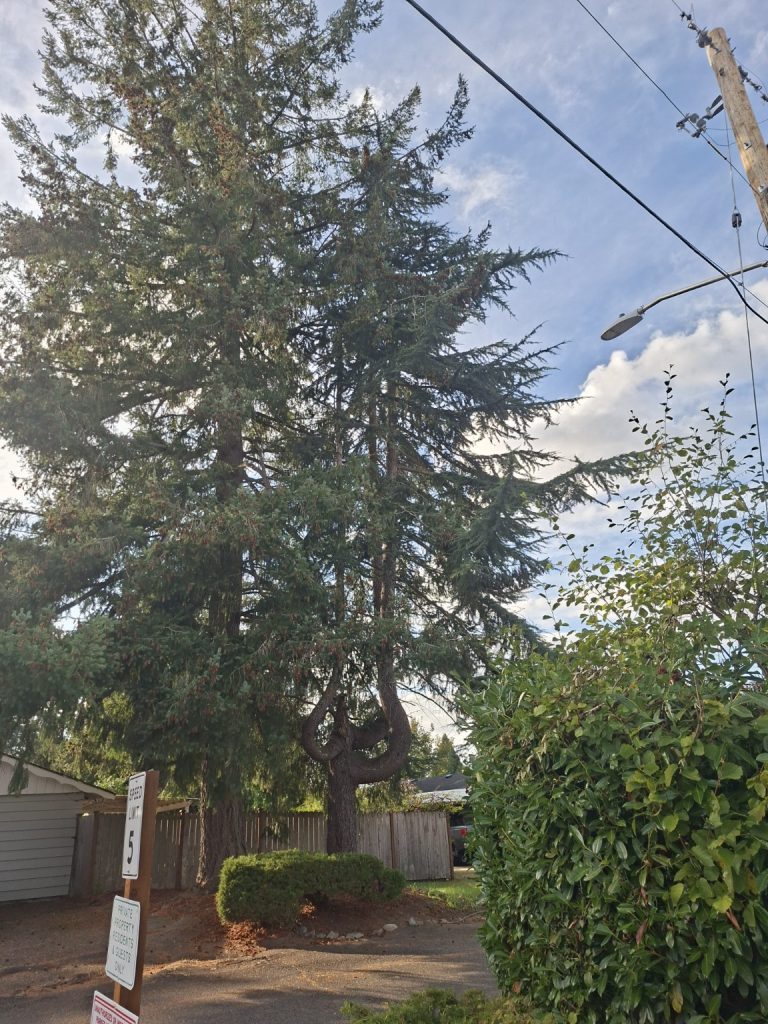
Suddenly those bends become only one part of something much larger.
There’s an enormous canopy above them.
There’s life everywhere.
There are branches reaching in directions that probably weren’t part of the original blueprint.
And there are three trunks reaching skyward where once there was only one.
That feels especially relevant to me now.
Two years after going No Contact, I’d love to tell you I’ve reached the part where all the bends have disappeared.
They haven’t.
There are still triggers.
There are still dates on the calendar capable of stirring things I wish they couldn’t.
There are still mornings when my first reaction to another day isn’t exactly enthusiastic.
There are still things I’m grieving, things I’m learning, and things I’m probably going to understand differently five years from now than I do today.
But I’ve also been so focused at times on examining the bend that I’ve forgotten to look above it.
There is an awful lot of life above the bend.
And more of it keeps growing.
Maybe This Is What Thriving Looks Like
I don’t know what this tree would look like if whatever happened to it had never happened.
Maybe it would be taller.
Maybe straighter.
Maybe healthier.
Maybe completely unremarkable.
We’ll never know.
And I don’t know who I would have become if my own story had been different, either.
That’s a ghost I’ve spent enough time chasing.
This is the life I actually have.
This is the tree that actually grew.
So maybe thriving isn’t about finally becoming the person I was supposed to be before trauma interfered.
Maybe it’s not about erasing every scar, straightening every bend, or making the evidence disappear.
Maybe sometimes thriving is standing decades beyond the place where your life changed direction and realizing:
I’m still here.
I’m still growing.
And somehow, where there once seemed to be only one way forward…
I found three.
The injury remains part of the story.
But it isn’t the ending.
It isn’t even most of the tree.
I grew anyway.