I recently learned about something called filial responsibility laws—laws in some places that can require adult children to contribute to the care or support of aging parents under certain circumstances.
The legal details vary, and this isn’t a post about legal advice.
What caught my attention was the question these laws raise for trauma survivors:
What happens when the parent failed their responsibilities first?
Because that is where the conversation becomes uncomfortable.
Most people hear the phrase filial responsibility and picture loving families helping aging parents through difficult years. They picture parents who sacrificed, nurtured, protected, and supported their children, and children who later return that care out of love and gratitude.
In healthy families, that makes perfect sense.
But not every family is healthy.
Some children grow up managing a parent’s emotions instead of learning how to manage their own.
Some become the family caretaker long before they are old enough to understand what that means.
Some spend decades being manipulated, gaslit, financially exploited, emotionally neglected, or blamed for problems they did not create.
Some discover in adulthood that much of what they believed about their family was built on deception.
In those situations, the question changes.
It is no longer:
“Should children help their parents?”
It becomes:
“Does a parent get to claim lifelong obligation after refusing to honor their own responsibilities?”
For many Adult Children of Narcissists, this is not a theoretical question.
We’ve already paid.
We’ve paid in anxiety.
We’ve paid in self-doubt.
We’ve paid in lost opportunities.
We’ve paid in emotional labor.
We’ve paid in years spent trying to rescue people who had no interest in changing.
We’ve paid by carrying burdens that were never ours to carry.
Many survivors were taught from an early age that their needs came last.
That keeping the peace mattered more than telling the truth.
That loyalty mattered more than reality.
That family obligations only flowed in one direction.
As a result, many adult survivors confuse guilt with responsibility.
They feel guilty for stepping back.
Guilty for saying no.
Guilty for protecting themselves.
Guilty for refusing to sacrifice more years, more money, more emotional energy, and more peace of mind.
But guilt and responsibility are not the same thing.
Feeling guilty does not automatically mean you are doing something wrong.
Sometimes it means you are breaking a lifelong conditioning pattern.
There is also an important distinction between care and access.
You can hope someone receives proper care.
You can wish them safety.
You can want them to have food, shelter, medical attention, and support.
And still decide that direct involvement in their life is unhealthy for you.
Those positions are not contradictory.
They’re called boundaries.
One of the most damaging myths survivors encounter is the belief that biology creates an unlimited debt.
That because someone holds the title of “mother” or “father,” they possess permanent rights to your time, your energy, your finances, and your emotional well-being.
But relationships are not sustained by titles.
They are sustained by trust.
By honesty.
By accountability.
By mutual respect.
By consistent behavior over time.
A title may describe a relationship.
It does not excuse the destruction of one.
At some point, many survivors must confront a difficult question:
What do I owe myself after surviving all of this?
For years, maybe decades, the answer was always someone else.
Someone else’s feelings.
Someone else’s demands.
Someone else’s crisis.
Someone else’s version of reality.
Healing often begins when that answer changes.
Because continuing to abandon yourself in order to rescue someone who repeatedly harmed you is not compassion.
It is self-sacrifice without limits.
And that is not a healthy foundation for any relationship.
Not even a parent-child relationship.
Especially not a parent-child relationship.
Filial responsibility may be a legal concept.
But the deeper issue is an emotional one.
Many trauma survivors have spent their entire lives being told what they owe.
Very few were ever encouraged to ask what was owed to them.
And perhaps that is the conversation we should have more often.
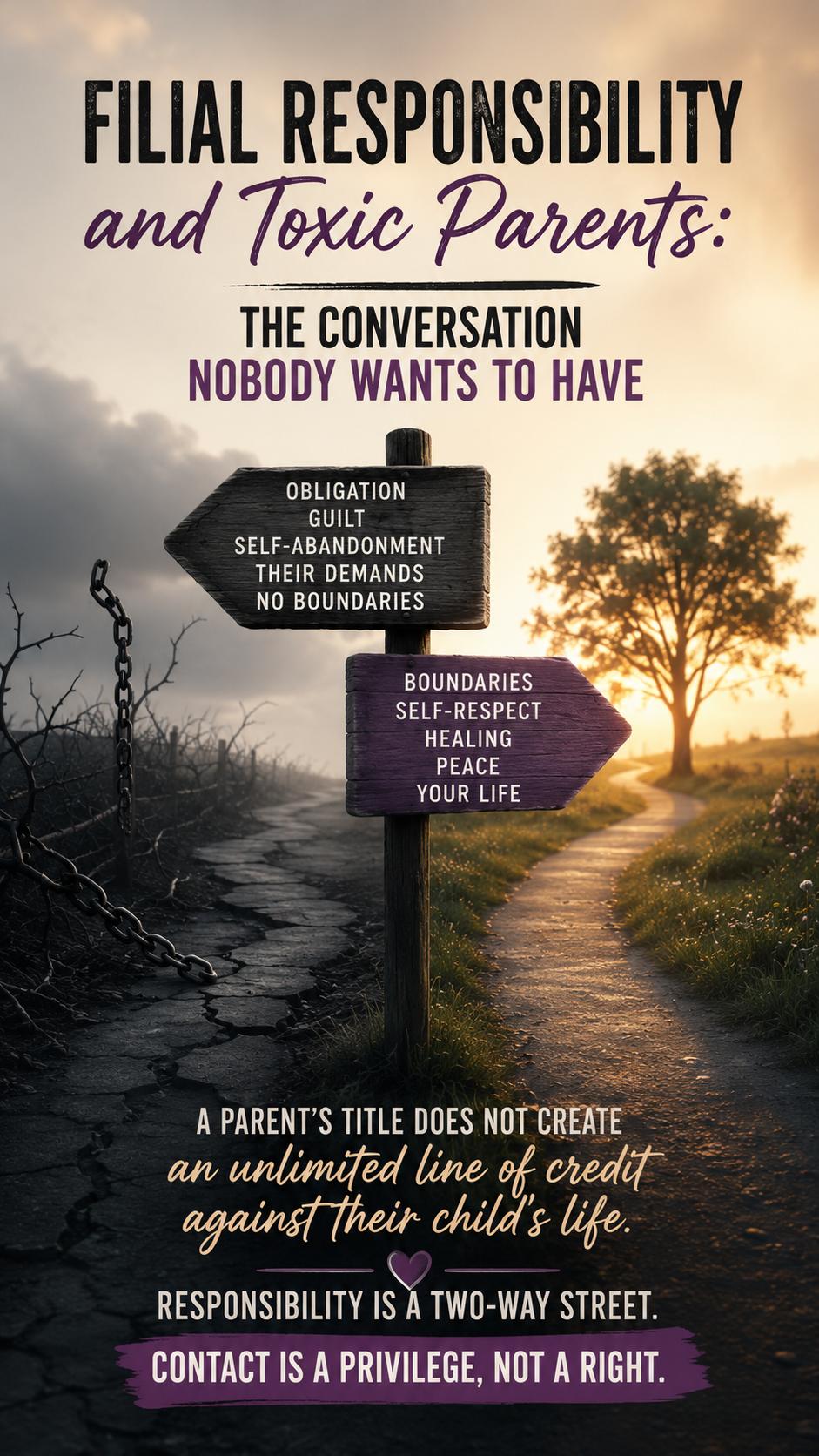
Because responsibility is a two-way street.
If a parent spent decades destroying the bridge, they should not be surprised when their adult offspring refuses to cross it.
Contact is a privilege, not a right.
And obligation without accountability is not love.
It’s control.