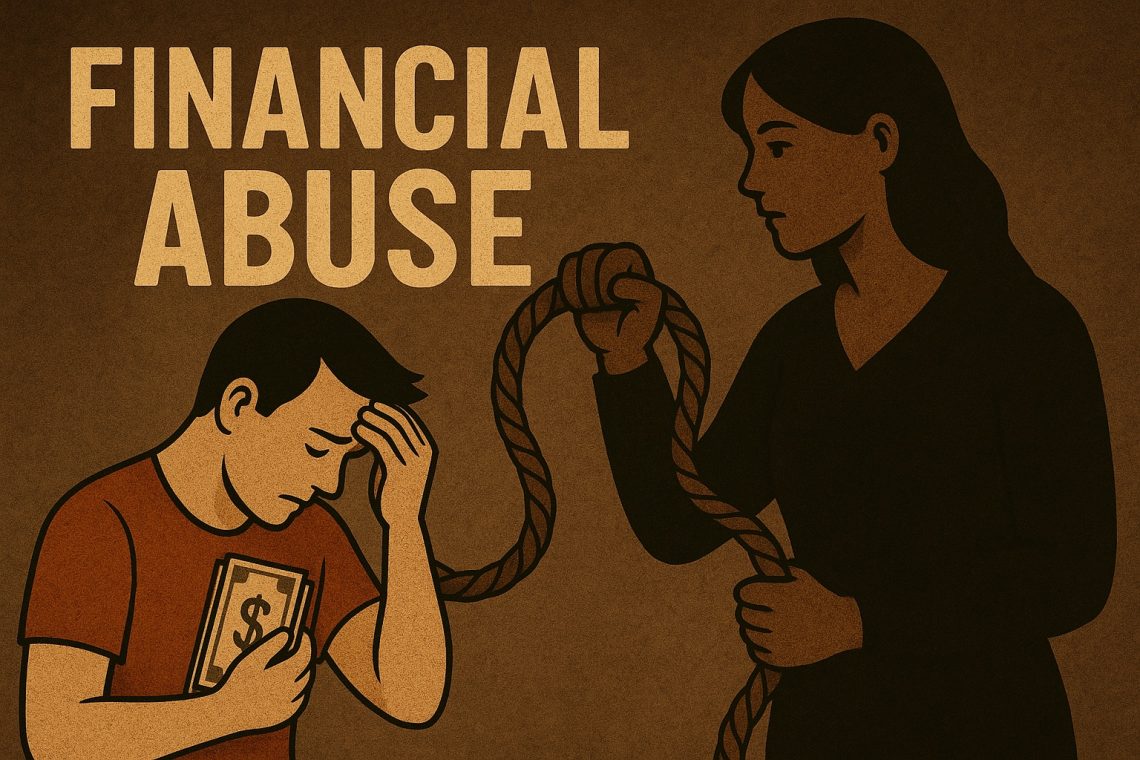
Financial abuse doesn’t always look like someone stealing from you.
Sometimes it looks like:
- needing constant “help”
- always being in crisis
- never quite landing on their feet
- surviving through others instead of alongside them
- rotating through providers
- framing dependence as misfortune
- calling extraction “support”
- and making other people feel guilty for ever wanting out
This is called a dependency cycle — and it often hides in families for decades without being named.
What a Dependency Cycle Actually Is
A dependency cycle forms when someone:
- never becomes fully self-supporting
- relies on relationships for housing, income, or stability
- avoids accountability through victim narratives
- moves from one provider to the next
- reframes rescue as love
- and treats support as something they’re owed
Over time, this becomes identity.
Not:
“I’m going through a rough patch.”
But:
“Someone will always carry me.”
Why It’s So Hard to See When You’re Inside It
If you grow up in this system, you are trained to believe:
- rescue is normal
- sacrifice equals love
- boundaries equal cruelty
- saying no equals abandonment
- your role is to fill the gaps
- exhaustion is the price of loyalty
- guilt means you’re doing the right thing
You don’t see dependence as manipulation.
You see it as family responsibility.
How Narcissistic Dynamics Supercharge Financial Abuse
In narcissistic or exploitative systems:
- money becomes leverage
- dependency becomes control
- crisis becomes currency
- and guilt becomes the enforcement mechanism
The person at the center is never the “problem.”
The environment is always blamed.
The partner is always blamed.
The children are eventually blamed.
But the pattern never changes.
Only the provider does.
The Silent Role of the Children
In many families, children eventually become:
- emotional regulators
- financial buffers
- crisis managers
- moral permission slips
They’re pulled in not because they’re responsible —
but because they are accessible.
They become the last safety net.
Until they collapse.
The Moment the Illusion Breaks
The illusion usually breaks not with a fight — but with evidence.
A document.
A pattern.
A timeline.
A stack of “coincidences” that suddenly align.
That’s often when a survivor realizes:
“This wasn’t random hardship.
This was a long-running system.”
And that realization is destabilizing.
Because it requires grieving two things at once:
- the person you thought you were helping
- and the version of yourself who believed the story
Why Walking Away Feels Cruel (Even When It’s Not)
When you leave a dependency cycle, you’re often told:
- you’re selfish
- you’ve changed
- you’ve abandoned them
- you’ve become cold
- you’re ungrateful
But what’s really happening is this:
You’re exiting a system that depended on your compliance.
And systems don’t thank you for leaving.
They punish you for breaking the pattern.
The Truth Survivors Need to Hear
You are not required to:
- fund another adult’s life
- fix anyone’s financial chaos
- absorb endless emergencies
- sacrifice your future for someone else’s present
- remain in permanent rescue mode
Support is not supposed to be endless, one-directional, and identity-consuming.
That’s not support.
That’s extraction.
What Healing Looks Like in These Situations
Healing from financial abuse and dependency trauma often involves:
- learning to tolerate guilt without obeying it
- unlearning the idea that love requires rescue
- building boundaries that feel “wrong” at first
- choosing stability even when someone else chooses chaos
- redefining compassion without self-destruction
- recognizing that enabling is not kindness
And most importantly:
Realizing that walking away is not abandonment.
It’s self-preservation.
If This Resonates With You
If any part of this sounds familiar, you are not alone.
These cycles are:
- generational
- invisible until named
- reinforced by guilt
- and devastating to the nervous system over time
And the moment you see it clearly?
You can’t unsee it.
That’s not betrayal.
That’s awakening.