Understanding Complex Trauma and Its Lasting Impact
For years, I thought trauma was something that happened in a single, catastrophic moment.
A car accident.
A violent assault.
A natural disaster.
That’s how most of us were taught to understand PTSD.
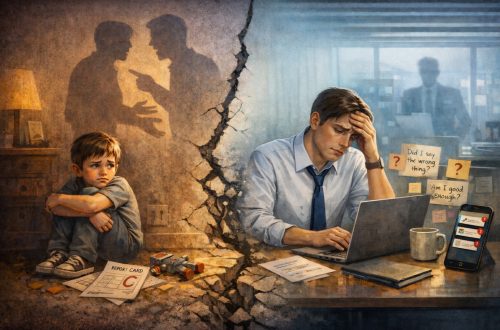
But what happens when the trauma isn’t one moment —
when it’s the environment you grew up in?
That’s where Complex Post-Traumatic Stress Disorder (cPTSD) comes in.
PTSD vs. cPTSD: What’s the Difference?
Traditional PTSD usually develops after a single or time-limited traumatic event.
Complex PTSD, on the other hand, develops after chronic, ongoing trauma, especially when:
- The trauma begins in childhood
- The survivor cannot escape
- The harm comes from caregivers or authority figures
- Safety, consistency, and emotional attunement are absent
cPTSD isn’t about what happened once.
It’s about what never stopped happening.
Common Causes of cPTSD
cPTSD often forms in environments marked by relational trauma, including:
- Narcissistic, emotionally abusive, or controlling parents
- Chronic emotional neglect
- Growing up in households with addiction, chaos, or instability
- Being responsible for adult emotions as a child (parentification)
- Repeated betrayal, gaslighting, or psychological manipulation
- Long-term exposure to fear, shame, or unpredictability
Many survivors say the same thing when they finally learn about cPTSD:
“Nothing that bad happened… and yet everything felt unsafe.”
That contradiction is a hallmark of complex trauma.
Core Symptoms of cPTSD
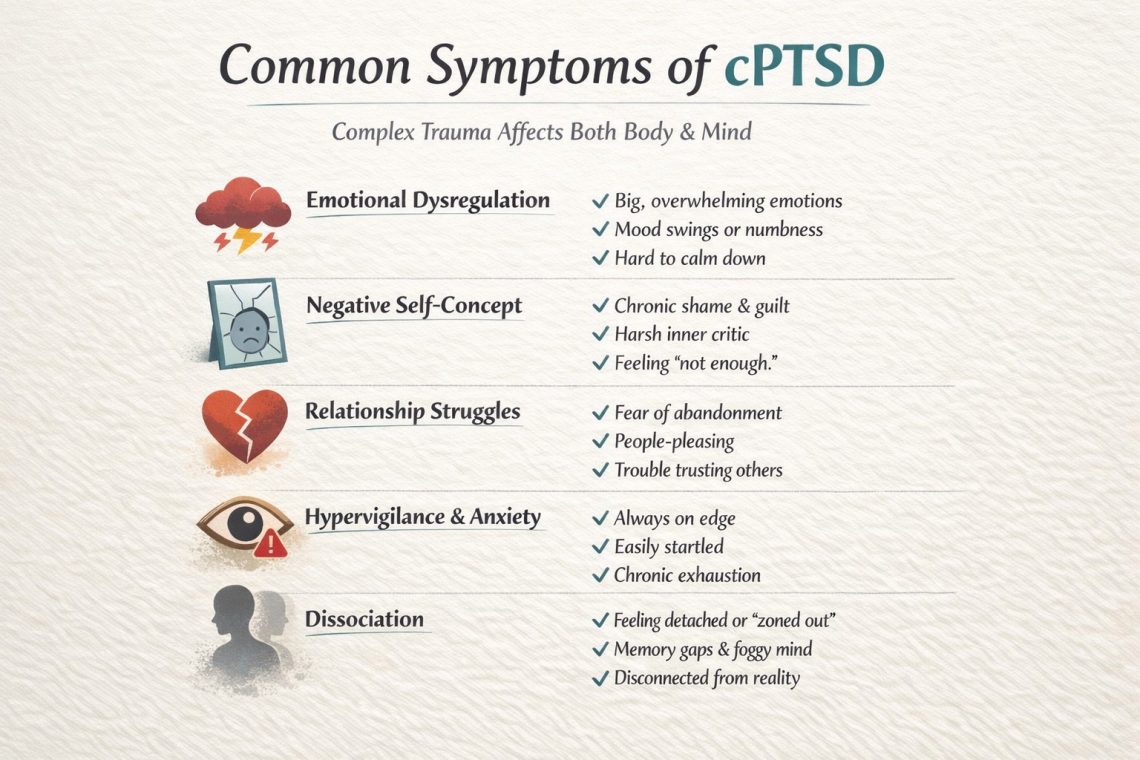
cPTSD affects how the nervous system, identity, and relationships develop.
Here are some of the most common symptoms.
1. Emotional Dysregulation
- Emotions feel overwhelming or muted
- Sudden anger, grief, or despair that feels “too big”
- Difficulty calming down once activated
- Emotional numbness followed by emotional floods
2. Negative Self-Concept
- Chronic shame
- Feeling defective, broken, or “too much”
- Harsh inner critic
- A belief that love must be earned through performance
3. Relationship Difficulties
- Fear of abandonment or engulfment
- People-pleasing or hyper-independence
- Difficulty trusting others
- Staying in unhealthy relationships longer than makes sense
4. Hypervigilance & Nervous System Exhaustion
- Always scanning for danger
- Overreacting to small stressors
- Difficulty relaxing, even during “safe” moments
- Chronic fatigue or burnout
5. Dissociation & Emotional Detachment
- Feeling disconnected from your body
- Zoning out or “going blank” under stress
- Memory gaps around childhood or emotional events
- Feeling unreal or detached from reality
Why cPTSD Often Goes Undiagnosed
Many survivors don’t recognize cPTSD because:
- Their trauma was normalized (“That’s just how families are”)
- There was no obvious physical violence
- They were high-functioning and responsible
- They were praised for being “strong,” “mature,” or “low maintenance”
In other words:
They survived too well to be noticed.
cPTSD Is Not a Personal Failure
This part matters.
cPTSD is not:
- Weakness
- Over-sensitivity
- A character flaw
- A failure to “move on”
cPTSD is a nervous system adaptation to prolonged threat.
Your body learned what it had to learn to keep you alive.
Healing Is Possible — But It’s Not Linear
Healing from cPTSD isn’t about erasing the past.
It’s about:
- Re-teaching the nervous system what safety feels like
- Learning emotional regulation skills that were never modeled
- Developing boundaries without guilt
- Rebuilding identity outside of survival mode
This work is slow.
It’s layered.
And it’s deeply human.
But naming cPTSD is often the moment everything finally starts to make sense.
If This Resonates
If parts of this post feel uncomfortably familiar, you’re not alone.
Complex trauma survivors often spend decades believing they’re broken —
until they realize they were injured, not defective.