There was a time I thought my reaction to the news meant something was wrong with me.
That I was weak.
Avoidant.
Uninformed.
“Burying my head in the sand.”
But after naming my cPTSD — after finally understanding how my nervous system was shaped — I see it clearly now:
The problem isn’t that I “can’t handle the news.”
The problem is that modern news media is designed to keep people in a state of fear, and trauma survivors are uniquely vulnerable to that design.
Fear isn’t a side effect.
It’s the business model.
The Nervous System Doesn’t Know This Is “Just the News”
If you live with cPTSD, your body doesn’t process information the way people without chronic trauma do.
Your nervous system doesn’t neatly separate:
- personal threat from global threat
- immediate danger from abstract danger
- “this is happening somewhere else” from “this could happen to me”
Headlines don’t just inform — they activate.
Breaking news alerts, scrolling feeds, endless commentary, catastrophic framing — all of it lands in the body first. Long before the rational brain gets a vote.
Your heart rate changes.
Your muscles tense.
Your sense of safety erodes.
And then we wonder why we feel exhausted, irritable, hopeless, or numb.
Trauma Trains You to Monitor Danger — The News Exploits That
Growing up in chaos teaches you a very specific skill set:
- Constant vigilance
- Scanning for threats
- Reading emotional weather
- Staying alert so you’re not blindsided
That wasn’t a personality trait.
It was survival training.
Modern news media taps directly into that wiring. It rewards doom-scrolling, urgency, outrage, and fear-based engagement — because fear keeps eyes on screens.
For someone without trauma, that may be irritating.
For someone with cPTSD, it can become re-traumatization disguised as civic responsibility.
“Staying Informed” vs. Staying Regulated
There’s an unspoken moral pressure baked into news consumption:
If you tune out, you don’t care.
If you step back, you’re irresponsible.
If you protect your peace, you’re complicit.
That narrative is especially damaging to trauma survivors — many of whom already carry excessive responsibility, guilt, and hyper-empathy.
Here’s the truth:
Caring does not require constant exposure to threat.
Awareness is not the same thing as endurance.
Being informed is not the same thing as being flooded.
You can care deeply about the world and choose not to keep your nervous system in a perpetual state of alarm.
The Trauma Echo: Danger Without Agency
One of the most damaging aspects of modern news isn’t just fear — it’s helplessness.
Story after story presents:
- looming danger
- systemic failure
- moral outrage
- very little personal agency
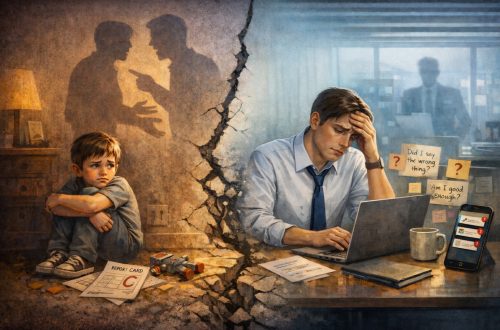
That combination is brutal for trauma survivors because it mirrors childhood dynamics exactly:
Something bad is happening.
You can see it coming.
You can feel it in your body.
And you can’t stop it.
That’s how learned helplessness is reinforced — not because you don’t care, but because your system is reliving a familiar trap.
When people say, “Everything feels pointless lately,” this is often part of why.
Choosing Boundaries Is Not Avoidance — It’s Self-Respect
Stepping back from the news — or changing how you consume it — is not denial.
It’s regulation.
It’s choosing:
- summaries over live feeds
- limited windows over constant exposure
- trusted sources over outrage algorithms
- grounding over reactivity
It’s recognizing that your nervous system is not a public utility.
You are allowed to protect it.
Especially if you spent decades without that option.
Final Word
If the news leaves you dysregulated, hopeless, or shut down, that doesn’t mean you’re weak.
It means your body learned early what danger feels like — and it’s responding exactly as it was trained to.
Fear may be a business model.
But you don’t have to keep paying the price.
Sometimes the most responsible thing a trauma survivor can do is this:
Turn down the noise.
Come back into the body.
And choose safety — on purpose.