There’s a part of the Missouri story I don’t talk about much — not because it’s dramatic or explosive, but because the shame around it lingered long after the dust settled.
It’s the part where my daughter told me she was pregnant.
November 13th, 2023.
I remember where I was sitting.
I remember the warmth in my chest.
I remember thinking, I’m going to be a grandpa.
And almost immediately afterward, another thought hits me —
one I’ve carried like a weight ever since:
“I should have called the whole thing off.”
The move.
The house.
The plan.
All of it.
My son and I already knew that house needed a lot of work.
We didn’t know the full truth yet — not the structural issues, not the extent of the hoarding damage, not the layers of hidden decay — but we knew enough to be cautious.
And yet we kept pushing forward.
Not for convenience.
Not out of laziness.
But because I believed I was doing something good.
Something for my daughter.
Something for the family.
Something for the future.
A future I was trying to build in an environment I didn’t fully understand.
And after everything collapsed, after my daughter and her fiancé had to move right back out of the state they’d just moved to, a knot formed inside me:
“I failed her.
I let her down.
She trusted me, and I should have protected her better.”
I paid her back for the move (she didn’t ask — I just felt it was the right thing to do, so as soon as I had the money, I did it).
I made sure she wasn’t financially burdened by my decision.
But money wasn’t the part that haunted me.
It was the fear that maybe… deep down…
that whole experience shook her trust in me as a father.
Not in the big-picture emotional way — I know she loves me.
We’re good.
I was at her wedding.
I held my granddaughter that day, and felt something inside me heal.
But in the practical way.
The protective way.
The “Dad will make sure we’re safe” way.
I worried that I’d damaged that part.
And to be fully honest with myself — that thought hurt more than anything my mother ever did.
The Truth I Finally Saw
It took time, distance, and a hell of a lot of healing to realize something I couldn’t see back then:
I didn’t fail my daughter.
I was trying to build something inside a world that wasn’t mine.
The Missouri house didn’t fall apart because of me.
It fell apart because my mother had been destroying that house (and everything inside it) for years with her hoarding and neglect.
I inherited the chaos.
I didn’t create it.
I stepped into a collapsing structure — literal and emotional — and tried to create stability on ground I didn’t know was cracked all the way through.
And here’s the part I couldn’t see at the time:
I didn’t leave her in danger —
I helped her get out when I realized the truth.
That’s what mattered.
Not that the plan didn’t work.
Not that the house wasn’t ready.
Not that the dream fell apart.
What mattered was this:
The moment I saw it was unsafe,
I made sure her and her fiancé got out.
I paid them back.
I owned my part.
And I tried my best, to make sure nothing she experienced there became permanent.
That’s what protection looks like in real life.
Not perfection — but response.
The Real Root of the Shame
The shame wasn’t about her.
It wasn’t about the house.
It wasn’t about the disaster that move turned out to be.
It was something old.
Something from childhood.
Something conditioned.
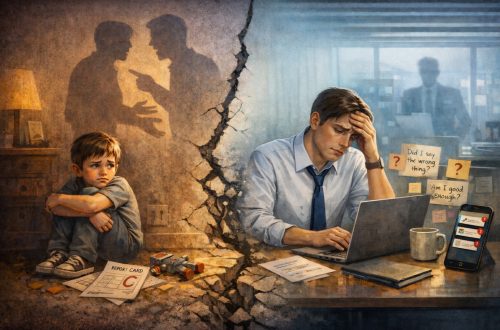
The belief that anything that goes wrong in the family is automatically my fault.
That’s a survivor’s “inheritance.”
That’s the “parentified child” speaking.
That’s the emotional residue of growing up under a narcissistic parent who made every problem the child’s responsibility.
I was holding myself accountable for things that weren’t mine.
I was punishing myself for damage I didn’t cause.
What My Daughter Really Saw
This is what I finally understand — and honestly, it took months of healing to begin to see it clearly:
My daughter didn’t lose trust in me.
She saw me:
- trying
- showing up
- building something
- protecting her
- paying her back
- admitting what went wrong
- being there
- being accountable
- loving her
- being present and participating in her wedding
- being a grandfather
- continuing to choose truth
- continuing to grow
She saw my humanity — not my failure.
And the truth is, she never asked me to be perfect.
She just needed me to be honest and present.
And I was.
Why I’m Writing This
Because a lot of survivors carry this same type of shame:
“If I didn’t foresee the danger, I failed.”
“If the plan fell apart, it’s my fault.”
“If chaos happened near my kids, I’m responsible.”
But that’s not how real life works.
Real life is messy.
Plans fall through.
Houses fall apart.
People make decisions with limited information.
Parents do the best they can at the time.
And children — the healthy ones — judge their parents by their perseverance, not their perfection.
I didn’t fail my daughter.
I failed to see the truth about a house and a toxic family system, that were both already collapsing long before I ever tried to fix them.
And I did what any good father would:
I protected her the moment I knew the danger was real.
Final Thoughts
If you’ve ever carried guilt for a moment you didn’t fully understand at the time,
if you’ve ever replayed a decision with the benefit of hindsight and punished yourself for it,
if you’ve ever worried that one misstep will define you as a parent —
please hear this:
Survival-mode decisions aren’t failures.
They’re just the choices you made with the knowledge you had.
What matters is what you did when you saw the truth.
And if you pulled the people you love out of harm’s way —
even if it was messy, imperfect, or late in the game —
then you didn’t fail.
You stepped up.
Just like I did.