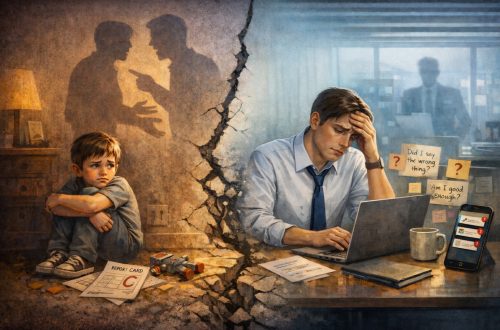

There’s a moment from my daughter’s wedding that keeps resurfacing in my mind — not because it ruined the day, not because it carried malice, but because it revealed something deep about how invisible trauma can be to people who haven’t lived through it.
During the rehearsal, I met the groom’s uncle — another Andrew, which made for an easy icebreaker. We talked over drinks while everyone bustled around getting ready. At that point, all he knew was the surface-level version of the Missouri situation — that something had happened bad enough to send my daughter and her fiancé packing a week before my granddaughter was born.
Eventually, the conversation went deeper, and I told him the truth: the DNA revelation, the lies, the unmasking, the collapse of my very identity, my mother’s vengeance on my son, my sister & I teaming up to rescue him, and the resulting decision my entire immediate family made to go No Contact.
That’s when he gave me the line.
One of those “nice” lines.
One of those polite, Southern-adjacent well-meaning-but-not-helpful lines.
“You don’t want to regret this decision later, how old is your mother now?”
In the moment, I didn’t snap.
I didn’t defend myself.
I didn’t go into lecture mode or trauma-education mode.
But something inside me recoiled.
I didn’t know the word for it right then, but I know it now:
Invalidation.
It was a quiet kind of invalidation, wrapped in courtesy, tone-dipped in gentleness, seasoned with “I’m just trying to look out for you.” The classic Bless your heart energy — the kind that sounds sympathetic, but actually translates to:
“You must not understand what you’re doing.”
“You’re being emotional.”
“You’re being dramatic.”
“Family is family — surely it wasn’t that bad.”
“You’ll regret choosing yourself.”
He didn’t mean harm.
But intent doesn’t erase impact.
He didn’t live through what I lived through.
He didn’t grow up inside the distortion.
He didn’t wake up at 49 to find his whole identity built on someone else’s lie.
He didn’t watch the mask fall off in real time.
He didn’t rescue his son from a person who should’ve been a grandmother, not a threat.
He didn’t have to choose between peace and family — and realize peace was the only choice that didn’t destroy him.
People who grew up in healthy enough families will never fully understand the lasting damage of covert narcissism and the emotional abuse/manipulation that comes with that.
They will never understand the cost of staying.
They will never understand the value of leaving.
And they will absolutely never understand the kind of clarity it takes to decide:
“My mother being alive, does not obligate me to endure her.”
What he saw was a son choosing distance.
What I lived was a son choosing survival.
He heard “estrangement.”
I lived “liberation.”
He felt pity.
I finally felt free.
It’s not his fault he didn’t get it.
But it is my right to protect the parts of myself he can’t understand.
Looking back now, I realize this encounter is universal among survivors:
No matter how much truth you carry,
someone will always try to tell you to carry the person who harmed you, too.
Walking away didn’t cost me anything worth keeping.
Staying cost me far too much.